
 For the past month, book lovers have been voicing opinions, signing online petitions and inciting mass actions to take up what is turning out to be the greatest cause literary lovers have advocated in a long while.
The Lowdown
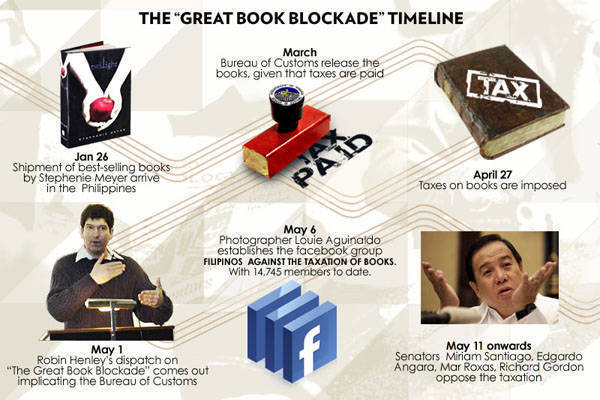
What is incurring their ire: The Bureau of Customs (BOC) has imposed one-percent import duties on "educational" books" and five percent for "non-educational" books, at the same time blocking air shipments of books from coming into the country in January 2009, according to a report by writer Robin Hemley in mcsweeneys.net. Hemley is the Director of the Nonfiction Writing Program at the University of Iowa who is in the country on a Guggenheim Fellowship.
Following what Henley has been dubbed as the 'Great Book Blockade of 2009' is a flurry of activity to raise awareness for the issue and voice opposition against the taxation mandate. The BOC move supposedly violates the Florence Agreement, a treaty signed by the Republic of the Philippines as a member state of the UNESCO. Under the agreement, "books, newspapers, periodicals and many other categories of printed matter are granted duty-free entry…The exemption granted to books is not subject to any qualifications as to their educational, scientific and cultural character."
Avid book readers, newspaper columnists most notably Manuel Quezon III, the Book Development Association of the Philippines, and more recently, Senators Miriam Santiago, Edgardo Angara, Mar Roxas III and Richard Gordon, and countless bloggers have been using all mediums possible, including a Facebook igroup called FILIPINOS AGAINST THE TAXATION OF BOOKS BY CUSTOMS included, to oppose the possibility of reading material becoming more expensive in the country because of the taxes imposed on books.
To date, 12,275 members have joined the cause on Facebook, created by lensman Louie Aguinaldo. Among the growing number of supporters include artist Nina Tesoro-Poblador, blogger Spanky Enriquez, philanthropist Kitkat Zobel, chef and food writer Claude Tayag, and architect Dan Lichauco. "The Bureau of Customs does not and should not have the authority to determine which books are educational and which are not," the group states on its page.
For the past month, book lovers have been voicing opinions, signing online petitions and inciting mass actions to take up what is turning out to be the greatest cause literary lovers have advocated in a long while.
The Lowdown
What is incurring their ire: The Bureau of Customs (BOC) has imposed one-percent import duties on "educational" books" and five percent for "non-educational" books, at the same time blocking air shipments of books from coming into the country in January 2009, according to a report by writer Robin Hemley in mcsweeneys.net. Hemley is the Director of the Nonfiction Writing Program at the University of Iowa who is in the country on a Guggenheim Fellowship.
Following what Henley has been dubbed as the 'Great Book Blockade of 2009' is a flurry of activity to raise awareness for the issue and voice opposition against the taxation mandate. The BOC move supposedly violates the Florence Agreement, a treaty signed by the Republic of the Philippines as a member state of the UNESCO. Under the agreement, "books, newspapers, periodicals and many other categories of printed matter are granted duty-free entry…The exemption granted to books is not subject to any qualifications as to their educational, scientific and cultural character."
Avid book readers, newspaper columnists most notably Manuel Quezon III, the Book Development Association of the Philippines, and more recently, Senators Miriam Santiago, Edgardo Angara, Mar Roxas III and Richard Gordon, and countless bloggers have been using all mediums possible, including a Facebook igroup called FILIPINOS AGAINST THE TAXATION OF BOOKS BY CUSTOMS included, to oppose the possibility of reading material becoming more expensive in the country because of the taxes imposed on books.
To date, 12,275 members have joined the cause on Facebook, created by lensman Louie Aguinaldo. Among the growing number of supporters include artist Nina Tesoro-Poblador, blogger Spanky Enriquez, philanthropist Kitkat Zobel, chef and food writer Claude Tayag, and architect Dan Lichauco. "The Bureau of Customs does not and should not have the authority to determine which books are educational and which are not," the group states on its page.
Article continues after this ad.
Article continues after this video.
ADVERTISEMENT
watch now
Article continues after this ad.
ADVERTISEMENT - CONTINUE READING BELOW
Share this story with your friends!
Help us make Spot.ph better!
Take the short survey