
Guide to the SSS Maternity Benefit
Mommas, this one's for you.
(SPOT.ph) Bringing a child into this world can be a dream and incredibly rewarding, but it comes with many costs. Mothers, in particular, have to take extended work leaves to recuperate and care for their children. Wondering who has enough leaves for that? Well, this is where Maternity Benefits come in. Whether you're a contractual worker, a private employee, or a self-employed-slash-voluntary contributor to the SSS, this Social Security System benefit is crucial in ensuring financial stability at this time.
Check out our guide to getting the most out of your SSS Maternity Benefit.
Here's what you need to know about the SSS Maternity Benefit:
The SSS maternity benefit is like a financial lifeline for female members whoare going through childbirth, a miscarriage, or an emergency termination of pregnancy. It’s there to support moms who need a bit of time off to recover after giving birth or dealing with a miscarriage by providing a daily cash allowance to help with expenses like prenatal care, delivery, and postnatal care.
Here's a video explaining the Expanded Maternity Leave Law, which is the basis for the SSS Maternity Benefit:
How do you qualify for the SSS Maternity Benefit?
Any female SSS member can avail of this benefit regardless of the frequency of her pregnancy, her civil status, employment status, or the legitimacy of her child, and so long as they meet the following requirements:
- She must have paid at least three months' worth of contributions within the 12-month period immediately before the semester of childbirth, miscarriage, or emergency termination of pregnancy.
- If she is employed, she must have notified her employer of her pregnancy and expected delivery date. Otherwise, she must directly notify SSS if she is a voluntary member, an OFW, or a self-employed member.
How much will you get from the SSS Maternity Benefit?
You can skip ahead to the next section if you don't want to deal with the exact computation of the amount. It can get pretty complicated, and we won't blame you if you use an SSS Benefit Calculator for this part.
TLDR: the amount of SSS Maternity benefit is based on the Monthly Salary Credit of your SSS contribution. The higher the MSC, the higher the computation of your maternity benefits.
But for those who are curious, computing your SSS Maternity Benefit requires knowing the following:
- Monthly Salary Credit (MSC): This refers to the compensation base for contributions as indicated in RA 11199 or the SSS Law. To find your MSC, refer to SSS's contributions table, which can be found online.
- Semester of Contingency: This refers to two successive quarters ending in the quarter of your expected delivery month. For example, if you are expected to give birth in May 2024, your semester of contingency will be from January 2024 to June 2024.
From here, you can apply the following steps to compute your total SSS Maternity Benefit:
1. Identify the six highest Monthly Salary Credits (MSC) from 12 months before your semester of contingency. So, given the example above, 12 months prior to the semester of contingency will cover the periods of January 2023 to December 2023.
2. Get the total of the six highest MSCs. If you changed employers or had an increase in your contributions, you might notice some variations in your month-to-month contributions. For cases such as this, note that only the six highest MSCs within the 12-month period should be chosen. This can be the same number if the increase is constant after some time.
3. Divide the total MSC by 180 days to compute your Daily Maternity Allowance (DMA).
4. To get your total Maternity Benefit, multiply the Daily Maternity Allowance depending on the appropriate category:
- Multiply the DMA by 60 days for cases of medical abortion or miscarriage.
- Multiply the DMA by 105 days for cases of cesarean delivery and normal delivery
- Multiple the DMA by 120 for registered Solo Parents regardless of delivery type.
With the passing of the Expanded Maternity Benefit Law, apart from the expanded 105 days leave, the law granted payment of a salary differential, which ensures that the SSS Maternity Benefit will now be equal to 100% of the employee's salary regardless of the amount received from SSS. In cases wherein the SSS payout does not meet the employee's salary, the salary differential is to be shouldered by the employer.
How to File for the SSS Maternity Benefit:
- For normal delivery: The child's birth certificate is duly registered with the local civil registrar. In cases where the child is a stillborn or a medically aborted fetus, provide a fetal death certificate.
- For caesarean delivery:
- The child's birth certificate is duly registered with the local civil registrar. In cases where the child is a stillborn or a medically aborted fetus, provide a fetal death certificate.
- Documents issued by the hospital indicating the type of delivery:
- Operating room record (ORR)
- Surgical memorandum
- Discharge summary report
- Medical/clinical abstract
- Delivery report
- Provide a detailed invoice showing cesarean delivery charges if the child was delivered abroad.
- For complete miscarriage
- Obstetrical history that indicates the number of pregnancies certified by a licensed physician with their Professional License Number.
- Any of the following documents:
- Certified true copy of hospital records
- Dilation and curettage (D&C) report
- Histopathological reports
- Pregnancy test before and after miscarriage
- Ultrasound report indicating the pregnancy
- For ectopic pregnancy
- Obstetrical history that indicates the number of pregnancies certified by a licensed physician with their Professional License Number.
- Any of the following documents:
- Certified true copy of hospital records
- Certified true copy of operating room record (ORR)
- Histopathological reports
- Pregnancy tests before and after
Article continues after this ad.ADVERTISEMENT - CONTINUE READING BELOW
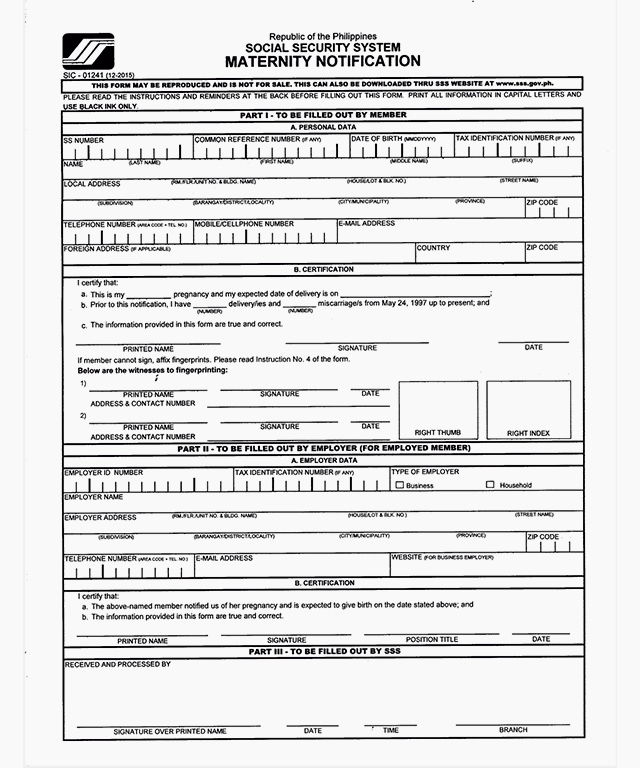
- Notify your employer as soon as you confirm your pregnancy. The maternity notification should be made at least 60 days from the date of conception. Your HR representative will ask you to submit the SSS Form MAT-1 and proof of pregnancy, such as an ultrasound report and other medical proof.
- After your delivery, submit the SSS Form MAT-2 to your employer and the post-delivery documents mentioned above.
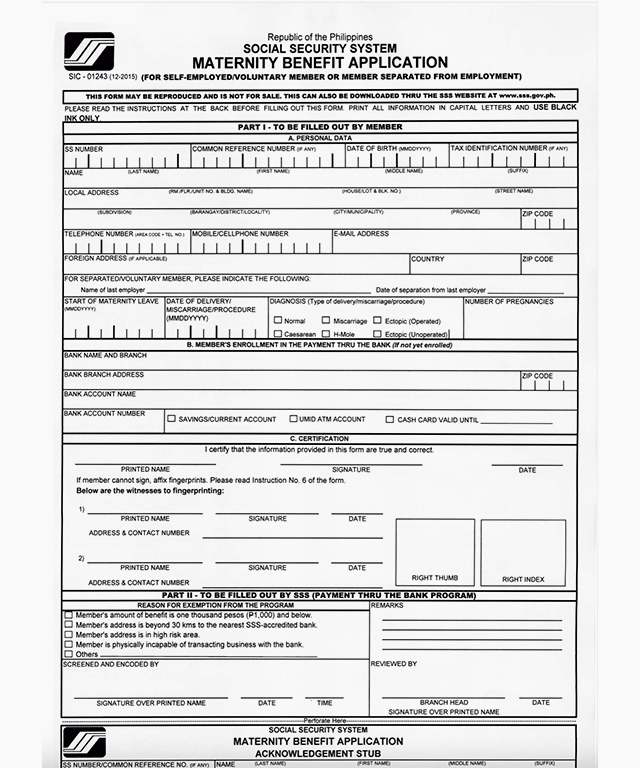
- Receive the total amount of your SSS benefit from your employer.
For newly transferred/unemployed members:
- Notify SSS directly regarding your pregnancy by submitting the SSS MAT-1 form.
- After your delivery, submit the SSS Form MAT-2 together with the appropriate post-delivery documents mentioned above.
For voluntary contributors:
- Notify SSS directly about your pregnancy by submitting the SSS MAT-1 form.
- Submit the SSS MAT-2 form and the necessary post-delivery documents.
- Submit a copy of the SS E-5 Form to the nearest SSS office to receive your benefit.
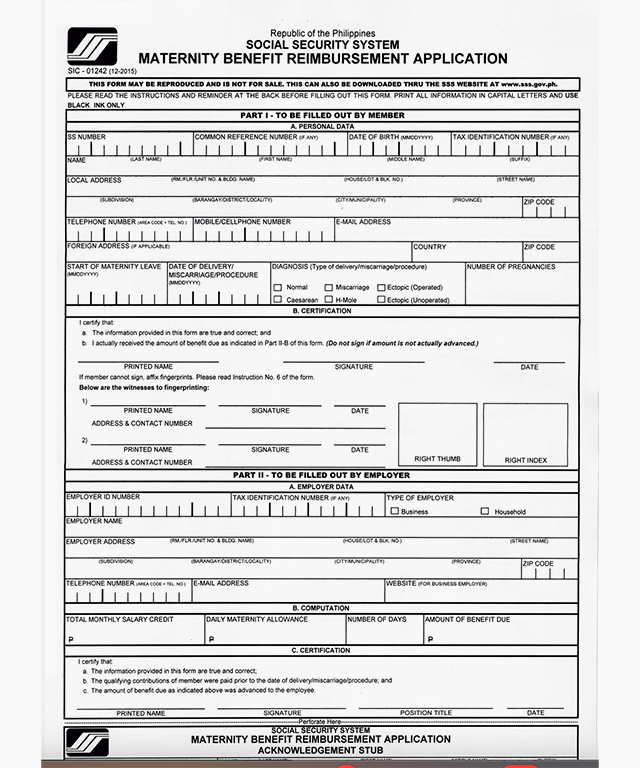
For self-employed contributors:
- Notify SSS directly about your pregnancy by submitting the SSS MAT-1 form.
- Submit the SSS MAT-2 form and the necessary post-delivery documents.
- Submit a filled-out SS R-1 form.
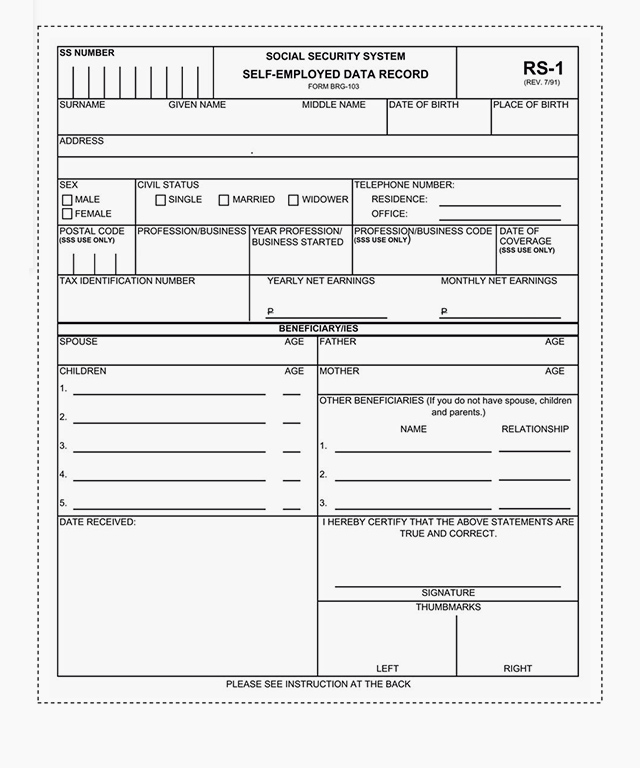
For members who live far away from any SSS branches, you may also opt to file your claim online through the MySSS portal.
How to track your SSS Maternity Benefit Claim:
Once you submit the necessary forms and documents for your SSS Maternity claim, you will receive email updates from SSS about your application, including the target date of when you can receive your benefit amount. Alternatively, you can track the progress of its approval and disbursement through the MySSS portal and the SSS mobile app.
For more information, visit the Social Security System (SSS) website.
Also read:
The Best Credit Cards With No Annual Fees in the Philippines
10 Savings Accounts With No Maintaining Balance
10 More Mobile Wallets to Try for a Cashless Existence
Hey, Spotters! Check us out on Viber to join our Community and subscribe to our Chatbot.