

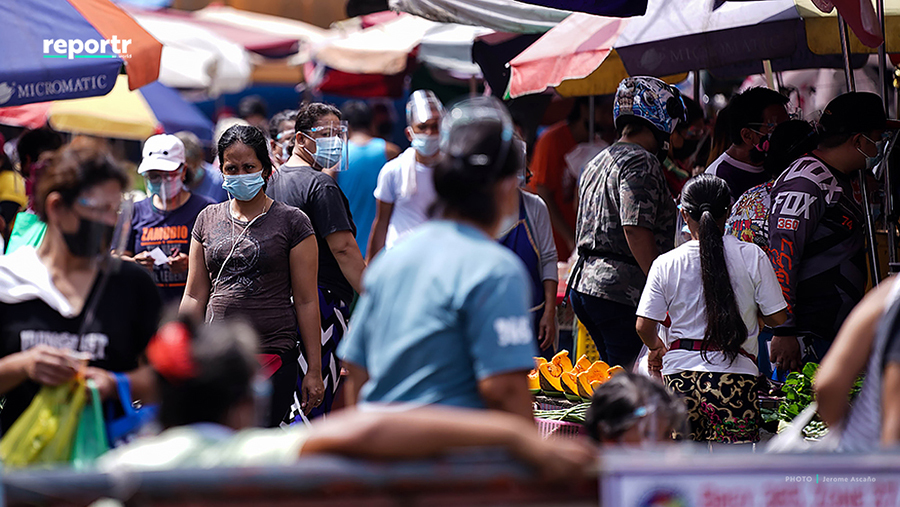
The Philippines has a population of 109 million, made official by a recent declaration from President Rodrigo Duterte, the statistics agency said. This means more Filipinos sharing resources during the pandemic.
Compared to the last official data in 2015, the population grew by 8,053,906, placing the annual population growth rate at 1.63%. This is lower compared to the 1.72% recorded for years 2010 to 2015.
Duterte's Proclamation No. 1179 declared the results of the 2020 census, wherein 109,035,343 persons were figured to reside in the country as of 12:01 am of May 1, 2020. It includes Filipinos in Philippine embassies, consulates, and missions abroad, according to the Philippine Statistics Authority.
Region IV-A (Calabarzon) is most populous in the country, having logged 16,195,042 people. Metro Manila is second with 13,484,462, followed by Central Luzon with 12,422,172.
These three regions account for 38.6% of the country's population.
The three least populated regions are the Cordillera Administrative Region (CAR) with 1,797,660; Region XIII (Caraga) with 2,804,788; and MIMAROPA with 3,228,558.
Likewise, CALABARZON had the biggest increase from 2015, logging 1,780,268 new persons in 2020 to its 2015 population count.
In terms of annual growth rate, the Bangsamoro Autonomous Region in Muslim Mindanao (BARMM) is the fastest, having grown by 3.26% annually from 2015 to 2020. Region VIII (Eastern Visayas) had the lowest yearly growth at 0.50%.
The law mandates the Philippine Statistics Authority to conduct a national census of population and other data every five years. National statistician Claire Dennis Mapa said the most recent one came with its own difficulties because of the COVID-19 pandemic.
"The PSA has proudly overcome unprecedented challenges to collect and produce high-quality data that are critical in decision-making for good governance, development planning, risk reduction and crisis response, social welfare programs, and business market analyses, among others," he said.
A population boom is expected after 2020, as the pandemic hampered access to birth control measures, the Commission on Population and Development (POPCOM) earlier projected.