
How Deaf-Friendly Are You? Some Tips on How to Connect With Deaf Persons
A little more inclusivity won't hurt.

(SPOT.ph) How do you communicate with the Deaf? Often, when faced with unfamiliar situations like this, we freeze on the spot. Aside from learning sign language, what else can we do to effectively connect with their community?
At least 21% of the Filipino population aged five and above in 2020 had difficulty in hearing, according to the Philippine Statistics Authority, so at some point it isn't impossible to meet a Deaf person. To address this, Caravan Food Group Inc. holds regular Deaf Awareness and Basic Filipino Sign Language seminars in partnership with De La Salle-College of Saint Benilde School of Deaf Education and Applied Studies in hopes of inviting more hearing persons to embrace inclusivity.
"Apart from our company—we hire Deaf employees—we also want the public to appreciate them as well. To appreciate them, we also have to give some kind of awareness to them," said Theo Cacayan, Business Development and Operations Manager of Caravan Food Group Inc. the company behind Overdoughs, Elait, Raw, and Mary & Martha. So far, more than half of CFGI's 60-strong workforce are Deaf persons.
"The goal is to spread awareness about Deaf inclusion, whether it's in their homes or companies."
Here's what you need to know about Deaf people
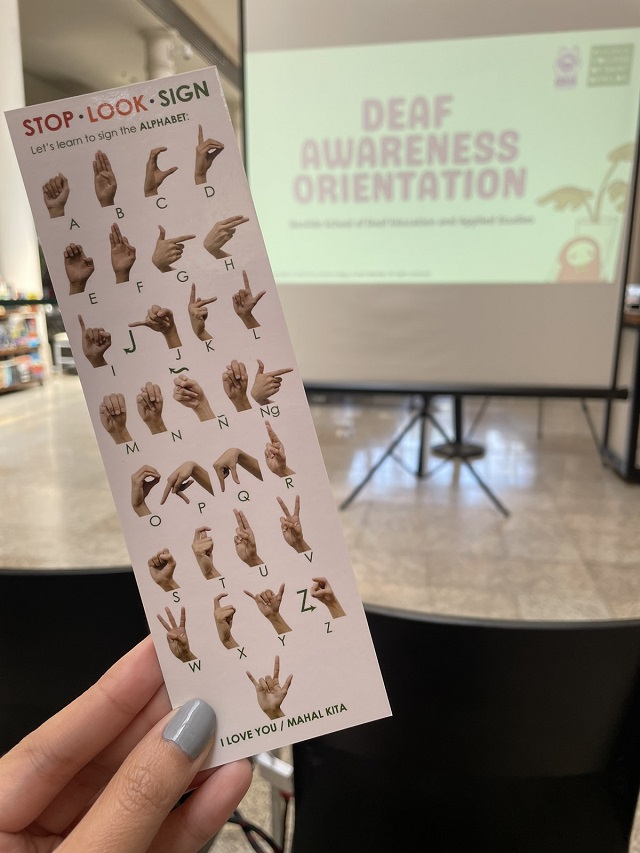
The Deaf community has their own language and culture. The Filipino Deaf community even has their own sign system called Filipino Sign Language (FSL) where they use natural facial expressions and body actions when signing. It's different from Signing Exact English (SEE), which solely uses the hands when matching signs with the English language.
Deaf people are expressive, keen observers, and very visual. Don't be surprised if they are more straightforward (or even blunt) compared to hearing people. Another misconception about Deaf persons is they can all lip-read—which isn't the case for everyone—that's why it's best to learn how to communicate with them without our voices.
And just like hearing persons, Deaf persons can live normal lives, drive cars and motorcycles, and get a stable job of their own.
How should we address deaf persons?
These are the acceptable ways to address them:
deaf
This term, with small letter d, is used to call people with hearing loss in general. They don't identify as part of the Deaf community.
Deaf
Yes, that's Deaf with capital letter D. This is the group of people with their unique language and culture. Many people around the world identify as Deaf.
Hard of hearing
Not everyone is entirely deaf; some can still hear a little and can live in both the hearing and deaf world. Also, those who are hard of hearing have their own identity, too.
These are the unacceptable terms:
Deaf-and-dumb
Being deaf does not make them stupid.
Deaf-Mute
This means the person cannot speak nor hear, but that is not the case when it comes to the Deaf community. Some can still use their voice but prefer not to, while others prefer to communicate through sign language instead.
Pipi
This term can be offensive as not all Deaf people are mute.
Hearing-impaired
This focuses on their deafness as a disability, or frames them as being broken or damaged.
How to communicate with the Deaf

Some points to remember when communicating with Deaf persons:
- Maintain eye contact when communicating
- Be close in proximity
- When calling their attention, do not shout at them. Instead, thump on tables or floors, wave your hands, or tap them lightly
- To call their attention, you can also switch the lights on and off, or hand them a written note
- Tap the power of technology: video-call them or talk via Zoom or Teams so they can see you
What to do if you have a family member who is Deaf
- Spend time learning how to sign, even if this means learning just the basics.
- Allow your Deaf family member to give you a sign name, a unique way to identify someone without spelling out names. This can be related to your facial features, characteristics or even personality.
- Include them in your family group chat and use basic English.
- Create a family tree complete with names and pictures when introducing other family members.
- During family reunions. write how you're related to the Deaf family member.
Want to know more about Deaf Awareness or interested to know more about these seminars? Visit Overdoughs for more updates.