

How Can We Combat Plastic Waste? Greenpeace Says "Be Very Ambitious"
It's no longer enough to reuse, reduce, and recycle.

(SPOT.ph) "Reduce, reuse, and recycle" has become the environmentally conscious world’s favorite jingle. You might think we’re doing better with this kind of awareness we have now, but an OECD report shows that annual plastic production has skyrocketed from 234 million tonnes in 2019 to 460 million tonnes in 2019.
Desensitized by that fact? Let’s move closer to home. In the Philippines, 146 million sachets and 93 million plastic bags are used every day, as per Global Alliance for Incinerator Alternatives (GAIA). But the Philippines isn’t solely to blame for those shocking figures earlier.
“It’s an unfortunate and unjust label for [us],” Greenpeace Philippines campaigner Marian Ledesma said in a media conference on July 28. “We’re also receiving the world’s plastic waste. We’re the victims, really, of how we package everything we consume in single-use plastics.”
How can we escape from a system that we have built ourselves? Greenpeace has realized that it's no longer enough to just ban specific chemicals or push for proper waste management.
When it comes to saving the planet, Greenpeace Philippines is now urging an all-or-nothing approach through the Global Plastics Treaty, where the objective is to target the whole lifecycle of plastics.
“It has to be very ambitious to be very effective," Ledesma said.
Also read: How to Embrace the Eco-Friendly Lifestyle in a Sachet Economy
Greenpeace: Starting from the roots
There is merit in starting with small actions, but Greenpeace Philippines is seeking more urgency from the people with the most power. If passed at the United Nations Environmental Assembly, the Global Plastic Treaty will be a legally binding contract for countries to make the necessary changes in the whole lifecycle of plastics.
“Only 9% of all plastic has been recycled globally, yet corporations still use recycling as an excuse to promote a single-use model, prioritizing their interests over the well-being of communities and the environment,” Greenpeace Philippines said, quoting the OECD report.
When we think about plastic, we often think about the non-biodegradable waste it leaves after usage, rarely what constitutes the creation of it.
“We rarely see or hear the issues of the plastic lifecycle,” Ledesma said. Before plastic becomes plastic, it will go through extraction, production, and distribution. Just the process of extraction will involve hazardous chemicals that poison groundwater. Refinement, transportation, and every next step that follows are no less harmful than when it becomes waste.
Microplastics are everywhere—in the air, in the water, and in the food we eat. As much as 13,000 chemicals are used in plastics, 3,200 of which are considered hazardous, Ledesma said. Even commercially sold water bottles were found to have microplastics inside of them.
Plastics with recycling labels on them aren’t any better, too, considering that we lack the proper recycling infrastructure in the Philippines. On the other hand, getting rid of plastic by thermal treatment will only release more carbon emissions into the air.
“Plastics aren’t infinitely recyclable,” Ledesma said. What she is trying to say is this: There’s no winning with plastic already in the picture. This is why it’s so important to start at the root.
Also read: Here’s Where You Can Exchange Trash for Cash in Quezon City
A black-and-white solution
Remember the black-and-white picture of a sea turtle in the earlier part of this article? That’s actually not a sea turtle, but a bunch of plastic waste formed to look like one.
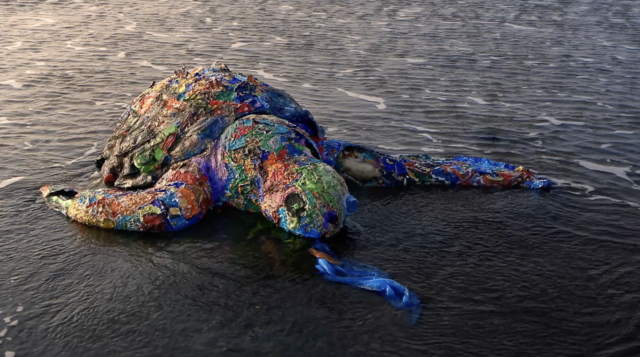
This is part of Greenpeace Philippines’ recent Black and White campaign hopes to show how plastic pollution is more than just trash in the ocean, hence the need for a strong Global Plastics Treaty from our world leaders.
"The Global Plastics Treaty is our once-in-a-generation opportunity to address the plastic pollution crisis head-on. Greenpeace calls for a strong treaty that encompasses comprehensive measures, including eliminating plastic pollution from production to disposal, capping and phasing down plastic production, and ensuring a just and inclusive transition to a low-carbon, zero-waste, toxic-free, and reuse-based economy," Ledesma said.
Sign the petition.
Also read: The Best Eco-Friendly Online Stores for All Your Sustainable Lifestyle Needs