
Omegle Shuts Down After 14 Years—Here’s Why
Talking to strangers will never be the same.

(SPOT.ph) Our parents taught us to never talk to strangers. So what did we do? We went online and did just that—not just on any platform. Omegle became a favorite pasttime in high school and college, so it's with a heavy heart, and some reservation, that we bid farewell to Omegle after 14 years of operation.
Typing in omegle.com on the browser will now lead to a quote by C.S. Lewis and Douglas Adams and long heartfelt message by founder Lief K-Brooks.
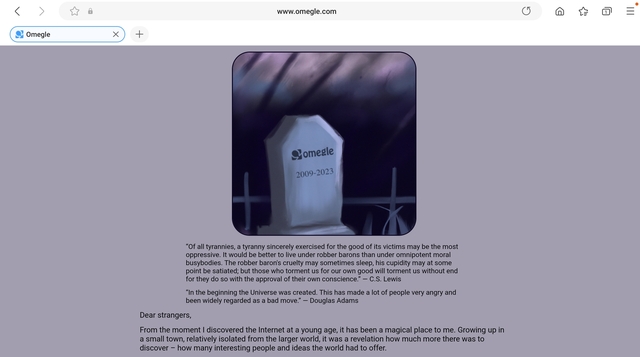
He reflects on the Internet's role in his life, particularly as a survivor of childhood trauma. He credits the online world with providing a safe space to interact without the risk of physical harm, a sentiment that was foundational to Omegle's creation—and unfortunately, the erosion of this safe environment is what led to its eventual closure.
Also read: After 24 Years, PinoyExchange.com Says Goodbye
Why did Omegle shut down?
K-Brooks was only 18 years old in his parents’ basement when he created the platform in 2009. He saw Omegle as an extension of the "global village," a digital street corner where conversations with strangers could spark at any moment. However, the very nature of anonymous connectivity that made Omegle a haven for open dialogue also brought with it the darker aspects of human interaction.
"Virtually every tool can be used for good or for evil, and that is especially true of communication tools. The telephone can be used to wish your grandmother ‘happy birthday,’ but it can also be used to call in a bomb threat. There can be no honest accounting of Omegle without acknowledging that some people misused it, including to commit unspeakably heinous crimes,” K-Brooks wrote.
Despite strong moderation efforts, the platform was not immune to misuse. Time and time again, Omegle was reported to have been full of predators, with some victims coming forward to sue the website. Increasing attacks on communication services and, of course, safety issues critics have taken their toll.
The decision to shut down Omegle was not taken lightly.
“As much as I wish circumstances were different, the stress and expense of this fight–coupled with the existing stress and expense of operating Omegle, and fighting its misuse–are simply too much,” K-Brooks wrote. “Operating Omegle is no longer sustainable, financially nor psychologically. Frankly, I don’t want to have a heart attack in my 30s.”
As Omegle's chat windows close, K-Brooks apologies to and thanks everyone who has used the platform in a positive light—and he certainly wasn’t referring to those who liked to flash their genitals...or worse.