

This Lady's Mission Is to Make You See The Culture Beneath Quiapo's Chaos
No one knows the ins and outs of Quiapo like Annabel Hatol.

(SPOT.ph) As tour guide in one of Manila's oldest city centers, Annabel Hatol knows Quiapo like the back of her hand. On any given day, you might find her with a bright smile weaving through the crowd at Plaza Miranda, exchanging small pleasantries with the district's fixtures that cross her path. The day we meet her, she introduces us to the Maranao owner of a popular neighborhood eatery, tells us the names and brief histories of this and that Plaza Miranda vendor, and shares the secret to really knowing Quiapo: Master first the exits and entrances of the underpass.
Hatol was born in this colorful, chaotic district once described by the great writer Pete Lacaba (or was it Nick Joaquin?) as "the armpit of the nation." But Hatol, since she was young, has only called Quiapo home. Over the decades, she's witnessed history happen from the sidelines: political rallies at Mendiola, Batang Quiapo tapings, the annual procession in honor of the Black Nazarene which she watches from her window. She lived in Barangay 825 until she had a family of her own.
One heartbreak, a hundred tourists, and 37 years later, the lady is giving back to the district that has nurtured her all these years. She has taken on the mantle of a mission to showcase Quiapo as a heritage site worth preserving for future generations.
Also read: It's Time You Saw a Different Side of Quiapo
A fresh start in Quiapo
In 2019, the Fundacion Santiago and the San Sebastian Basilica Conservation and Development Foundation launched the Bukas Quiapo Tour. True to its name, the five-hour tour offers more than surface-level tourist experience.
A typical one includes visits to Quiapo Church, the famous Excelente Ham store, Vienna Bakery, Quinta Market, the Ilalim ng Tulay (or Ile de Tulle to oldtimers, a cheeky name for the two passageways under Quezon Bridge which host vendors of local handicrafts), Nakpil-Bautista museum, the Manila Golden Mosque, and San Sebastian Basilica. There are also specialized tours on food, shopping, or culture, depending on what’s been requested for that day.
“Gusto naming mabawasan ang imahen na palaging nalalagay sa Quiapo,” Hatol tells SPOT.ph. To focus less on the chaos and more on the culture. “Gusto ko iparating na ang Quiapo ay hindi lang pang Instagram. Meron tayong history.”
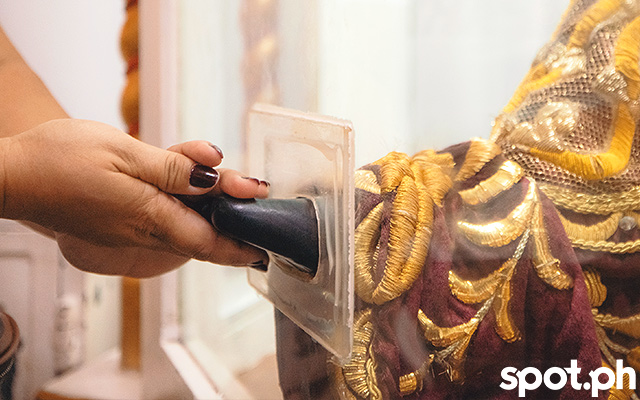
Hatol was in her late 40s when she decided to embark on this “second career.” She was a regular parishioner at the San Sebastian Basilica when she was roped in to help lead the tour alongside Manila expert Dennis Barcelo, with both of them besting 20 other aspiring guides for the position. The opportunity was almost serendipitous, as it came to her shortly following the loss of her husband in 2017. The job enabled her to start anew in a place she already knows by heart.
Her strong devotion to the Black Nazarene is intertwined with her desire to preserve the uniqueness of the district. Quiapo is where tradition meets spirituality, Hatol says. In one block, we have the Quiapo Church, in the next one the Manila Golden Mosque. Further down are tarot readers and charm sellers who knock on the doors of the otherworldly. It’s a melting pot of everything a person could want or need.
“Dito ko natutunan paano magdebosyon. Pupunta ka pa ba sa iba?”
A tour guide for the people
For Hatol, Bukas Quiapo is as much for the community as it is for the visitors. Neighbors, market vendors, and organization-partners stand to benefit from opening themselves up to anyone who would listen.
She enjoins her guests to get to know the people on the ground. “Mga tao na nakapalibot dito sa Quiapo, may mga storya sila. Mula noon hanggang ngayon, bakit nandito pa rin sila sa Quiapo, tulad ko?” In her tour with us, she was joined by her daughter, Pauline, a recent graduate who is poised to follow her mother’s footsteps in promoting Quiapo’s local tourism.

When Bukas Quiapo took a break amid the COVID-19 pandemic, Hatol redirected her efforts to support Senate Bill No. 1471, which is currently under consideration in Congress. This proposed legislation aims to elevate the entire Quiapo area as a Cultural Heritage Zone. While the region from Hidalgo to San Sebastian already enjoys some heritage protection, advocates like Hatol are campaigning to extend this protection to cover the whole Quiapo district.
It's only natural that she wants her district protected. “Tignan mo naman,” she says, pointing to the high-rise condominium building behind the Quiapo Church, poking out of the background like a sore thumb. It is reminiscent of the Rizal Monument’s Torre de Manila problem. “Wala na kami magagawa diyan.”
What Hatol is referring to is, of course, the growing trend of developers hogging the land in densely populated cities, driving up property prices for everyone else. Designating Quiapo as a heritage zone serves as a protective measure against these commercial pressures.

Bukas Quiapo is set to return in the Old Downtown of Manila in the first quarter of 2024 with a rebrand—Community Heritage Tour—which hopes to be more intentional. Whether or not we'll see Hatol at the helm should not matter. What matters is that there will be more people who will take on her mission, like her daughter.
“Maraming pamana na dapat pangalagaan sa Quiapo,” Hatol says. “Ang tour…special sa akin ‘yun. Siguro ito ‘yung legacy na maiiwan ko dito.”
Photos by Jilson Tiu