
Last Supper It's Not: The Outrage Over The Olympics Opening Show
Get your paintings right.
(SPOT.ph) There were so many outraged posts about blasphemy in the Paris Olympics opening ceremony on social media, so here's a quick fact-check: The tableau in the ceremony is not a reference to Leonardo Da Vinci's Last Supper but may have been inspired, according to online sleuths, to Jan Harmens van Bijlert's The Feast of the Gods (1635).
You can see why the suggestion is so potent: The blocking of the performers is very nearly identical to the 17th century Dutch masterwork, with Apollo and his crowning sun rays at the center of the table—no, that isn't Jesus Christ—and Dionysus the god of wine and pleasure in the foreground, right down to a child representing Eros. And it is, of course, hanging in the Magnin Museum in Dijon, totally accessible to the designer of the ceremony, Thomas Jolly (who has since confirmed that Dionysus was indeed his inspiration for the number). Why this reference? Because Apollo and Dionysus are Greek gods, and the Olympics are a Greek invention, a tribute to Zeus.
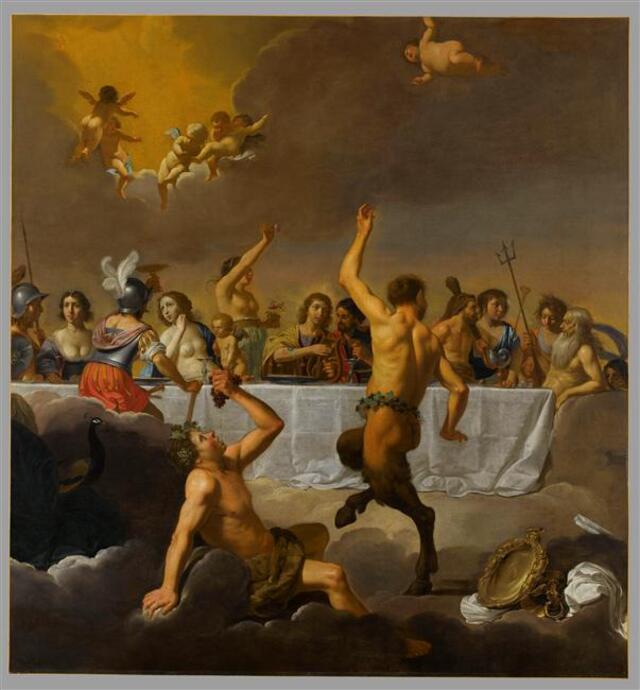
Strong the similarities may be, van Bijlert’s work isn’t even unique in its subject matter: Bacchanalia as a mythological event was a prevalent topic in 17th century European art. There is, for example, Baroque painter Michaelina Woutier’s Bacchanal, which features Bacchus in a reclining pose—much like the blue-hued Dionysus of Paris—as a focal point. Everyone from Jan Brueghel (elder and younger) to Peter Paul Reubens to Diego Velazquez painted scenes of gods feasting; Dionysus was a big deal in Greek mythology, after all, with his own cult within the larger belief system.
Yes, there was also a decapitated woman cradling her own head. That's a reference to Marie Antoinette, whose beheading (along with the rest of French royalty in 1793) was a turning point for France moving away from a Catholic monarchy into a Republic.
And, yes, there was a metal horse galloping down the Seine. And, no, it is not the pale horse of Death. The horseman was actually a horsewoman, a female member of the Gendarmerie (that’s the French police force), wearing a cape emblazoned with the Olympic rings, and she is meant to symbolize Sequana, the goddess of the Seine...who happens to be the daughter of Dionysus.
Living, breathing showcase of French culture
Some reviews found the opening ceremonies of the Paris 2024 Olympics boring. Or bloated. Or bewildering (a woman dressed as a croissant?). I felt it was a living, breathing showcase of French culture. Think back to opening ceremonies of yore, where each country’s delegation was cued to enter a stadium and wave to the crowds. How static. How expected.
This time, Paris officials hit upon the idea that it wouldn’t be the athletes that would be the selling point, but the city (and by extension, the nation of which it is the capital). And so they devised an opening that would have production numbers performed or broadcast in strategic points along the Seine’s serpentine route. Believe me, as a tourist who’s done a Seine river cruise—but only once! There are too many things to do in the City of Light!—those athletes would have been thanking their lucky stars the river got all dressed up for them.
Also read: Meet The Filipino Athletes in the 2024 Paris Olympics
You might say, but the athletes are the point of any Olympic games; why take the spotlight away from them? To which I say, no other Olympic venue has the Seine, which is the focal point of the city and is dotted with many breathtaking Parisian landmarks and historical markers. The officials would have been fools not to take the opportunity to use this world-famous river as a vehicle to showcase France’s culture and history.
Table gatherings don't always mean Last Supper
By the outpouring of performative outrage on Facebook, what a showcase it turned out to be. But hear me out: For those of you who saw blatant disrespect for our Lord’s passion and sacrifice with that bacchanalian display of drag queens and a Dionysus in blue body makeup, please remember that Christianity does not hold a copyright on arranging people around a table for a religious feast.
The fact is, Greek polytheism predates Christianity by centuries. So if anything, the Greeks were holding bacchanals and breaking bread and wine in the names of Zeus and Athena long before Christians were hiding out in catacombs, holding makeshift masses. Just because Da Vinci arranged Jesus and the apostles around a table, doesn’t mean Christianity suddenly has dibs on people gathered around a table.
When your only point of reference is your Christianity, anything resembling a tableau or anything including performers in drag or anything with even a hint of impropriety will have you clutching your pearls. But here’s a newsflash: Not everything is about your faith. Especially in France, which is a multicultural and increasingly immigrant society. Alas, we as Filipinos have next to no experience with immigrants (which are different from expats—those white dudes who live in BGC and get effusive when you take them out to Poblacion), and our culture is largely defined by our Catholicism.
Because so many of SPOT.ph’s readers can afford to travel, let me give you a handy tip: Please stop with the intellectual laziness; replace it with intellectual curiosity. Read mythology, read history, look at art, do a simple Google search. Don't let your intellectual horizons begin and end with the Bible. (Which, by the way, has scores of children being massacred not once...but twice! So I don't know why one simulated beheading should bother you.)
The Parisians will roll their eyes at you
The French will be French. They will do their thing. France has the grand trappings of its Catholic past—the Chapel of the Miraculous Medal, Mont Saint-Michel, more cathedrals than you can shake a missal at—but if you display even a hint of your ignorance of the immigrant experience or your Catholicism-is-under-attack viewpoint, the Parisians will roll their eyes at you. And then you will have embarrassed not only yourself, but the entire country.
Now enough with feeding the outrage algorithm! Watch Celine Dion perform Edith Piaf’s “Hymne a l’amour” a second time on YouTube. Watch it a third time—heck, watch it 30 times. My French may be spotty, but I’ll be damned if that performance doesn’t hit me square in the feels. And when you pair the adversity of Celine Dion’s backstory with her soaring vocals and those closing lyrics:
“We will have eternity for us;
In the blue of all the immensity
Of the sky, no more problems;
My love, do you think we will love each other?
God unites those who love”
Really, how can you be outraged?
Also read: Olympics Style: The Designer + Inspiration Behind The Sinag Barong