

Saan Galing Ang Eyyy? The Good Vibes Greeting Started in Hawaii
BINI just revived it. A sugar mill accident started it.

(SPOT.ph) From Jollibee mascot to priests in the middle of their sermon (Eyyy-men!), and more recently President Ferdinand "Bongbong" Marcos with the Filipino Olympic athletes posing for photographers in Malacañang—everyone it seems have caught the "Eyyyy" fever.
Reviving this hand gesture with a very interesting history is BINI Sheena, who's been dubbed the ‘Eyyy ka muna’ mother. In an interview posted on TikTok, Sheena explained that Eyyy is all about positive vibes and is a hand sign to express happiness. In its current context, that’s exactly what Eyyy is giving—all around positivity.
Also called Shaka, the hand sign traces its origins in Hawaii in the 1900s, according to history geek and genealogist Mona Magno-Veluz, more popularly known on social media as Mighty Magulang. On TikTok, Magno-Veluz explains that Eyyy has deep cultural roots in Oahu, Hawaii and is attributed to a man of noble ancestry named Hamana Kalili who was born in 1882.
From Eyyy to Z
Even if he is of noble blood, Kalili’s family wasn’t rich and he worked as a fisherman. On the side, he worked as a laborer at Kahuku Sugar Mills and his job was to operate the sugarcane presser. An accident while working on the machine caused him to lose his index, middle, and ring fingers leaving him with just his pinky and thumb.
Due to his disability, he was transferred to work as security personnel for a train that transports sugarcane, according to a blog entry in Polynesia.com, where the origins of Shaka is explained. His new job entailed calling out the local kids who would jump on the train to go on a joyride before it left the station. To do this, he would raise his hand with the missing digits and reprimand the kids, asking them to get down.
Soon, the children would use this to mean “all clear” or “go for it” when Kalili was not around and that they were free to hop on the train. When these same kids became adults the Shaka sign became a nostalgic symbol of their youth growing up in Laie town in Oahu. In the 1950s to 60s, the hand sign caught up with Californians who came to surf in Hawaii’s coasts and appropriated it to mean ‘Hang Loose’, “Right On’, ‘Things are Great’ or ‘Take Care’, says Magno-Veluz.
The Father of Shaka
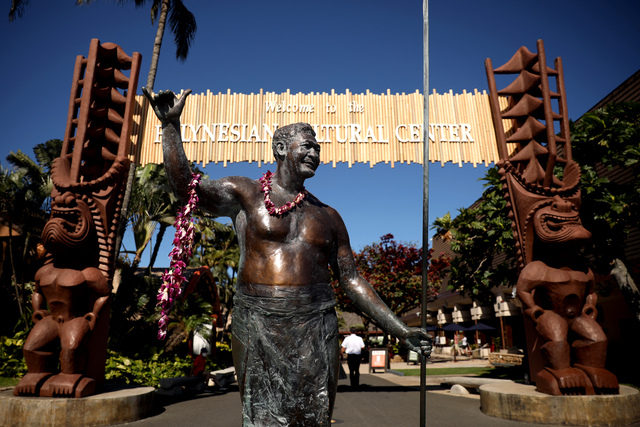
In his own hometown, Kalili is considered the ‘Father of Shaka’, and his story is made immortal by his very own monument at the Polynesian Cultural Center that shows him in traditional Hawaiian clothing, his left hand carrying a fishing spear while his right hand is raised proudly displaying the Shaka sign.
Within Hawaii, the Shaka is not just an iconic hand sign but considered a movement, where debates on how it should be properly ‘flashed’ are discussed according to an article in apnews.com (some do it with the palm facing down to show respect while some say shaking the palms is a no-no). Local politicians, including former US President Barrack Obama who grew up in Hawaii have freely made it their signature when greeting the public. During the Covid-19 pandemic, Hawaiians used it a as a greeting to avoid shaking hands.
There is also a House Bill officially recognizing it as the official gesture of the State and it symbolizes ‘sharing aloha’ or ‘fostering connection.’ The same bill also settles the right way to do the Shaka: “… extending the thumb and smallest finger while holding the three middle fingers curled and gesturing in salutation while presenting the front or back of the hand; the wrist may be rotated back and forth for emphasis."
Just like the Shaka, the Eyyy trend in the Philippines is used in the same spirit as the Hawaiians. So, if you’re feeling happy and want to let the world know, or just want to spread positive vibes, let’s take it from BINI Sheena: mag “Eyyy ka muna!”