

Filipinos Have Improved in Disaster Preparedness: Harvard Study
At least that's what we tell ourselves.

(SPOT.ph) Following the string of powerful typhoons that hit the Philippines over recent months, a new survey by the Harvard Humanitarian Initiative (HHI) tells us Filipinos believe they are better prepared for disasters than they were a decade ago. Guess practice really does make perfect?
The survey found an average preparedness score of 19.2 out of 50 across five objective measures: planning, training, material investment, information, and social support. That’s a 42% increase in self-reported preparedness levels over the past seven years, a notable improvement from the 13.5 average score in 2017.
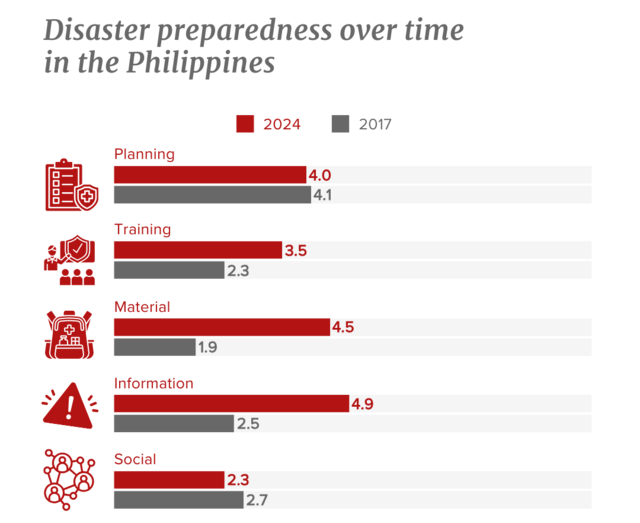
Filipinos scored highest at 4.9 out of 10 in information (knowledge of disaster risks) and lowest at 2.3 out of 10 in social support (lack of community/local support during disasters).
“This is a significant improvement from [the] study conducted by HHI in 2017 using the same methodology and instrument; however, it is not enough for a country with the highest disaster risk in the world,” HHI noted, with the co-lead for this study Dr. Vincenzo Bollenttino adding that “the score suggests that Filipinos are only doing 38.4% of the kinds of disaster preparedness activities needed to be prepared.”
Also read: Baha Ka Lang, Pinoy Kami: Why Are We So Good at Being Funny During Disasters?
Who are the most disaster-prepared in the Philippines?
Metro Manila ranked 11th in the level of disaster preparedness at 19.1, which is slightly below the national average of 19.2. According to HHI, it has made “the least progress in disaster preparedness over time, with an increase in preparedness score by only 22% or 3.4 points from 15.7 in 2017.”
“NCR is the heart of the Philippine economy and home for a significant part of the country’s population, yet it is routinely hit by natural hazards; thus, increasing its disaster preparedness is crucial,” Bollenttino said.
This gap in preparedness becomes clearer when looking at the highest and lowest scoring regions. Cordillera Administrative Region (CAR), Central Visayas, and Western Visayas scored the highest at 24.0, 21.5, and 21.4, respectively; while the Davao Region, Negros Island, and the Bangsamoro Autonomous Region in Muslim Mindanao (BARMM) scored the lowest at 17.3, 15.8, and 15.1, respectively.

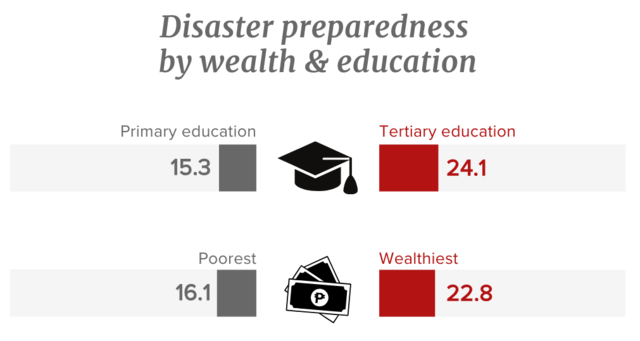
Beyond regional disparities, the survey also examined the influence of socio-demographic factors on disaster preparedness. It found that wealthier individuals and college-educated individuals score higher on readiness levels compared to those with lower income and only primary education.
Age and gender do not show a significant impact.
HHI is a research center at Harvard University that focuses on improving humanitarian response worldwide through research, education, and training. HHI’s work provides data-driven insights that help shape policies and practices in disaster preparedness and response, making its research particularly valuable for high-risk countries like the Philippines.
Also read: PSA: Employers Can’t Force You to Work During a Typhoon