

E-Scooter Is Life for This Manila Commuter, for Better or Worse
On one man's experience weaving in and out of city traffic.

(SPOT.ph) Business news journalist and voice talent Diego de la Paz works the night shift. Like any other employee with the same arrangement, he gets up at an ungodly hour to prepare for his pre-work routine—that is, making sure his electric kick scooter and external battery pack for his horn and headlights are fully charged. At 2 a.m., or 3 a.m. at the latest, he mounts his Dualtron Spider unit from his home in San Juan City and heads to his office in Makati City, with only a backpack on him.
Since most establishments are still closed when he heads out, De la Paz heads straight to the office on a journey that takes around 30 to 45 minutes to cover four kilometers without competition on the road. It’s peaceful, gliding through the sleeping city at a relaxed pace of 25 kilometers per hour.
The 36-year-old drops his ride of at the building's free e-scooter parking then heads to the washroom to freshen up a bit. After all, motor-vehicle pollution still exists even if it blends in with the night sky. "The elements will take its toll,” De la Paz tells SPOT.ph. By 1 p.m., de la Paz scooters out of his office building a free man—at least for the rest of the day. This is when the real adventure begins, which he likes to call his “side trips.”
“The money I save not using Grab… I use to get refreshments and enjoy the scenery along the way,” De la Paz says. Even if there’s no parking for e-scooters in a specific location, it’s possible to make a quick stop and see what the neighborhood has to offer just because. “That’s one of the luxuries I enjoy. You’re not constrained where the route will take you.”
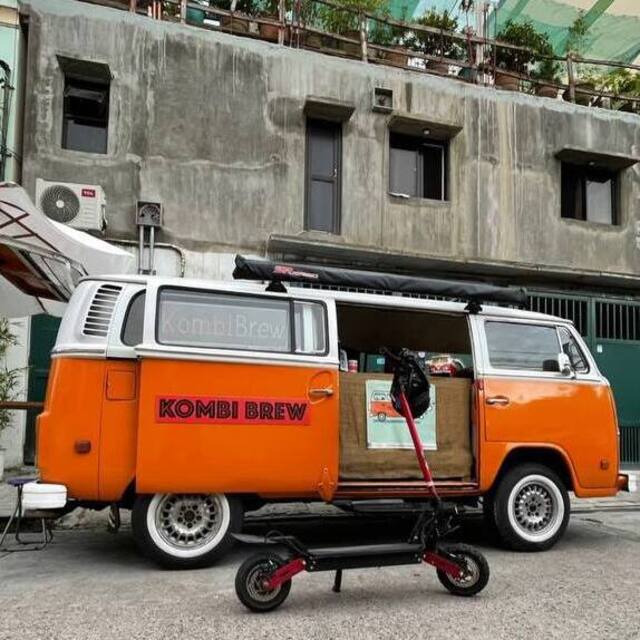
Since hopping on an e-scooter for the first time in 2021, De la Paz has roamed several cities in and around the Metro, chancing upon several hole-in-the-wall restaurants and cafés that he otherwise wouldn't have spotted if he were tucked inside a private vehicle or mass public transportation.
Also read: GUIDE: E-Scooter and E-Bike Registration, License Requirements
What it's like to ride an e-scooter in the Philippines
On his Instagram profile, De la Paz has several story highlights titled #MNLonTwoWheels where he documents his best and favorite finds.
“Being an active mobility user allows me to take more control of my time," he says. "I get to leave at a time that is convenient for me, that allows me to pace myself compared to other modes of transport.”
De la Paz's journey back home to San Juan City isn't as lovely in the late afternoon. Getting home becomes tricky now that motor vehicles are clogging the road—navigating them without designated bike lanes, a little trickier. "Cars are traffic," he says. It’s even worse in a location like Makati City’s Central Business District (CBD) since it “doesn’t have ample space for e-scooter users.”
Active mobility users like De la Paz have no choice but to occupy the middle of the lane to ensure that the larger vehicles around see him and know to stay clear. Luckily, he’s granted with a work-from-home setup on most nights, but on the few occasions he needs to go to the office or run some errands, the e-scooter is usually his transport pick.
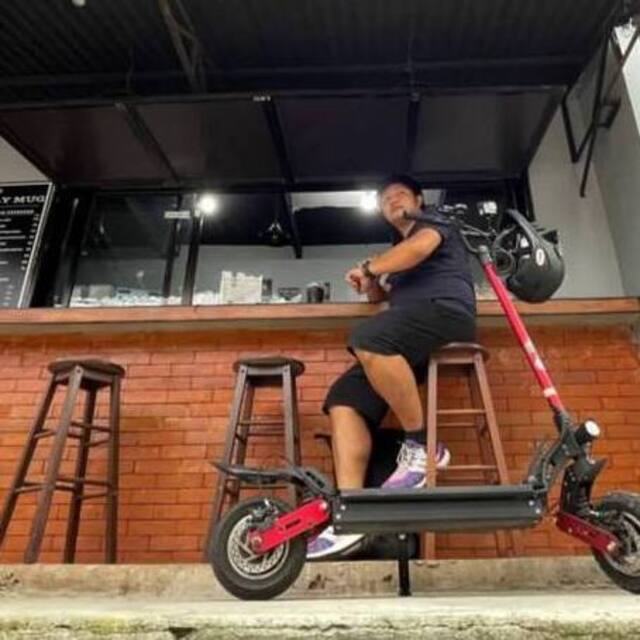
"There is some kind of danger [to riding e-scooters], but it's not inherent. It's more on the environment that is created because we have unfortunately prioritized motor vehicle traffic over any other form of mobility," De la Paz says. “If there’s no clear demarcation [of the bike lane] we are forced to take the road as is. Drivers feel that bicycles or e-scooters are nuisances on the road because we take up space."
The honks and stares coming from people behind the wheel fail to intimidate him. If anything, De la Paz has grown accustomed to the active mobility lifestyle (and all the stigma attached to it), having been inseperable from his bicycle since 2012 before he opted to give the e-scooter hype a try in 2021.
“It’s either I go on a bicycle or an electric scooter if I’m not commuting via trains. I never learned how to drive a car. I never had an inclination to get a license,” De la Paz shares. He laments how owning a vehicle has become a Filipino "measure of success…of having moved up in life” when it’s really nothing more than succumbing to the congestion problem in the Metro. That was, of course, until the pandemic.
The global rise of active mobility was slow but sure in a developing country that was plagued with several transportation woes: the restrictions of the pandemic, the rising fuel prices, the traffic, the growing inflation, the road rage. The distinctly Filipino frustration with how powerless we feel against it all.
According to PSA Market Research, the micromobility market will soar 158.6% from 2021 to 2030 in the Philippines. De la Paz is just one of the many e-scooter users that are part of this growing statistic. But the reality is also this: De la Paz happens to join us in a call for this article while he is in a public hospital that had no parking facilities for an e-scooter. And as it had been raining that Monday in June, he had been forced to hail a car to get there.
That was the usual protocol in event of rainfall: stop where he is, fold his unit, and book a private car to reach his intended destination. Not every e-scooter is splash- or weather-proof, De la Paz says, which means it can cause irreparable damage to the unit even in light rain. Beyond forces out of his control like the weather, the lack of designated lanes, parking spaces, and charging stations are things e-scooter users have to contend with in a country that has pushed alternative modes of transport to the margins.
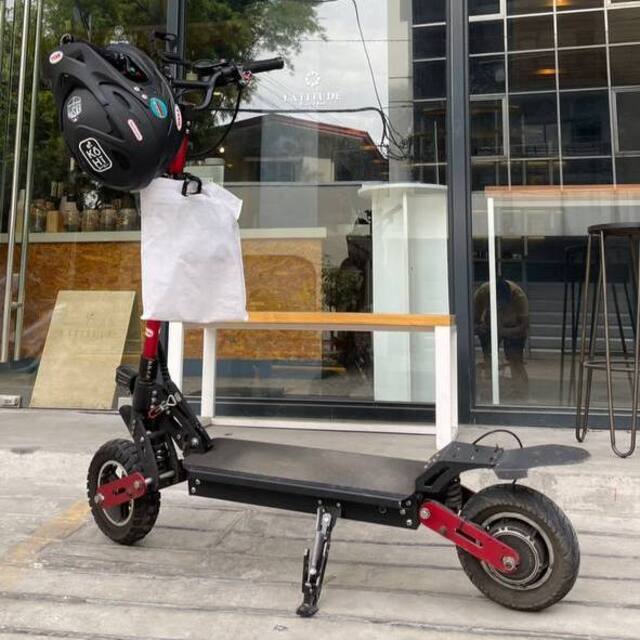
There's a lot left to be desired when it comes to how the Philippines treats its active mobility users. But in the meantime, those small pockets of freedom are everything for someone like De la Paz. For a few moments in his #MNLonTwoWheels journey, when he spots a charming little café worth stopping over, he is able to relish in a world that seemingly exists for e-scooter users like him.
“I’m hoping people will reconsider the lessons learned during the pandemic that active mobility works,” De la Paz says. “The choice is ours to make, to shift to a more efficient mode of transport. Not only will it relieve congestion on the road but will also lead us to much happier situations.”
Also read: Where to Buy Kick Scooters in Manila