

Heads Up, Motorists: Katipunan's Two-Week Zipper Lane Trial Starts Today
Will this finally ease traffic in the area?

The Metropolitan Manila Development Authority is trying out a new traffic scheme along Katipunan, so if this is along your regular route, take note. A zipper lane will be popping up in efforts to ease traffic in the area.
Also read:
Expect Longer Wait Time for LRT-1 Trains Due to Rail Maintenance
What We Know So Far About the Proposed Ride-Hailing App Tara“Stop Playing Loud Videos”: Etiquette Rules From a Frustrated Commuter in the Philippines
Here's what we know about the Katipunan Avenue northbound zipper lane
Beginning today, September 21, the MMDA and the Quezon City local government will implement a two-week dry run of the Katipunan Avenue northbound zipper lane. It will be open on weekdays during morning rush hour, from 6:30 a.m. to 8 a.m., except on holidays.
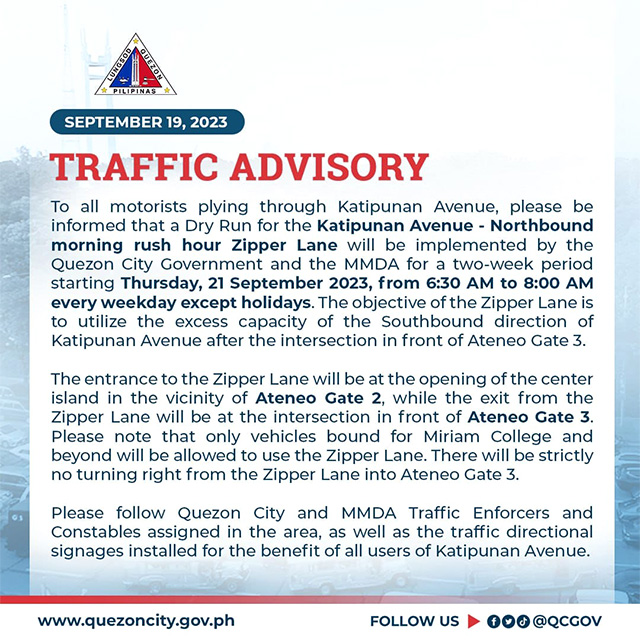
Quezon City traffic advisory on Katipunan Avenue zipper lane:
Only northbound vehicles heading to Miriam College and beyond (toward the direction of Commonwealth Avenue) are allowed to use the zipper lane. The entrance is at the opening of the center island near Ateneo de Manila University's Gate 2, and the exit is at the intersection in front of Gate 3. Vehicles exiting the zipper lane must proceed northbound and cannot turn right into Gate 3.
Directional signage and traffic enforcers from the MMDA and the local government will help guide vehicles during the zipper lane implementation.
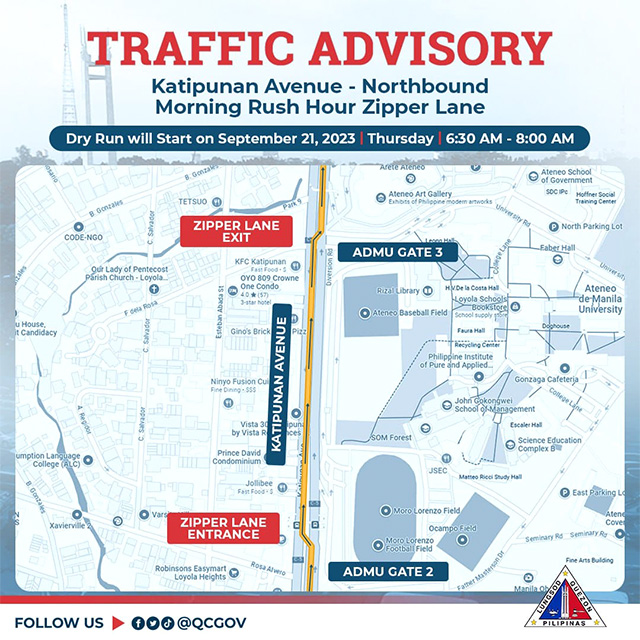
Earlier this month, the MMDA said that an average of 2,757 vehicles travel northbound (toward Commonwealth) from 7 a.m. to 8 a.m., while there are 6,636 vehicles traveling on the southbound side (toward Aurora Avenue) during the same period. The bottleneck on the southbound side tends to ease after the intersection in front of Ateneo Gate 3, where left-turning vehicles going to the school sometimes occupy up to three lanes and block the progress of vehicles heading straight.
"The objective of the zipper lane is to utilize the excess capacity of the southbound direction of Katipunan Avenue after the intersection in front of Ateneo Gate 3," the MMDA said.
Also read: LOOK: Here's What Our Train Lines Might Be Like by 2030