

A Three-Meter Wide Sinkhole Near Villamor Has Been Reported
Two lanes have been closed off to motorists.

(SPOT.ph) It’s not every day you see a massive hole opening on the ground in Metro Manila.
On April 14, a sinkhole began forming on the eastbound lane of Sales Road near Villamor Air Base’s Gate 3, which is right underneath the NAIAX-Skyway leading to and from NAIA Terminal 3 in Pasay City. It started off as a small crevice on the road:
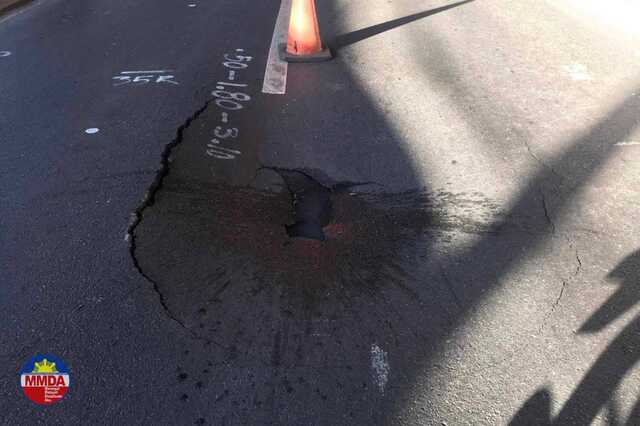
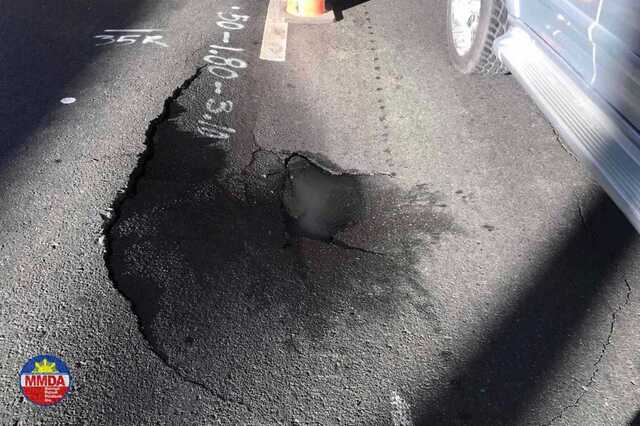
Within a few hours, a Metropolitan Manila Development Authority (MMDA) traffic enforcer said it grew to around three-meters wide. Later, the Department of Public Works and Highways (DPWH) revealed the sinkhole went down as deep as eight to ten feet.
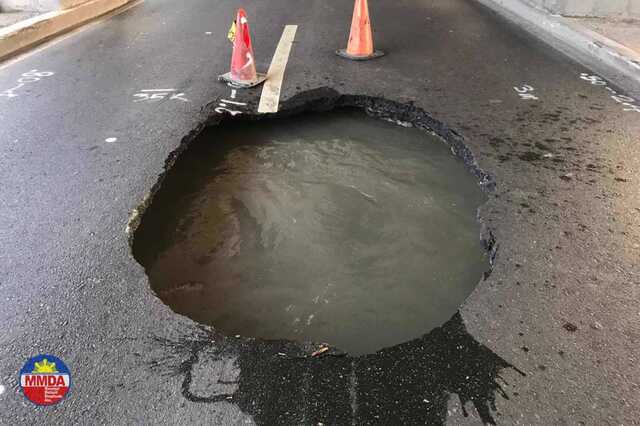
As a result, two lanes have been closed off to motorists, so take note in case you're on the way to the airport anytime soon. MMDA Chairman Don Artes said that the sinkhole was triggered by a water leakage from a Maynilad pipeline, causing soil saturation and its eventual collapse, as reported by ABS-CBN News. Investigations are still underway on who or what caused the hole in the pipe.
To manage the traffic, eastbound vehicles are restricted to one lane, while a temporary lane has been reportedly set up on Andrews Road. Vacuum trucks have also been dispatched to remove water from the sinkhole.
“Dapat mapanagot ang Maynilad at ang mga contractors nila dito!” Senator Ramon "Bong" Revilla, who heads the Committee on Public Works, said in a statement on April 15.
Additional inspections are expected to check if the road's integrity has been affected by the water leak.
Also read: Expect Heavy Traffic Along EDSA as Kamuning Flyover Will Be Partially Closed for 11 Months
What is a sinkhole?
Sinkholes happen when the ground collapses into voids when foundational rocks are dissolved underneath the surface. This is often caused by water flowing through and eroding away rocks like limestone. Sinkholes can also occur because of human activities like heavy construction or excessive groundwater pumping, which can weaken the ground.
Essentially, when the support inside the earth is no longer strong enough, the surface can suddenly drop down, forming a sinkhole.
What causes sinkholes?
Besides water leaks like the one in Pasay City, there are several other causes that can result in a sinkhole formation:
Natural erosion
Water from rainfall or groundwater flows through the soil, entering cracks in the rock, where it slowly dissolves the rock layer. Over time, as the rock dissolves, caverns develop underground. If these cavities grow large enough, the ground above may collapse.
Human activity
Sinkholes can also be induced by human activities such as the over-extraction of groundwater, mining operations, drilling, construction, heavy loads on the surface, and even alterations to water drainage patterns. These activities can increase pressure on the ground, hastening the formation of sinkholes.
Changes in water load
Significant changes in water load caused by seasonal variations, or the sudden introduction or removal of water like after a heavy rainstorm or the draining of a pond can also trigger sinkholes. The sudden weight or rapid movement of water can destabilize surface structures.
Vulnerability of the rock
The type of rock below the surface plays a critical role. Rock types that are easily dissolved, like limestone, are more susceptible to forming sinkholes. These rocks can develop voids as they dissolve over time.
Also read: Over 800 Sinkholes Were Found in Boracay