

"Plastic Roads" Made With Waste Get Official DPWH Greenlight
As a means of sustainability.

(SPOT.ph) You might have been hearing about "Plastic Roads" in the past few years. This technique of mixing plastic waste with asphalt for roads is one way to reduce the amount of non-biodegradable material we have laying around—and it looks like we're getting closer to this becoming a standard practice in Philippine infrastructure. The Department of Public Works and Highways has officially approved the use of plastic waste in road construction, thereby legitimizing and standardizing the process.

Also read: How to Embrace the Eco-Friendly Lifestyle in a Sachet Economy
DPWH Greenlights Plastic Roads
The department legitimizes the practice under Department Order No. 139, Series of 2024. The document sets specific standards for the technique, greenlighting the process "In line with the continuing efforts to support sustainable engineering and upgrade construction technology through adoption of successful research studies." This green light follows years of studies and tests.
"This research took almost six years to be approved and became a standard specification to be used in future DPWH projects," Research and Development Engineer Neilsen Campit of the Department of Public Works and Highways - Bureau of Research and Standards (DPWH-BRS) tells SPOT.ph in an online exchange.
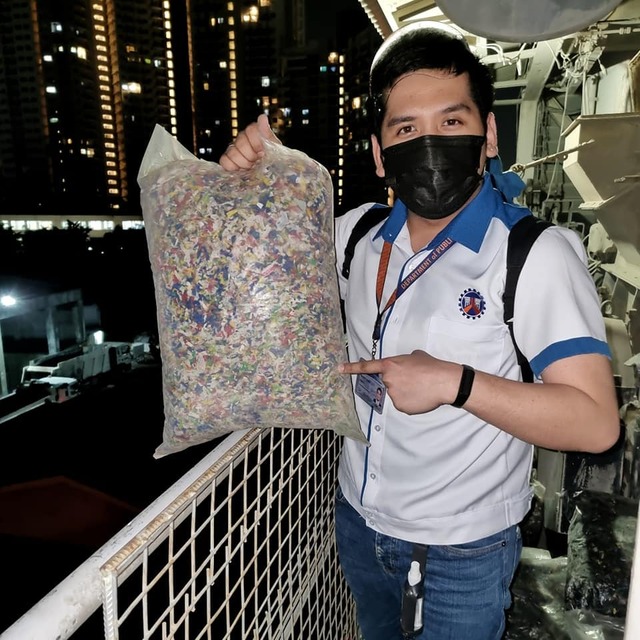
Campit had spearheaded the research since 2018 after coming back from taking his Masters of Environment and Sustainability at Australia's Monash University. As part of his scholarship program, Australia Awards, he was required implement a Re-Entry Action Plan (REAP). "It is a unique program of the Philippines that contributes to the development of the scholar’s target beneficiaries by applying the acquired skills from Australia. The REAP also serves as the scholar’s legacy as an instrument of change in their community," Campit explained.
As he shares with us, he had come back to work at the bureau after his masters and noticed the piles of plastic wastes submitted to them by Pilotage Trading Inc. as their office is in charge of studying alternative materials. "I saw the potential of this material," said Campit. He had seen videos of roads being constructed in India using plastic waste during his time studying in Australia, and knew he could use his REAP to do the same for the Philippines.
What followed was years of research and trial. "I did intensive research on plastic wastes as construction materials in road construction. Also, I applied what I learned in Australia since I understand the issue of sustainability re: the increasing number of plastic wastes, and how we need to look for possible solutions," said Campit.
What are plastic roads?
Campit's REAP is officially entitled Study on the Use of Low-Density Polyethylene (LDPE) Waste (Plastic Bags) as an Additive or Modifier in Hot Mix Asphalt, or in easier English, a study on how we can properly use plastic wastes in road construction. The study passed laboratory tests in 2019, which meant the next step was to bring it out in the real world and see how it holds up. Campit and team were able to test it in two separate instances.

Also read: Almost a Ton of Recycled Plastic Was Used to Pave a Portion of Quirino Avenue
The first small-scale trial was in January 2020. They paved a total length of 149 meters across four southbound lanes of Taft Avenue in Ermita with hot mix asphalt that contained the plastic bag waste as an additive. Then in 2021, they paved a total of 162 meters along President Quirino Avenue in Paco, Manila. The big factor here is that for the Taft Avenue one, they were able to use 750 kilograms of plastic waste, while in Quirino, they were able to use 850 kilograms. That's more than 1.5 tons of plastic waste used up.
"For one metric ton of asphalt mix, 3.8 kg of plastic bag waste is recommended," explained Campit.
When can we see the plastic roads?
Apart from the two pilot tests, the DPWH is yet to apply the process elsewhere, but has certainly laid the foundations to allow others to do so. "To date, the Department has not set any timeline or instructions to make it mandatory in DPWH projects," said Campit. "Nevertheless, the standard specification is already available to use plastic bag waste as an additive in hot mix asphalt and can now be fully adopted not only at the national level but also at the provincial, municipal, and local levels when constructing sustainable pavements."
This is project is a collaboration led by the DPWH-BRS and the South Manila District Engineering Office (Implementing Office), Readycon Trading and Construction Corporation (Contractor) and the Pilotage Trading and Construction Inc. (Supplier of plastic bag wastes).