

EDSA Congestion Fees Are Under Consideration, But Will It Happen?
Don't panic just yet.
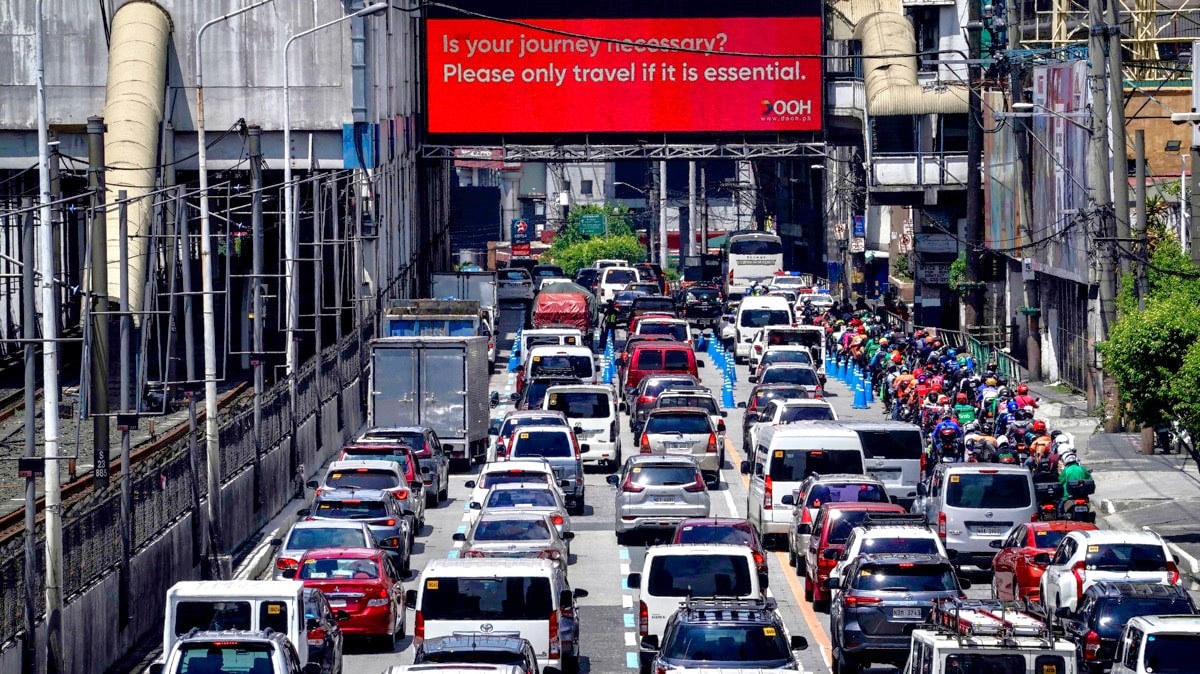
(SPOT.ph) You’ve probably heard the news: government agencies are considering a congestion fee for motorists using EDSA during peak hours to lessen traffic on the road. Before you shake your fists in the air in protest, ask first: how likely is this to happen anyway? Let’s check in with what the authorities have to say.
The proposal was first made known to the public by Department of Interior and Local Government (DILG) Secretary Jonvic Remulla during a Teleradyo Serbisyo interview on February 5. He believes that charging a congestion fee will encourage motorists to use public transportation.
“There will be a metering system within Metro Manila to encourage the public to use public transportation,” Remulla said. “So [driving along EDSA] becomes a privilege, not a right. The road will become anti-cars.”
MMDA Chairman Don Artes would later explain in a press briefing that the system would function like a toll—like Singapore’s congestion pricing model in the city.
“Pag pumasok ka, i-chacharge ka,” Artes said.
The Metropolitan Manila Development Authority’s (MMDA) latest figures reveals that over 470,000 cars pass this road every day, which is almost twice its intended capacity of 250,000. A bulk of that number use EDSA during the peak hours of 6 a.m. to 9 a.m. and 4 p.m. to 9 p.m.
Also read: MMDA Floats Idea of Removing Bus Lane to Ease Traffic on EDSA
Will this happen anytime soon?
The proposal was discussed during a meeting with President Ferdinand "Bongbong" Marcos Jr. on February 3, which focused on the Comprehensive Traffic Management Plan for Metro Manila and its neighboring provinces.
However, Artes said it will only be truly considered once reliable public transportation alternatives are in place. This is because without adequate options for commuters, charging a fee could unfairly penalize those who have no alternative but to use private vehicles.
“Kung ma-chacharge ka tapos wala naman option ang ating kababayan na gumamit ng public transport, parang hindi pa timely na magimplement ng ganoon. Ang ating pangulo ang mismo nagsabi na puwede lamang ‘yan kung may alternatibo na.”
The MMDA is also looking to study Baguio City’s attempts at a similar system. In 2022, the city proposed a P50 congestion fee for charging entering tourists with cars, but it was never put into effect. Another attempt for a P250 congestion fee was made in 2024, the plan put forward by the Metro Pacific Tollways Corporation (MPTC) under a Public-Private Partnership scheme.
When asked if EDSA’s congestion fee will be implemented any time soon, Artes said, “Hindi pa siguro. It’s just a suggestion that we discussed. Anything na makakatulong ng pagpapaluwag ng traffic ay kinokonsider.” Another controversial proposal that was brought up in the meeting with Marcos was the removal of the EDSA Bus Lane, which also faced strong opposition from the public.
Remulla stressed that there are more pressing matters for now: “But the first order of the day is that public transportation should be efficient, reliable, and comfortable. That will be prioritized.”
So there you have it. It seems like there’s no need to panic for now—our trains are still packed, buses are inconsistent, and jeepneys are stuck in traffic. Until that changes, don’t sweat the congestion fee just yet.
Also read: Baguio City Eyes P250 Congestion Fee for Entering Cars
Alternatives to EDSA congestion fee
The plan has also met resistance from several lawmakers, who argue that penalizing motorists without solving the root causes of congestion will only add financial strain.
Senator Joel Villanueva has proposed a possible alternative: fully enforcing Republic Act 11165 or the Work-from-Home Law to reduce the number of vehicles on EDSA. Doing so would significantly reduce the volume of vehicles on EDSA without imposing additional costs on motorists.
"Instead of penalizing motorists with congestion fees, why not maximize the potential of the Work-from-Home Law? It not only reduces traffic but also promotes work-life balance and productivity," Villanueva said in a press release.
"The solution is not to make driving a privilege for the few who can afford additional costs. The real solutions lie in significant improvements in the public transport system and reducing the need to travel in the first place. RA 11165 was designed precisely to address the latter.”
Senator Grace Poe echoed the same sentiments.
"Public consultation is essential. Without real traffic solutions in place, congestion fees will only worsen the hardships of motorists who are already dealing with traffic, high fuel prices, and inflation," Poe said.