

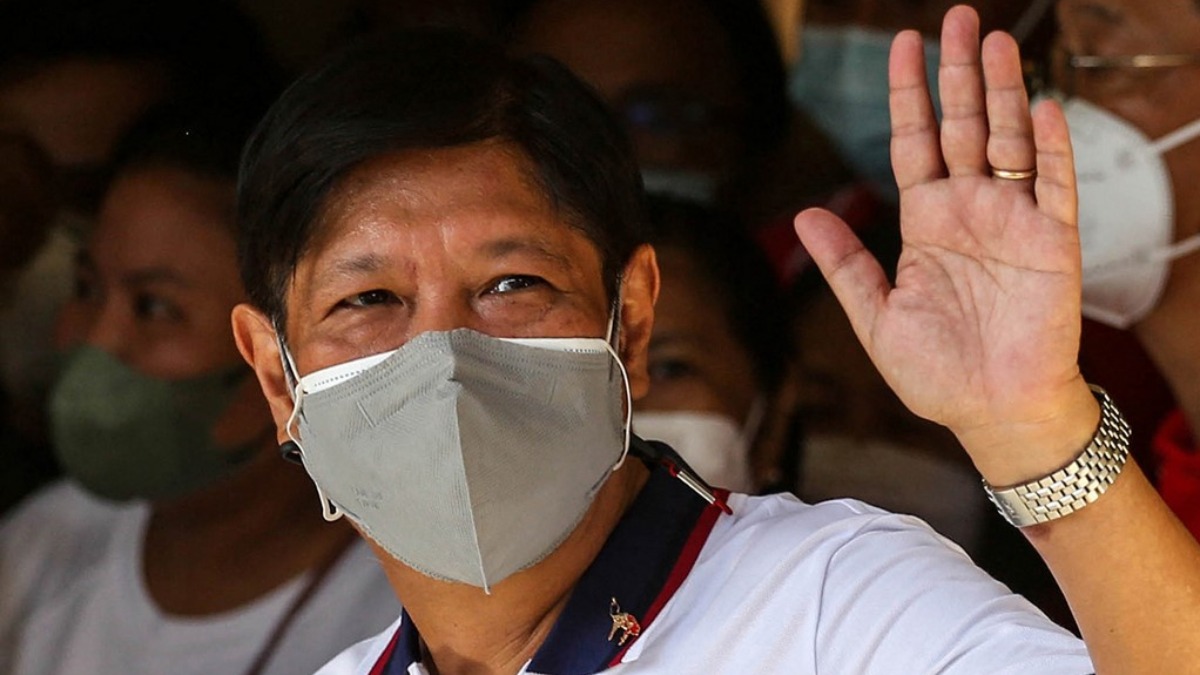
Former Sen. Bongbong Marcos has solidified his family's hold over the so-called "Solid North" as he dominated the presidential race in the Ilocos Region, Cagayan Valley and Cordillera in the May 9 elections, data showed.
Marcos' running mate, Davao City Mayor Sara Duterte-Carpio, also led the vice presidential race in all regions in Mindanao, strengthening her family's political base in the so-called "Solid South".
Partial and unofficial data sourced from GMA News' Eleksyon 2022 microsite as of 8:47 a.m. on Wednesday, May 11 showed that Marcos received 85% of the total votes cast for the presidential elections in Regions I, II, and CAR, accounting for 4.9 million votes.
Marcos archrival Vice President Leni Robredo got 10% of the total votes cast in the three regions, equivalent to over 585,000 votes.
READ: By the Numbers: Bongbong Marcos Heads to Landslide Win
Presidential race
Marcos' biggest win against Robredo in the "Solid North" regions came from Region II or Cagayan Valley, where he received 86% or 1.6 million of the total votes cast compared to the vice president's 9% vote share, accounting for over 167,000 votes only.
This was closely followed by Region I, Marcos' home region, where he got 85% or 2.5 million of the total votes cast against Robredo's 11% vote share or around 329,000 votes.
The son of the late dictator also benefited from the Dutertes' hold over Mindanao, garnering 54% of the total votes cast in the island, equivalent to 8 million votes. Robredo, on the other hand, got only 11% of the votes from the area with 1.6 million votes.
Robredo dominated the presidential race in Bicol Region, her home region, with 76% or 2.45 million of the total votes cast, against Marcos' 18% vote share or over 566,000 votes. She also led the Western Visayas vote with 48% or 1.9 million of the total votes cast, but only slightly higher than Marcos with 37% or 1.51 million votes in the region.
Marcos led in all other regions in the country, the biggest of which is in Calabarzon or Region IV-A with 3.97 million votes, followed by Region III or Central Luzon with 3.94 million votes, and National Capital Region with 3.26 million votes.
Vice presidential race
For the vice presidential race, Duterte-Carpio also won in her running mate Marcos' turf, receiving 75% or 4.2 million of the total votes cast in Regions I, II, and CAR. Sen. Francis Pangilinan, currently the second placer, only got 7% or over 418,000 of the total votes cast in the same area.
Duterte-Carpio won big in Mindanao, receiving 85% or 9.75 million of the total votes cast for the vice presidential race in the region, compared to Pangilinan with 6% or over 687,000 votes.
The daughter of President Rodrigo Duterte drew a landslide victory in Davao Region, her home region, garnering 92% or 2.25 million of the votes cast in that area.
Like Robredo, Pangilinan also led the vice presidential race in the Bicol Region, garnering 56% or 1.7 million of the total votes cast against Duterte-Carpio's 22% vote share, equivalent to around 669,000 votes.
Pangilinan lost to Duterte-Carpio in Western Visayas Region who got 39% or 1.5 million of the total votes in the region against the senator's 36% vote share or 1.4 million votes.
Duterte-Carpio led in all other regions in the country, the biggest of which is in Calabarzon where he got over 3.6 million votes, followed by Region III with 3.2 million votes and NCR with 3.1 million votes.
Why solid north, solid south?
Regionalism is a long-running theme in Philippine elections, where voters tend to vote for candidates that hail from the regions where they reside.
"The reality is that Filipinos vote based on personalities. They may say that they vote based on credentials but the results show that many still vote based on personalities and affiliation," University of Sto. Tomas political science professor Ronald Castillo told reportr in an earlier interview.
"There are really voters who vote for a certain candidate because they come from the same province," he added.
University of the Philippines political science professor Ma. Ela Atienza also said credentials sometimes only come second to personalities, which is why some candidates with reputations still win.
"Regionalism may be an indicator of the parochialism or personalistic character of Philippine politics where political parties and party programs are weak and secondary to personalities of candidates," Atienza said.
Marcos continues to lead the presidential race as he heads for a landslide victory along with Duterte-Carpio, both of them garnering over 31 million votes so far. --- with reports from Arianne Merez
ALSO READ:
Will Solid North Vote with Solid South? Bongbong and Sara Test Marcos Playbook
How Big is Bongbong Marcos' Win With 30 Million Votes?
Marcos Supporters Celebrate Outside His Campaign Headquarters