

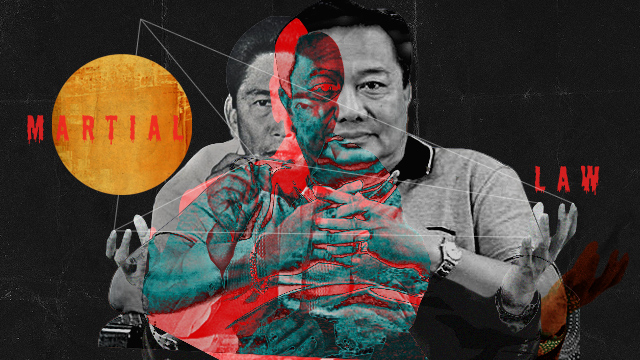
(SPOT.ph) It is quite amusing to watch members of the legislature fall over themselves in the effort to approve the proposal of the administration to extend the declaration of Martial Law in Mindanao. All sorts of reasons have been given by all sides both pro and anti as to this administration initiative. Legal reasons, business reasons, human rights reasons, you name it, it has frequently been given.
Whatever is said by proponents and critics of Martial Law, the basic premise of a declaration of such is that of a failure of civilian governance. In other words, the military is brought in to stabilize a situation wherein civilian agencies including the police play second fiddle. The implementation of said declaration may be in its classic repressive manner as what Ferdinand Marcos had done in 1972, or watered down as Rodrigo Duterte’s in 2017. Still, there will always be an effect on the military especially if it is prolonged in nature. The effect will be on the Armed Forces of the Philippines’ appreciation of the Constitutional declaration of civilian supremacy over the military.
One must understand that what drives the instability in Mindanao is conflict.
The military has been immersed in this situation for the most part of the country’s existence as a sovereign nation. From the 1950s Huk and Kamlon rebellions, the 1970s Moro uprising, the 49-year-old CPP NPA insurgency, the MILF campaigns, and this wave of terrorist organizations that sprouted up like mushrooms throughout Mindanao since the 1990s, of which the latest is the Maute. In this long immersion into counterinsurgency, the military has always believed one thing. In the matter of successfully concluding operations, the one thing that hampers them from doing so
The view among a number of military men of politicians is very unflattering, to say the least. The following are the prevailing perceptions:
Politicians have their uses: For a number of military men, politicians are useful in the sense that they can help in the advancement of careers. As positions in the service are not enough to cover each and everybody’s ambitions for promotion, that extra nudge from a politician may serve to create good career advancement. That is seen a lot in selection processes for top positions in the military. It also ends up putting them in the clutches of their political patron.
Politicians cause problems: As had been said, the conflicts are generated by locally occurring social justice issues borne out of feudal political power relations. Hence in many instances, local political entities are seen as creating the very instability that the military is brought in to deal with. A strange relationship is created wherein the military becomes the guarantor of local political feudal interests so it can pursue its mission of containing rebels and lawlessness. A relationship that because of its contradiction, causes so much friction between local politicians and military personnel not unless the latter become willing participants in the system.
Politicians insult them: During congressional hearings in aid of legislation, it had previously been a common occurrence for military officers to be harangued by members of the legislature. That created irritation among many members of the military and in fact was something Duterte capitalized on when he assured officers that under his administration the military would be spared of that. Thus, in the eyes of a military officer, it is bad enough that to advance their careers there has to be a certain level of kowtowing to politicians. It is bad enough also that many local politicians are the cause of many instability problems that the military has to contain or quell, which is also aggravated by insulting behavior from politicians themselves.
Since the military has been called upon to implement a one-year extension of Martial Law in Mindanao, the following is the context that they will be undertaking this mandate.
Conflict
There exists a very serious conflict situation in Mindanao. Will political decisions from Malacañang
Cycle of Violence
Martial Law gives the military additional powers to quell rebellion but gives them a one-year deadline. In other words, military frustration against incorrigible local political interests may lead to pressure for an aggressive implementation of Martial Law with broader powers for the AFP.
Weakened and Compromised Civilian Institutions
Ever since the Duterte administration embarked on policies and actions that have been seen as weakening or compromising institutions such as the Supreme Court, Congress, the police, et cetera, it has enabled the military to be seen by many as the sole institution of stability. The recently concluded Battle of Marawi gave additional positive exposure to the military which was also greatly aided by an excellent information operations program directed by media-savvy officers and spokesmen. The military it seems is beginning to flex its muscles with that stature it now has. It appears to be a bit more aggressive in some of its statements. One must remember that the military is still recuperating following the Marawi battle
Which is why it really is amusing to watch legislators a.k.a. politicians fall over themselves in efforts to support Martial Law extensions. It is like watching them sign their own termination with gleeful abandon. So what should be done as a solution?
Thus, this may be said as a gentle reminder to many politicians who support Martial Law, ”Be careful what you wish for.”