

(SPOT.ph) The Philippines has been engaged in trade from as early as the second century—first with the Chinese and then, of course, the Manila Galleon. From 1565 to 1815, Spanish trading ships traveled across the Pacific Ocean from the Philippines to Mexico. The galleons would make one to two voyages a year while carrying mostly Chinese goods.
During these voyages, the crew navigated through pirate-infested waters—not to mention tropical storms and slack winds. Despite all of that, the biggest challenge in sailing

One of the oldest working lighthouses, Faro de Punta de Malabrigo or Malabrigo Lighthouse, was completed and lit in 1896. Located in Lobo, Batangas, atop a natural hill above submerged reefs, it serves as a guide for ships going to Batangas Bay or
Malabrigo Point was notoriously dangerous for sailors, fishermen, and ship pilots for its rocky coastline, hence its name which means "bad shelter" in Spanish. Plans for the lighthouse were drawn up by engineer Guillermo Brockman, and it was built under the supervision of a Chinese contractor by the name of Jose Garcia. The lighthouse took about five years to finish only because the site was inaccessible and equipment such as timber, bricks, and other materials had to be transported over long distances.

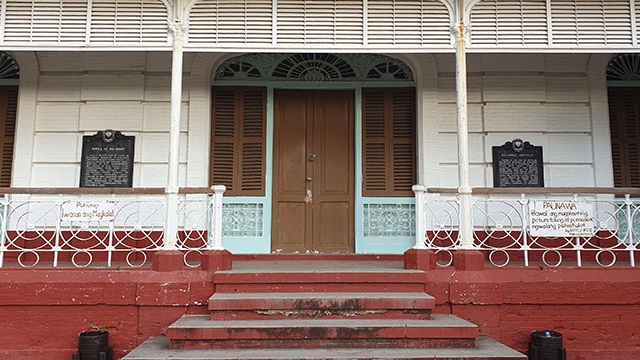
Its design is noticeably inspired by Victorian architecture—a cast iron stairway acts as a fireproof and durable way to ensure the structure's sturdiness. A machine room and a keeper's quarters (which can accommodate up to two families) were built along with the lighthouse.
Through the years, it suffered quite a bit of damage. During World War II, the lighthouse itself was damaged after American forces shot at it. Soon after that, the antique hardwood floors in the keeper's quarters were ripped open by treasure hunters after they received a tip that the fabled Yamashita gold was buried beneath. In more recent times, a film crew caused minor damage after shooting with no authorization. To prevent further damage, the Mayor's Office now requires a permit before filming in the lighthouse.
During the '80s, the lighthouse was made automated through a donation by the Japan International Cooperation Agency. Its light has since been replaced with a bulb that runs on solar power and uses bright halogen lamps.

It wasn't until 2004 when Captain James Marsh Thomson, PCGA, came into the picture that the orphaned lighthouse found hope. Thomson and his family signed an agreement with the Philippine Coast Guard to adopt the lighthouse as official custodians. His daughter, Olympic swimmer Akiko Thomson Guevara, formed the Friends of Malabrigo group to restore, develop, and preserve the historical landmark.

In 2006, the National Historical Commission of the Philippines designated the site as a National
Malabrigo Lighthouse
Known as the Faro de Punta de Malabrigo, designed by Guillermo Brockman as a cylindrical brick tower with metal staircase, adjacent pavilion
and machine room, 1891. Built by the Chinese contractor Jose Garcia, 1896. An outstanding work of architecture from the Spanish colonial period. It has served as a beacon to sea vessels at the Verde Island Passage. Declared as a NationalHistorical Landmark, 27 November 2006.
The municipality of Lobo also signed an agreement to adopt the lighthouse in 2014. Faro de Punta Malabrigo was renovated and repainted, becoming the