
Bicol Might Be Home to a Critically Endangered Species of Dolphins
These dolphins have been hiding in plain sight all this time.
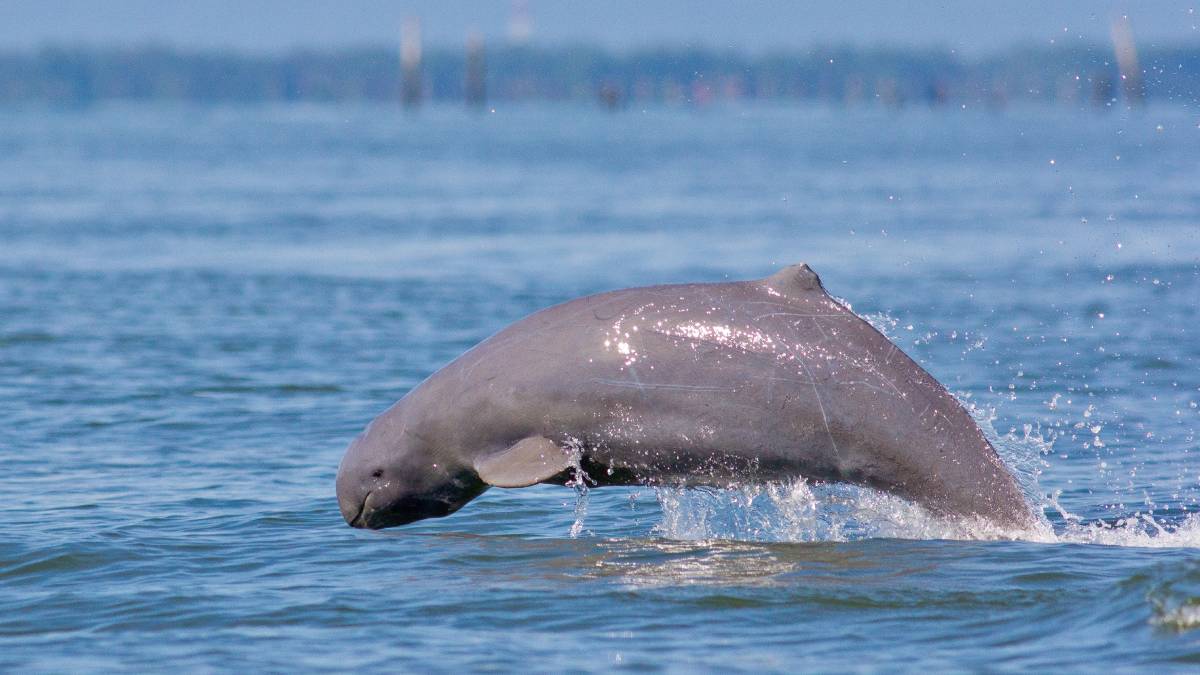
Scientists from the University of the Philippines Diliman College of Science are hot on the trail of a subpopulation of rare and endangered dolphins in the San Miguel Bay area in Bicol. Key Informant Interviews with local fisherfolk indicate that the dolphins may have been thriving there for decades, even while so far eluding capture and official documentation.
Previous sightings of Irrawaddy dolphins in the Philippines
On August 16, an Irrawaddy dolphin Orcaella brevirostris was found accidentally entangled and drowned in a fisherman's net in San Miguel Bay off Calabanga, Camarines Sur. This was the first time that this species—considered critically endangered by the Philippine Department of Environment and Natural Resources—had been found in the Eastern part (Pacific side) of the country.
Apart from other Irrawaddy dolphin populations scattered in South and Southeast Asia, all previous sightings in the Philippines were exclusively in the Western part of the archipelago: in Malampaya Sound, Palawan, and the Iloilo-Guimaras-Negros Occidental area.
The discovery prompted Dr. Lemnuel Aragones, a professor at the UPD-CS Institute of Environmental Science and Meteorology (IESM) and president of the Philippine Marine Mammals Stranding Network (PMMSN), to organize a reconnaissance trip in the hopes of finding more of these dolphins in the area.
Careful interviews reveal telltale clues
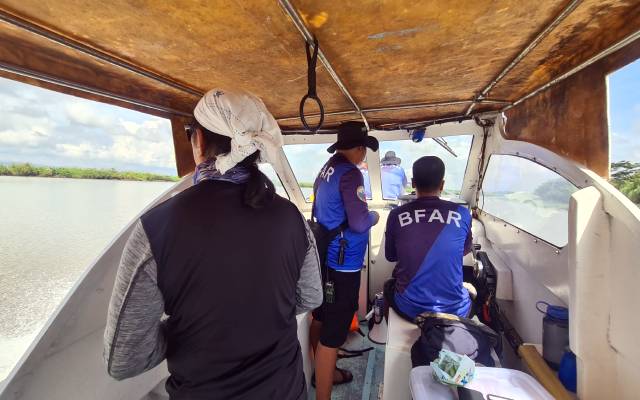
From October 21 to 24, a joint team of researchers from the IESM and BFAR Regional Office 5 conducted opportunistic boat surveys and key informant interviews with local fisherfolk in areas surrounding the location of the initial Irrawaddy dolphin sighting and beyond (see map below).
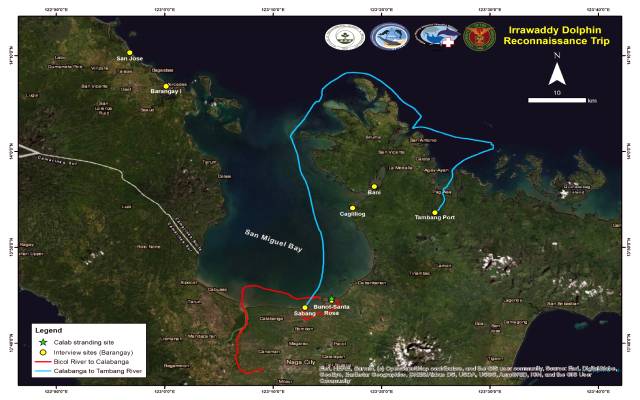
The team carefully crafted open-ended questions for the interviewees, allowing the latter to describe the features of the dolphins they saw or still see in their areas. The responses helped the researchers validate the species of the creatures in these sightings. In addition, some informants noted telltale features that point to these being Irrawaddy dolphins—such as their small size (2-2.5 meters long), the absence of a beak, and a small rounded dorsal fin. Afterward, the interviewees were shown pictures of Irrawaddy dolphins to confirm the actual appearance of the creatures they had seen. As an added step, the researchers also prudently documented the interviewees' fishing grounds, gear, and catch.
A thriving subpopulation
Based on some local key informants' long-term recollections, it seems that a subpopulation of Irrawaddy dolphins may be thriving in San Miguel Bay and seasonally visiting specific areas for several decades now.
"Some preliminary but important information derived from this recon trip includes the possible seasonal movement of the dolphins in response to prey abundance, and some localities have confirmed sighting these animals in their areas," Aragones said.
"Our key informant interviewees provided preliminary information which showed that these animals may have been in the area since the 1960s and are usually sighted in small groups of three to seven individuals. There's even an exceptional sighting in 2021 of a group of over ten dolphins by a key informant from Tinambac, Camarines Sur," he added.
Also, Aragones said, "the locals just referred to them as dolphins, and this might have been why they all thought that they were just the usual ordinary ones often sighted offshore."
Moreover, careful measurements of the temperature, salinity, and depth of the waters surrounding Tinambac point to an environment conducive to attracting Irrawaddy dolphins.
"The combination of the shallow depth of the Bay, nearby islands, isolated embayment, the wide range of available possible prey items such as small fish and crustaceans, and the wide range of salinities in San Miguel Bay are some of the features that enable the Irrawaddy dolphins to thrive in this area," Aragones explained.
The reconnaissance trip was part of the IESM's Assessment and Mobilization of Research Initiatives on Philippine Marine Mammals (PHLMarMams) Project funded by the Department of Science and Technology - Philippine Council for Agriculture, Aquatic and Natural Resources Research and Development (DOST-PCAARRD).
A full-blown survey to quantify the relative abundance and range of distribution of Irrawaddy dolphins in San Miguel Bay and adjacent areas is scheduled for early 2023.