
Why Did Senator Robin Padilla Raise His Index Finger During Lupang Hinirang?
It's a show of Islamic faith, he said.
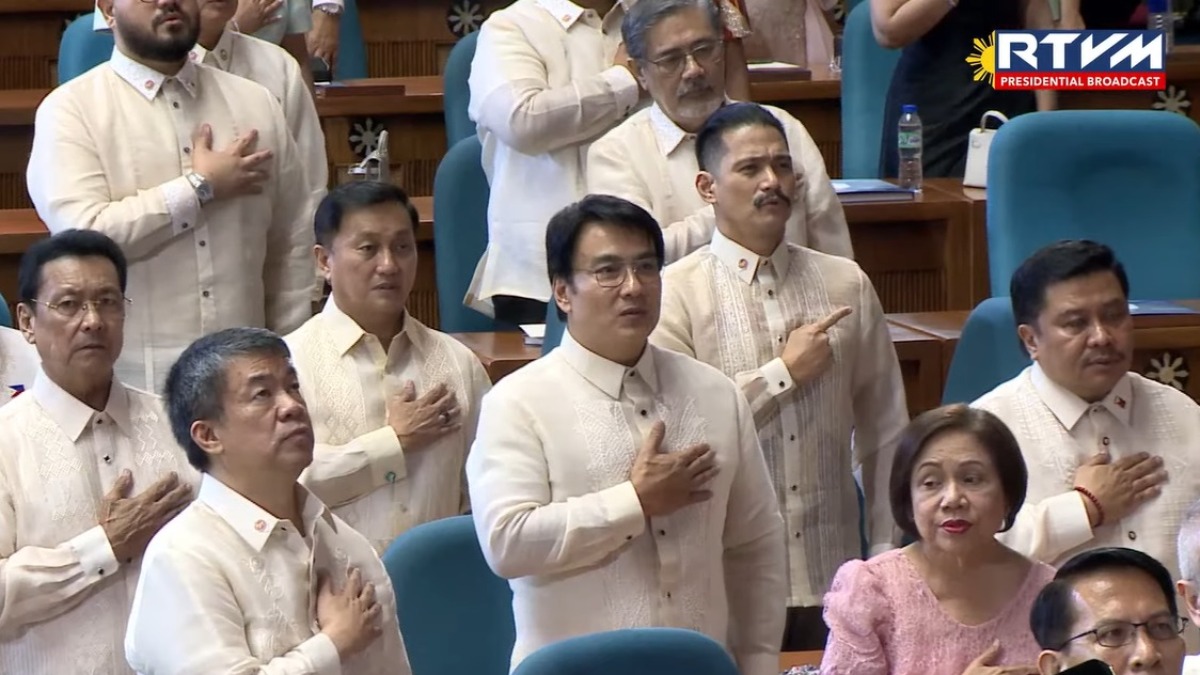
(SPOT.ph) Senator Robin Padilla was seen with his right fist clenched and his index finger raised while singing the Lupang Hinirang during President Ferdinand "Bongbong" Marcos' second State of the Nation Address (SONA) on Monday, igniting conversations on the viral hand gesture's significance to the Muslim community and whether he broke the law by doing so.
Padilla, who converted to Islam in the 90s while he served his sentence for illegal possession of firearms at the New Bilibid Prison, said it was a "show of Islamic faith" when he did the "Kalima La ilaha ilalah" hand gesture.
"I always do the 'Kalima La ilaha ilalah' with my hand here. Why can't you do that? I would rather resign than somebody telling me I cannot (practice) my faith," he said during a meeting with Malaysian visitors on Wednesday.
"I will never, never exchange my faith to be a politician," he said, adding that he is willing to step down as senator before someone bars him from practicing his beliefs.
"If I will not be successful in pushing for a federal parliamentary form of government I'd rather be an imam, I'd rather go to Malaysia and study the Koran than be a senator."
Also read:
Robin Padilla is Number One Senator, Here's Why the Topnotcher Matters
It's Sen. Robinhood Padilla: Actor to Use Real Name as Lawmaker
What Robin Padilla's hand gesture means

First, let's break down what "Kalima La ilaha ilalah" means.
There are six Kalimas—or a declaration of allegiance to Allah—and the first is Tayyab, which means purity. It teaches Muslims about Tawheed or the "oneness, uniqueness of Allah", according to the Sahih al-Bukhari, a collection of the sayings and deeds of Prophet Muhammad.
In English, the Tayyab means this: “There is none worthy of worship except God (Allah) and Muhammad is the messenger of God.”
Raising an index finger is a signal of tahqiq (verification) of Allah's oneness, according to this mufti, a Muslim legal expert.
What the Flag and Heraldic Code of the Philippines says
Reacting to Padilla's viral SONA moment, former senator Panfilo Lacson cited Republic Act No. 8491 or the Flag and Heraldic Code of the Philippines to point out that the Philippine flag, anthem, and other national symbols require "reverence and respect at all times."
"Sorry, RA 8491 has nothing to do with choosing between faith and politics," Lacson said in a July 27 tweet.

This is what the law says (specifically, Section 38) should happen when the National Anthem is played at a public gathering:
"As a sign of respect, all persons shall stand at attention and face the Philippine flag, if there is one displayed, and if there is none, they shall face the band or the conductor. At the first note, all persons shall execute a salute by placing their right palms over their left chests."
Plus what Robin Padilla has to say next
Padilla addressed Lacson's tweet on Thursday through a public Facebook post.
"Wala po tayong issue, Ginoong Senador Panfilo Lacson," Padilla said as he cited the same law, the Flag and Heraldic Code of the Philippines, in defending his case.
"Ang aking pahayag patungkol sa pagbibitiw sa tungkulin ay walang kinalaman sa Batas Republika 8491 dahil ang batas na 'yan ang nagbibigay pahintulot sa akin na malayang gawin ang 'kalimah la ilaha ilalah'," Padilla said.
Citing Section 38, he said: "Wala po sinabi sa seksyon na ito na bukas na palad, saradong palad o nakaturong palad."
"Laws must be clear, precise, and uniform for all citizens. Ang mga batas ay dapat na malinaw, tumpak, at pare-pareho para sa lahat ng mamamayan."