

Arroceros Forest Park Records Cooler Temps Than Manila
A whole five-degrees difference.

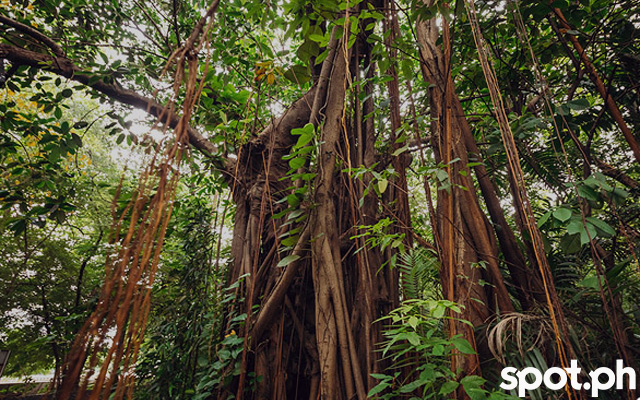
(SPOT.ph) The Arroceros Forest Park is dubbed "Manila's last lung" for a reason. It is the city's only prevailing nature park, home to about 3,000 trees and 8,000 ornamental plants, including 20 to 30 local and migratory bird species. It was also recorded to be 5°C cooler than the rest of Manila this week. With how scorching hot the temperature have been lately, maybe it's time we give attention back to this stronghold of greenery.
Also read: SPOT.ph Roundup: Metro Manila Malls With Open Spaces You Can Unwind In
Manila's "last lung" offers relief amidst scorching heat
The park recorded a temperature of 36°C on Tuesday, April 23, according to News5. While the city's temperature was a blistering 41°C, which already falls under "Extreme Caution" in PAGASA's heat index, it remained relatively cooler in the Metro's last lung thanks to the park's dense canopy providing ample shade.
Regular maintenance of the park will ensure that it remains a vital green space for visitors and its neighboring areas. The park serves as an excellent venue for environmental education, recreational activities, and community engagement for sustainability.
It is open to the public daily from 8 a.m. to 5 p.m. and admission is free.
Since its re-opening in 2022, the park has been adorned with elevated paths, a jogging lane, a trail bridge, water fountains, and a koi pond. It also has meditation and play areas, and even a coffee shop, in line with the city's goal to provide green spaces for Metro folks to destress.
We may know Manila for its buildings, monuments, or throngs of people, but never ponder the role played by the trees or lush greenery that makes it hospitable and cooler. So, let's take the time to appreciate and look into the sole forest park that brings fresh air to the crowded city.
Also read: Free Tree Tour of Arroceros Forest Park
Arroceros Forest Park's History
The Arroceros urban park was only developed into a forest park in 1993, so its flora and fauna are quite young. What used to lie on its site was traced by historians to be an ancient settlement called Parian. This settlement gave birth to Manila's bustling commercial center in the 16th and 17th centuries.
For some brief history lesson: there were three Parians. The first one was located where Arroceros Urban Forest Park is today, called Parian de Arroceros, which was a settlement outside Intramuros where Chinese vendors sold rice—or arroz, hence the name. The second was in what is now Liwasang Bonifacio. Finally, the third Parian is now Binondo, where the first Chinatown emerged.
In the late 1500s, the Chinese were forced to pay excessive fees and unpaid labor for the Spanish colonial government following the deterioration of Spanish-Chinese relations. Despite the high taxes, the Chinese made a flourishing commercial center in Parian that came to be the Lawton area in Manila.
Now, the urban forest, situated on the south bank of the Pasig River near the Quezon bridge, brings fresh air to the Lawton area, which sees heavy traffic on a daily.
Threats to the Arroceros Park
It was in 1993 when civic group Winner Foundation achieved a significant accomplishment in their environmental advocacy by transforming an unused public land in the heart of Manila into an urban forest, the Arroceros Forest Park.
The park covers a 2.2-hectare property in the Ermita district that was purchased by the city government from the Land Bank of the Philippines for P65 million in 1992 during Mayor Alfredo Lim's term.
Winner Foundation was appointed as the caretaker of the park to help Lim's vision of creating a natural haven within the bustling city. Since then, the foundation has been responsible for the planting and nurturing of Arroceros Park's flora. But years later, things went awry as the City Hall came under different administrations, and multimillion-peso "development" plans that went against the original vision surfaced, wherein thousands of trees were cut in the process.
Also read: Arroceros Forest Park Declared "Permanent" by Manila Government
Ten years later, a new threat to the urban park arose, this time during Mayor Joseph Estrada's term, who had planned to build a university gymnasium inside Arroceros Park. This led to the formation of the Save Arroceros Movement, which aimed to protect the park against malicious projects. The group took its campaign online and gathered over 200,000 signatures in a petition opposing Estrada's plan.
Arroceros Park's Rehabilitation
In March 2020, then-Manila mayor Isko Morena Domagoso signed City Ordinance No. 8607, or the Arroceros Forest Park Ordinance, declaring the site a "permanent forest park" and allocating an initial P1 million for its upkeep under a new governing committee. The ordinance singlehandedly ended the long tug-of-war between the area's caretakers and the government, the latter of which through the years has eyed the property for various uses.
However, environment advocates and experts initially expressed concern over the blatant construction and placing of structures under the premise of beautifying the park's aesthetics, citing that Domagoso's move may have a negative impact on the area's biodiversity. The rehabilitation began in 2021, and the redeveloped Arroceros Park opened a year later.
Hey, Spotters! Check us out on Viber to join our Community and subscribe to our Chatbot.