

Surviving a Saltburn Screening Is All the Craze on TikTok—But Is It Really That Shocking?
What's up with the Gen Z reaction to the movie?

Warning: Major spoilers ahead.
(SPOT.ph) What exactly is the big deal about Saltburn—an indie movie that punches way above its weight in popular consciousness that its star Barry Keoghan has now gone two for two when it comes to jokes about his penis in the first two shows of the awards season—and why is it burning up social media?
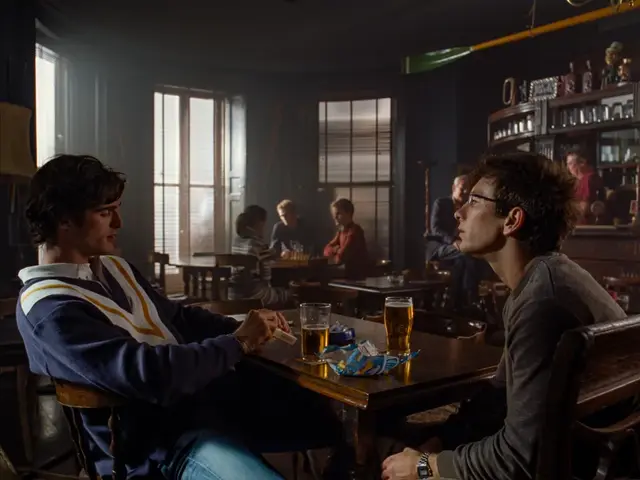
In case you have no idea what Saltburn is—and really, what are you doing reading this commentary if you do—then let me offer a quick synopsis: Saltburn is English writer-director Emerald Fennell’s second film after her polarizing and Oscar-winning debut feature Promising Young Woman. The film follows lonely Oxford nerd Oliver Quick (Banshees of Inisherin’s Barry Keoghan) as he befriends fellow student and spoiled toff Felix Catton (Euphoria’s Jacob Elordi) and gets an invitation to spend the summer at the latter's country estate, whereupon Oliver becomes obsessed with Felix and his well-heeled family.
A Facebook user commented that Saltburn is “a Gen Z retelling of The Talented Mr. Ripley.” I think the key to the film’s outsize imprint on pop cultural consciousness begins with the phrase “a Gen Z retelling.”
Also read: Eternals: The Next Stage in the Evolution of the Marvel Universe
The Gen Z Mr. Ripley: Saltburn
Unlike their put-upon generational predecessors, Millennials, Gen Z are not defined by their limited economic opportunities nor their adversarial relationship with their Baby Boomer grandparents. Gen Z are digital natives, never having lived in a world without the Internet; social media is their vehicle for expressing their politics and preferences.
Gen Z politics are admirably progressive—or at least their First World denizens believe them to be. They are pro-choice, pro-vote and pro-change. (Which is probably why the octogenarian Joe Biden is still on a slippery slope with these young voters.) And according to a TIME article published in May 2023, Gen Z’s ideas of gender are more fluid: “Not only can people be transgender, identifying with a gender different from their sex assigned at birth, but they can identify as neither male nor female (often called nonbinary…) Gen Z speaks a whole language of gender often barely understood by their Gen X and even Millennial parents.”
But there’s an interesting contradiction to Gen Z: While they believe gender to be fluid, they prefer their media diet to be less…flexible. The annual UCLA Teens & Screens report, published last October, found that a majority of adolescents surveyed “want less of sex and trauma seen in shows such as HBO’s Euphoria and The Idol,” according to The Guardian, “and more storylines reflecting ‘lives like their own’, namely more platonic relationships and less of a focus on romance.”
Stars like Scarlett Johansson, Keira Knightley, and Blake Lively were quick to agree, expressing their desires for body doubles, invoking no-nudity clauses in their contracts, or criticizing the prevalence of “the male gaze” in filmed entertainment. Penn Badgley, who plays stalker Joe Goldberg in Netflix’s romantic thriller You, even asked show creator Sera Gamble if he could just opt out of filming intimate scenes: “I don’t think I’ve ever mentioned it publicly, but one of the main things was, like, do I want to put myself back on a career path where I’m just always the romantic lead,” the Gossip Girl alum said in a February 2023 episode of his podcast “Podcrushed”. “Fidelity in a relationship, and especially my marriage, is really important to me.”
Into this curious media environment comes Fennell, a Millennial with an appetite for throwing bombs at the status quo, if her (so far) small filmography is any indication. In Promising Young Woman, she expressed female rage by having Carey Mulligan walk around in arm bracelets and nurses’ uniforms while interrogating and torturing her one-night stands.
In Saltburn, Fennell turns her sights on class warfare, the topic du jour in a world populated by execrable tech bros and erratic billionaires. And as in Promising Young Woman, sex is the weapon of choice. And as in Promising Young Woman, the sex is designed to make you squirm in arousal or in scandal…or both.
[Again, warning: Major spoilers follow for Saltburn. If you haven’t seen the movie on Prime Video, skip the next seven paragraphs.]
The major buzz seems to emanate from a sequence where Oliver spies Felix masturbating in the bathtub, after which the social outcast steals into their shared en suite bathroom, lowers himself into the bathtub...and proceeds to lap up the bathwater as it drains. Self-filmed reactions on TikTok range from turned-down lips (“someone described it as egg drop soup *crying emojis* and that was enough for me,” a user commented) to squealing disbelief to smart alecks worrying about Keoghan contracting rust poisoning.
The most gleeful reactions have come from the gays, who have posted videos of themselves asking viewers for time stamps of sequences involving Elordi that they should “skip,” to memes of Elordi and Keoghan looking into each other’s eyes on the red carpet and celebrating them as the latest homosexual couple of their media-induced fever dreams.
Long shunned by the mainstream, gays have naturally embraced any hint of the unconventional or the alternative in pop culture. Back in the ‘60s, the hints were coded, like a particularly freighted gaze in a Roman bath between Spartacus’s Tony Curtis and Laurence Olivier. Today, with more gay actors living their lives out and proud, social media is salivating over straight Irish actor Paul Mescal wearing the latest in high-waisted, “soft” men’s couture on the promotional tour for his movie All of Us Strangers.
On the other end of the spectrum of Saltburn’s sexual transgressions, there is a sequence showing Oliver stripping naked in the photogenic gray rain of the English countryside and humping the wet soil of Felix’s grave. I remember laughing at that sequence when I first saw it, thinking, The Cattons are supposed to be this rich family and they can’t afford a mausoleum? I guess cold marble would be more difficult to doggy.

But if the previous reactions from Gen Z were grimaces and awkward jokes, the response for this scene was loud objection. “Everyone freaking out over the bathtub scene like that was tame in comparison to the grave scene,” a TikTok user commented. “Why is no one talking about the grave scene!!!” Those who filmed reactions of their friends watching Saltburn garnered exclamations of “I don’t want to watch this!” and “Why did you make me watch this, dude!” One even went so far as to name-drop one of Oscar’s worst best picture winners and, despite the chasm between the two movies’ subject matter, declared Saltburn “worse than Crash.”
But here’s one depressing (albeit non-scientific) statistic I found from observing the social media furor over Saltburn: There’s an equally scandalous sequence in between the bathtub and grave moments that seems to have been lost in the shuffle. In it, Oliver seeks to embed himself deeper into the Catton family by seducing Felix’s dissolute sister Venetia (Alison Oliver) on a bench under the moonlight. How does he do it? By telling her she can afford to eat more…then he proceeds to dip his fingers into her menstrual flow before licking the blood from them like he's just relished the last grains of a pack of Cheetos.
Again, this is all built on dubious statistical ground, but the fact that I couldn’t find many reactions devoted to that one scene alone—at best, it’s only alluded to in connection to the bathtub scene—indicates to me that viewers are still shunting women off to the side. I have a feeling even this transgression is too taboo, literally too dirty to even be acknowledged.
Also read: Call Me By Your Name Is a Sun-Kissed Tale of First Love
What's with the Gen Z reaction to Saltburn?
Back in the pre-pandemic times, when I worked in ABS-CBN as a creative consultant, I took my group of Gen Z brainstormers to watch Call Me by Your Name. Even back in 2017, I wanted to test a hypothesis: Were Gen Z as open-minded as they professed to be?
The result seemed to be a heartwarming yes. I was bracing for boos and groans when the sexual tension between teenage prodigy Elio and graduate student Oliver (another Oliver!) finally came to a boil, but none came. The trainees I were shepherding all cried over and raved about this small, understated queer indie, seemingly oblivious to the problematic man-boy relationship at its center.
It could even be argued that Timothee Chalamet and the since-disgraced Armie Hammer ushered in this current age of “queer baiting,” one form of which has beautiful male—most of them ostensibly straight—actors adopt gay-coded poses to promote their work, whether it’s Tom Holland talking about his early morning workouts with Jake Gyllenhaal while shooting Spider-Man 2: Far From Home, or The Bear’s Jeremy Allen White slouching outside a locker room full of disrobing athletes to push his wrestling movie The Iron Claw, or Andrew Scott and Paul Mescal giggling together in interviews for All of Us Strangers.
Which is why all this Internet pearl-clutching over Saltburn is a bit puzzling to me. Are these supposedly open-minded Gen Z-ers genuinely offended? Or are they secretly thrilled but just acting out norms expected of them by their elders? Because speaking as a Gen X-er who lived through a time when teenagers had to squint through scratchy Betamax tapes just to watch a porno, or secretly applauded when Sharon Stone crossed and uncrossed her legs in Basic Instinct, your elders weren’t exactly saints.
To get to the bottom of this contradiction, I decided social media could not be trusted. So I once again convened a few of my ex-subordinates from ABS-CBN—at least the ones who had seen Saltburn—and asked for their candid thoughts directly.
The consensus among this group was that there was nothing deeply offensive about Saltburn; if there was anything even remotely objectionable, it was that for all the flash of its imagery, the movie wasn’t really saying anything original. But that didn’t mean there wasn’t anything new about Saltburn: What was novel about the movie was the permission it gave audiences to gawk at male nudity and, by extension, contemplate male sexuality.
What’s so fascinating about the film’s buzzy bathtub scene is that it is almost a direct lift of a scene in 1999’s The Talented Mr. Ripley. In that now 25-year-old scene, Matt Damon as the treacherous Tom Ripley is playing chess with Jude Law’s spoiled Dickie Greenleaf while Dickie is submerged in a bath. With studied casualness, Tom complains that he’s cold and, while languidly stroking the water with his left hand, asks if he can get in.
Saltburn is both an extrapolation and, oddly, a retreat from the tension of that earlier scene. Having laid his cards on the table, Tom backpedals…but it is too late. A fissure has appeared in the friendship, which is only deepened when Law rises out of the bathtub and catches Damon looking at a reflection of his backside in a mirror. (In fact, Law shows more skin in that one scene than Elordi does in the whole of Saltburn.)
There is none of that confrontation in Saltburn’s version. What Fennell offers instead is an extreme conclusion to the interrupted fantasy of Tom and Dickie’s bathtub interlude: Oliver simulating the conclusion of oral sex.
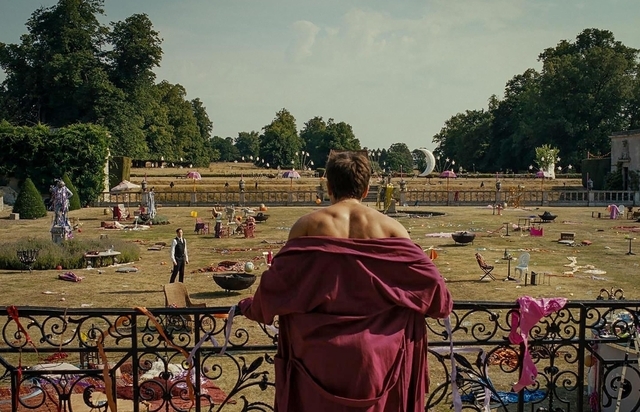
My former hires said that the permission to ogle men’s bodies felt refreshing. In The Talented Mr. Ripley, the camera catches Law rising out of the bathtub from above, so when he turns, we catch a glimpse of shadowy genitalia. But the subtext of the scene is rejection and suspicion. Meanwhile, at the end of Saltburn, we see Keoghan [SPOILER ALERT] dancing with naked abandon through the titular estate, his bits flopping around triumphantly for awards show hosts to make jokes about.
It's the fulfillment of what Chris Pratt said back in 2016 when he was promoting his sci-fi movie Passengers. For the record, Pratt is another of those celebrities who shuns sex scenes. But eight years ago, when he was in the first bloom of his celebrityhood, he had no problems with male nudity: “I think it’s OK, I don’t feel appalled by it,” he told BBC Radio 4’s Front Row. “I think it’s appalling that for a long time only women were objectified. But I think if we really want to advocate for equality, it’s important to even things out.”
Of course, Gen Z isn’t a monolith. Not everybody is expected to react this liberally to the idea of guys dropping trou in front of the camera. Which inevitably led me to another question: Did my sample group perhaps skew too liberal?
What I needed was a Gen Z sampling that was a bit more grounded, a little less schooled in film theory. Which is where my nieces and nephews came in.
Over the Christmas holidays, thanks to them piggybacking on my account, they had been texting me about this “wild” movie I should be streaming on Prime Video. And because no good deed goes unpunished, I sent them reciprocal messages grilling them for what made Saltburn so wild.
TikTok first put the movie on their radar. But the videos were mini-narratives in themselves: people ensconced in their theater seats expecting one thing, mouths agape when they got another; screenshots of Keoghan peeping at Elordi scored to Rockwell’s “Somebody’s Watching Me.” No marketing campaign could be as effective.
A niece of mine admitted not understanding the bathtub scene when she first saw it, needing a friend who was watching with her to explain what Keoghan was doing. At which point her friends squealed a second time in commiseration with her delayed squeal.
The vote was unanimous on the menstrual blood scene: gross. But as the movie went on, my nieces confessed their squeals became less about squeamishness and more about being part of a communal experience. The idea that they could gasp at a death or scream (or, as with my nephews, groan) at the cemetery scene together made the watching even more enjoyable. By the time that final dance sequence set to “Murder on the Dance Floor” came along, Saltburn had even become funny.
It all boils down to the water-cooler conversations that our increasingly fragmented pop culture no longer affords. Gone is the monoculture that allowed us to converge around something as defining as Star Wars or Michael Jackson’s Thriller. Which is why when Gen Z can agree on something in an age of limitless streaming content, it might as well be earth-shaking.
I prefer to think that Gen Z isn’t so much scandalized as acting a role to be part of a larger narrative. Some even assume the role of adopters, as those enterprising peddlers of Jacob Elordi Bath Water-scented candles on Instagram Shopping or ingenious mixologists posting recipes of bathtub-inspired cocktails on YouTube are doing.
As Jodie Foster told The Guardian in her critique of Gen Z actors: “They need to learn how to relax, how to not think about it so much, how to come up with something that’s theirs.”
Saltburn is theirs.