

Art Roundtable: The Critic's Not Dead but The Filipino Artist is In Power Now
As the big ALT show opens this week, we sit down with its movers to talk state of Philippine art and the power of words.

(SPOT.ph) It hasn’t even been a full week since Art Fair Philippines closed its latest edition and already art-watchers and art makers are off to another big fair. ALT, or ALT Fair as some people refer to it, is opening its doors to the greater public Friday with two days of VIP viewing prior. Happening at the SMX Hall A within the Mall of Asia complex in Pasay, it’s nine of the country’s premier galleries showing 250 artists in a space that’s almost 3000-sqm.
But let’s not focus on the numbers. It’s just “one very big group show,” describes gallery owner and fair co-organizer Mawen Ong, speaking to SPOT.ph. The organizing nine galleries— Artinformal, Blanc, Drawing Room, Finale Art File, Galleria Duemila, Underground, Vinyl on Vinyl, West Gallery and Ong’s MO_Space—are quick to distinguish this fair from the others. To hear them say it, this one is more curated, more intimate, and there’s none of that marketplace atmosphere.
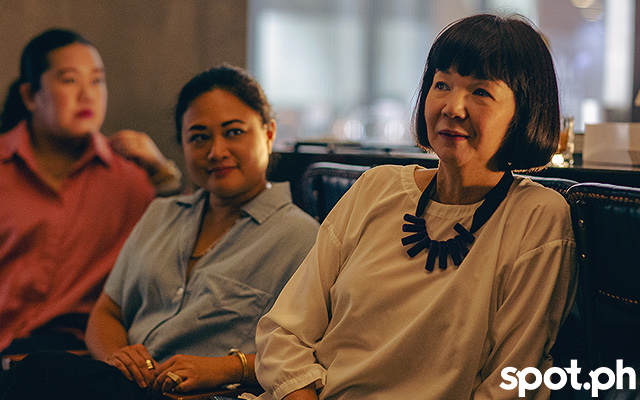
“For me ALT is a representation of a certain niche in the art community. Because the fact that we are just nine and not 90 is already a statement on its own,” continues Ong. “And the fact that these nine galleries have their own narratives and takeoff points, we have our own levels of diversity within the group. So when you see the coming ALT, I’m just going to say I think this will be our best ALT, the best edition. I put my money on it. It took one year of our lives to plan it.”
What we talked about at the art roundtable: the state of Philippine art
Weeks before opening, some of the movers and creators behind ALT sat down with SPOT.ph for a roundtable discussion—not just about ALT but largely about the State of Philippine Art. Big topic, we know. Huge! But, seriously, what went down in our talk is likely far from what you’re imagining. Discussions on “state of the art” in this country almost always move around the topics of money and collectors. But while we touched on those, our panelists—artists Gary Ross Pastrana and Nice Buenaventura, writers Cocoy Lumbao and Steph Frondoso, and gallerists Ong, Tina Fernandez of Artinformal and Jay Amante of Blanc—offered so much more.

Think of this as your glimpse inside the workings of the country’s major art galleries—from how young artists are able to get their foot in the door to what having a “Star Magic handler” can do to an artist’s career, from how much influence gallerists allow themselves to have in their artists’ work to why galleries really do what they do. We also talk about art critics—do they still exist? Lumbao, also a curator and educator, says yes. But do they still wield considerable power? Read on and find out. But here’s what we know wields considerable power: another artist’s approval. “That’s what gets young artists discovered by galleries,” says Buenaventura.
And what of the state of Philippine Art? It’s exciting and robust, says Frondoso. She takes in as much art happenings as she can week in and week out in this city, so we’re taking her word for it. And kind of FOMOing a little. To be at the center of an explosion of creativity and deep thought—that must be exhilarating. We hope the discussion below approaches that kind of feeling.
How artists get discovered in the age of the Internet
SPOT.ph: Let's start from where it begins: How does an artist get discovered? Jay, you're known to frequently show new, impressive talent at Blanc. Where do you find the artists?
Jay Amante: Artists are not really discovered. They’re there, they’re creating art. I think the best way to see new art today is via Instagram, it’s really online. Sometimes I go to shows, for instance in KalawakanSpacetime or Ninuno Gallery, both artist-run spaces, and see beautiful work and I just invite the artists for a show.

SPOT.ph: Is this the same for you Tina? How did you come up with your artist pool?
Tina Fernandez: Artinformal started as a school for art, but the teachers were artists who were experts in their field. Cos Zicarelli was an assistant teacher. Our teachers were John Santos, Pam Yan Santos, Marina Cruz, Maria Taniguchi, Joel Alonday, Pablo Capati. Most of them were practicing artists whom I met thru [the art patron] Dr. Joven Cuanang a long time ago. The school just naturally became a gallery because the students were learning about the process of art-making and therefore understood what they were seeing. I met Cos that time and Tatong Torres and I invited them to show. They referred friends and that’s how I got to meet new artists. Some of them attend shows, I meet them, I take a look at their work. If I find them interesting enough to be part of our art presentations, I invite them to do a show.
Mawen Ong: I basically meet artists thru other artists, thru get-togethers and openings and group shows, talking to artists who curate shows; they make recommendations.
SPOT.ph: There was also a time when people would go to the UP College of Fine Arts thesis shows to discover new artists.
Tina: Personally, I don’t like giving artists who just graduated a solo show, because they are still continuing to discover themselves. So it will be unfair to put them out there and they’re not ready. They may think they’re ready but they’re not. They need to experience working in group shows or working with other artists first, attend exhibitions, study what’s out there and how they can improve, go abroad, take a look at what’s being presented there, challenge themselves and ask themselves: Is what I’m doing the best that I can do?

SPOT.ph: Jay, do you share the same opinion?
Jay: No, I don’t. I like looking at talent at whichever stage in their career they’re in. Sometimes it’s really magical to see a young artist do great things and have his own voice. But I understand where Tina is coming from, that chances are the art might change eventually, but sometimes ready na eh, puwede na isalang eh, and I get excited with things like that.
SPOT.ph: When you can just watch them develop.
Jay: That’s what I enjoy as well. I like working with artists for long periods and I want to see how their works evolve or devolve.
Cocoy: Do you also discover young individuals who voluntarily propose a show to you? Kasi that’s what I tell my students sometimes. ‘If you really want to show your work, you go to a gallery, you send a portfolio. ‘Yun na muna masterin niyo, how to come up with a portfolio interesting enough.
Jay: That’s never happened to me. I tend to like more artists than I can accomodate in Blanc and Bunso, my new gallery. I haven’t received a proposal na natuloy maging show but I’ve received proposals from maybe eight years back tapos natuloy siya six years after. But I look back at some proposals and realize, putcha, bakit di ko na- show ‘to? Sayang pero gano'n talaga.
SPOT.ph: Is there any other way for a young artist to get his foot in the door?
Cocoy: Entering a competiton.
Gary Ross Pastrana: Yes. When we were starting there was Shell, Metrobank, Philip Morris.
SPOT.ph: Those art contests, are they as relevant now?
Gary: Parang hindi na eh.
SPOT.ph: Nice, how did you get started?
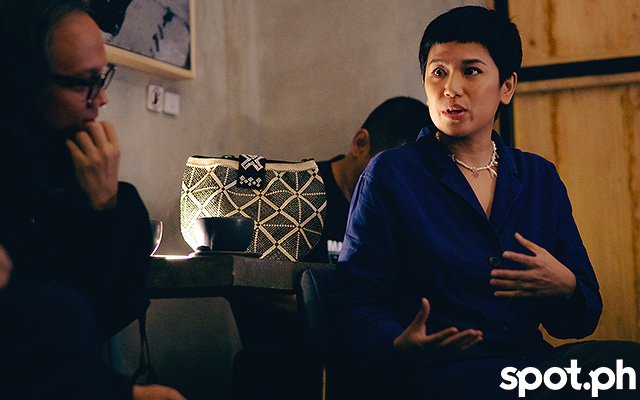
Nice: It’s pretty much the same as what Jay described—thru Instagram. It was [the collector] Dr. Rico Quimbo who reached out first because of some Instagram post I shared of my work. Based on that I think he recommended me to Soler Santos of West Gallery to show with them at Art Fair Philippines. That was my first brush with having an art show.
SPOT.ph: Did you make any other effort apart from posting your work on Instagram?
Nice: The Instagram was my effort in putting myself out there. I also kind of made an effort to—I know not a lot of people are comfortable with the word “networking” but I was going to parties. I used to go a lot to live performances, and incidentally a lot of artists also attend them so I got to meet those artists, and thru meeting them I got a glimpse of what it’s like to be an artist. And for a very long time I wanted to be one, because prior to practicing as an artist full-time I was a designer. So when I found out, Oh, it was possible [to live the artist life], I immediately went all the way.”
Road managers, contracts, and going exclusive
SPOT.ph: You are under the management of Tina’s Artinformal: Is it beneficial for an artist to sign with just one gallery?
Nice: I think it doesn’t make much sense to sign with multiple galleries within one region—it will post a conflict of interest. But I imagine it will be beneficial to get representation across different geographies.
SPOT.ph: Do you agree, Tina?
Tina: Because I handle artists on an exclusive basis, like for example Nice and Cos are signed with me, it gives me the opportunity to support them fully. It’s very hard to support an artist who I know will be showing in several galleries because I invest a lot of my time, energy, money in promoting the artist—so that they are shown in various platforms not just here but also abroad. I agree that an artist should be signed exclusively by a gallery in a particular region. For example, a European gallery meets Nice in Art SG, she can sign with them, but in the Philippines she’s signed with me. It doesn’t mean she can’t show in other galleries, it’s just that I am looking after her career, guiding her.

SPOT.ph: You’re also signed with a single gallery, Gary, which is Silverlens. What are the benefits?
Gary: You have the support of the gallery, the staff. They support you, sometimes financially, like if you have a big project, or you need to travel somewhere. I guess it’s like having a Star Magic (Laughs). Some of my friends, mostly hindi nila kailangan ng representation because they can sell from their studio. It makes more sense that wala na nagka-cut sa kanila because they handle everything. But for me mas kailangan ko ng support sa practice ko, pati sa storage ng work ko.
SPOT.ph: Are there a lot of established artists who choose to be independent? Manuel Ocampo, for example, is he independent?
Tina: Manuel is connected with Drawing Room. I think it’s the same situation with Gary—he needs support, he doesn’t want to think about the business side of things. But the ones who are independent are Nona Garcia, Louie Cordero. They were managed by Jeremy Guiab but Jeremy doesn’t have a gallery so Jeremy is like their impresario. Like a road manager. Other independent artists are Geraldine Javier, Elaine Navas, Yasmin Sison, Mariano Ching, Rodel Tapaya and Marina Cruz.
Gary: I guess once you get to a certain point, you don’t need a gallery to manage you. But if you’re starting at this time, it makes sense to get guidance. The galleries have insights na, a step-by-step to follow. [They can tell you] 'Mag-show ka muna dito, mag-residency ka diyan, mag-apprentice ka dito.' Kasi dati no’ng nagsa-start kami lahat—bago lang naman ang art scene eh, bago lang ang mga gallery—we were still discovering 'yong mga potential problems, benefits. I think ngayon, 10, 15 years later, the galleries already have exposure to Art Basel, Art SG, they’ve seen how galleries work abroad.
SPOT.ph: I guess mas okay nga 'yon so that you’re just focused on creating.
Gary: I think so. And the standards have changed. I remember when I was starting, I was struggling to understand ba’t ang aga naman pagdala ng works [for a show]. Sanay ako when we were younger, on show day itself dadalhin mo yong trabaho, wala ka pang artist statement, bibili ka pa ng pagkain. Ngayon pag nag-show ka sa ibang bansa, alam mo na kailangan mo i-ship yung trabaho mo so di puwede hindi siya tapos. Nata-transfer din yung professionalism sayo.
SPOT.ph: Are galleries allowed to influence, dictate the directions their artists should take in their work?
Tina: I wouldn’t. Even if my business is art, it’s not my business to tell an artist what to do. The reason you work with them is because you admire their thinking process and artistic process. So I don’t interfere.
SPOT.ph: But what if a collector requests for something that, for example, the artist is known for but has stopped doing na?
Tina: I will ask the artist if he or she wants to do it. But usually I’m already one step ahead—I tell the collector ‘The artist has moved on from this but we can ask if they're willing to do a commissioned work for you.’ More often than not the artist can’t do it anymore. They’ve done it na and there’s no point in doing it again. Right, Nice?
Nice: In some cases. Especially the ones that take a long time to make (laughs). Or works that demand work that my wrist can no longer perform. I've never received such an interference. Because I’ve always been with Tina. She’s the exact opposite of that. She lets me do whatever I want to do.
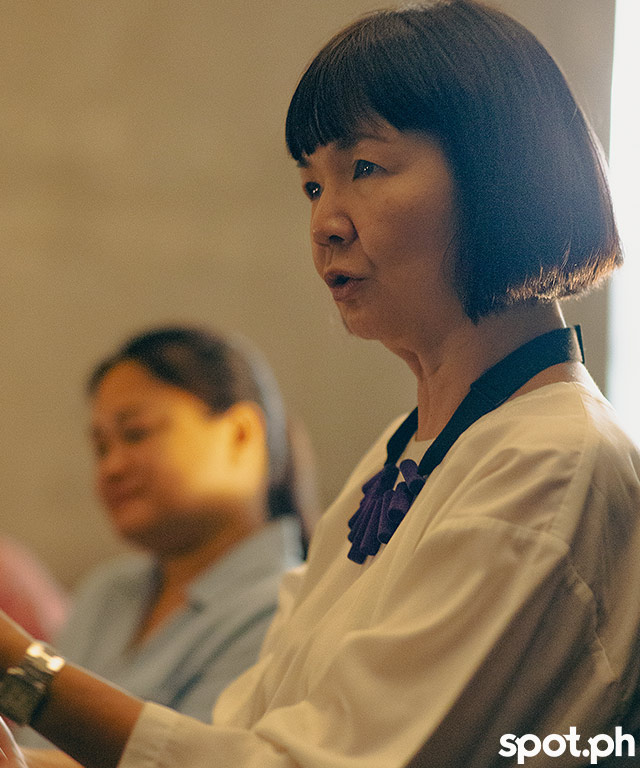
Mawen: There are times when artists want to discuss their ideas and concepts but more like as a friend—so I have to put on an artist hat so they can discuss it, because artists too need sounding boards for their ideas. If you’ve known them for quite a long time, maybe 10-15 years, and you’ve seen their process, we discuss certain ideas worth going back to, giving old works life again. Especially those they had during the time when there was very little audience for art in Cubao, but there were so many great things happening there, in Future Prospects [the art space ran by Pastrana and artist-friends in Cubao X in the 2000s]. I would tell them, 'Maganda yung ginawa mo don ah, baka puwede mo gawin ulit.' [The influence] is more like that. We don't make pakialam. When we have a show in MO_Space, most of the time we don’t know what the artist will make until we read the essay.
SPOT.ph: Speaking of Future Prospects, what was that time like, Gary?
Gary: That time ang main motivation namin was to bridge the gap, kasi nag-close yung Surrounded by Water and Big Sky Mind, both artist-run spaces. Parang may void na kailangan i-fill so nag-decide kami na mag-open ng gallery. Halfway thru Future Prospect's life—we were open for two years—parang nafi-feel na namin yong transition, parang nagkaka-market na. I remember, to support the rent, we asked artists for artworks and we had them raffled off, and may mga pumupunta na na buyers from Alabang, or Makati. Bumibili sila ng mga ten tickets.
Mawen: It was the first Art in the Park! Hahahaha.
Gary: And then may mga news na na sa auction may nabentang ganito, record-breaking. Parang yun na yung start [ng art boom]. I think may mga nagsimulang mag-collect because of that raffle. May mga natuwa na nanalo sila ng Geraldine Javier.
Mawen: Gary, at that time the Art Walk already had Finale, Duemila, West Gallery. They were already in Megamall and Sir [Roberto] Chabet was already making those big shows in the Art Center. Sila Gary and their Future Prospects were actually the alternative to that.
Are art critics still important?
SPOT.ph: Let's talk about art critics. Importante pa ba na may art criticism?
Tina: I believe so. A lot of artists come to me and ask for critical review because they feel it’s lacking.
SPOT.ph: What do you tell them? Who do you suggest they get it from?
Tina: I don’t know!
Cocoy: There’s this idea that there are no critics but actually there are. Art writers are art critics. Art historians are art critics. In the academia, there are writers there and they do some sort of criticism. It’s just that our idea of art criticism goes back to the glossy lifestyle magazine—which is also fine, it reaches a wider audience. But maybe that’s the only type of criticism that’s lacking.
Tina: But you know Cocoy I’m glad that you mentioned that because I have artists nga who ask me for critical feedback and that’s the reason naman why after I close my space [Artinformal] in Greenhills, I’m opening a private space in Makati, in Karrivin, where there will be roundtable discussions and I will invite, let’s say you, and a certain artist. You’ll be within a safe space where you can voice your opinion and an artist can ask questions.
SPOT.ph: That's great!
Cocoy: I would even go as far as saying that sometimes, what we do, which is writing about shows, writing exhibition notes, that’s also criticism. Because we evaluate the work. It’s just that it’s not negative criticism; we find the value in the work. We try to explain, interpret, so that the audience can understand. That’s the essence naman of criticism eh: we evaluate the work so the audience can decide for themselves.
But sometimes nga we think of an art critic as sort of an art detective tasked to find out who is the impostor—that’s not criticism. Sometimes artists look for art critiques because they feel frustrated, they want to expose a certain artist who they know is a hack job. And you understand the sentiment, because they want some kind of standard to uphold what they believe in.
The state of Philippine art: Busy, robust
SPOT.ph: Steph, you write a lot of art features and artist statements, exhibition notes. You consider your writing criticism also.
Steph: Yes, because it’s still a perspective. But it varies so much because I cover a very wide spectrum. My work is all over the Philippines, in different regions.
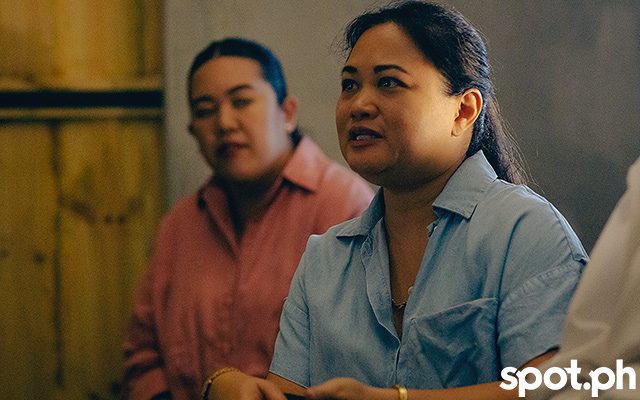
Looking back to the question you emailed us, about the state of Philippine art, I would say it’s quite robust just by the sheer number of artists and art spaces and events. It’s almost impossible to attend all these events. Yes I do look at Instagram but I also go to shows. I try to see the works in person, which is increasingly harder because there’s so much, but I still really, really try. I feel like it makes a big difference in how you write about it. I also conduct a lot of interviews. Even though I work together with the ALT galleries, these reputable galleries, I also never leave the avant garde. I try to see everything because I feel like I’ll be very ignorant. And seeing a lot informs how I write. I wanna have a comprehensive idea of what’s happening, what are people saying through their art, who’s investigating what, who’s experimenting on this material. That’s why I find that it’s really exciting in Philippine art now.
SPOT.ph: So I guess what we're saying is that the definition of art criticism has widened.
Cocoy: It has evolved because critics have become less evaluators and more describers. They describe more.
SPOT.ph: Why is that?
Cocoy: Because critics have lost their powers. Parang some people also got sick of them. “Who are you to decide who’s good?” Artists have become more powerful today, especially young generation artists. They know they can attract people without the usual platforms, like traditional media.
Gary: Even without galleries.
Cocoy: With Instagram lang they have the power na. They can be an influencer by posting their work and talking about it. I guess that’s why some critics have lost the power na to say what is good, what is bad, what’s worth seeing.
Gary: Imagine for example you’re a student now and nagdo-drawing ka ng anatomy or whatever, and you started a Youtube channel, and for some reason you get 100K followers. And then you have a teacher telling you, 'Maybe you can try something different.' Eh siya 500 followers lang. The currency has changed. May mga friends ako nagtuturo, they had to deal with that, parang reckoning: How will you impose your voice sa pagtuturo when sa outside world wala na siya masyadong weight?
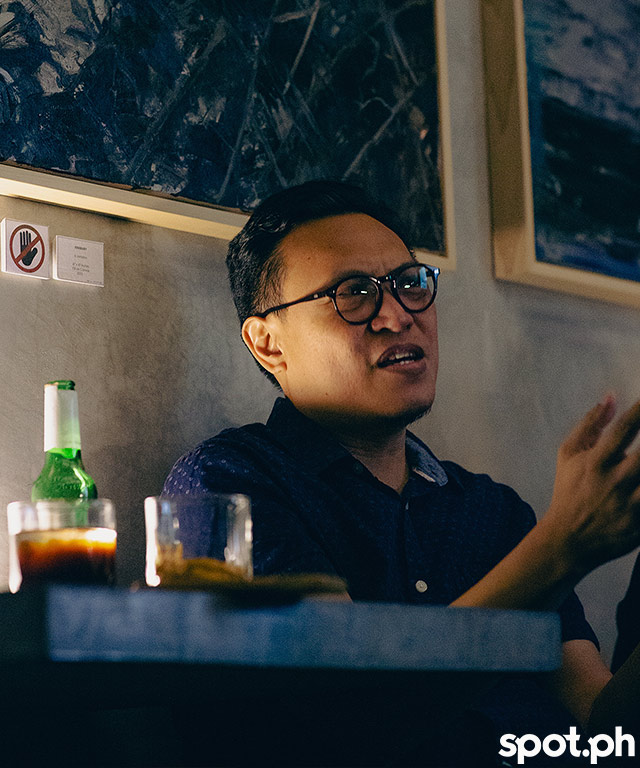
SPOT.ph: As someone who writes artist statements Cocoy, have your language changed over the years, your way of writing exhibition notes? Are you more descriptive now?
Cocoy: There’s an attempt to make it less complicated, the language.
Mawen: Cocoy is one of my favorite writers. I personally love his essays because artists also tell me his essays make them understand themselves more, and it even gives them a different way of seeing. Makes them think “Uy, puwede ko madevelop ang idea na ito.”
SPOT.ph: Is that your purpose when you write an artist statement: To give the art context or explain it, make sense of the art?
Cocoy: You wanna try as much as possible to capture what the artist is trying to articulate through writing.
SPOT.ph: Do you always have to love the work?
Cocoy: If you are writing for a gallery you are a bit biased already because you have a job to do, right? You have to appreciate the artist's work. But I still think the most effective way to evaluate the work is really to take the time to love the work and put careful attention no matter what happens.
SPOT.ph: Even if you don’t love the work.
Cocoy: You find out there’s actually something to love about the work. And one side of being a critic is to find what you can appreciate, instead of just putting them down.
Mawen: Ang bait!
SPOT.ph: You write a lot of artist statements, too, Steph, right?
Steph: I write a lot of artist's statement essays and I also do believe you have to keep it simple. I was trained that way, that it should be understandable to the general public. When I was taking some art writing courses at Sotheby's, they were explaining how especially for the museum-going public, the text should be understandable even to Grade 5 students. And I also think it should be delicious to read, that it shouldn’t alienate or repel.
SPOT.ph: The artist statement and the exhibiton notes are two of the most overlooked elements of an exhibition eh, di ba? Because if you're struggling to understand the art, the notes can help you connect with the work.
Steph: It's an art form in itself, because you have to make the artwork shine. You have to inhabit the artist’s mind.
Cocoy: I think one of the most important things exhibition notes can do is for collectors, or for the audience to help them evaluate or decide: do I really like this work? Or to maybe confirm: 'Ay yes, tama this is for me, I have to acquire this.' So it's really part of that whole ecosystem too of the art market, often overlooked. I appreciate why the galleries continue to hire us, because I think they know that it still has that function, that it can help people. Especially kung first time collector ka, you want info about the work eh.
Mawen: Which brings up the question: Are galleries still necessary? Di ba may mga ganyang questions before? It actually takes a village to launch a show, which is all a product of not just the artist but the person who handles the work, the writer, and all the people that helps within the gallery, right down to making it presentable for the market to see it. Para siyang bata na binihisan mo din eh, tapos after a while marunong na siya magsalita. I was just thinking that collectors are right now an important aspect of the market. MO_Space have lived through probably eight, ten years when we hardly sold a work, and we were just really there to champion ideas. Good thing I had a sustainable business to support the gallery. But now that collectors are there, it's important that the right artwork go to the right homes, the right collection. So art writing is very important because, to us, when collectors come, they read the essay or I encourage them to bring it home, and sometimes I get calls or text from someone in the morning that says "What exactly did this writer mean about this one?" So then after two cups of coffee you get to explain it. But works live on after the show because of the essays. I really think so. Words connected with a visual element gives you a certain kind of memory about the work that the collector brings home, whether or not he buys the work. That’s how they will remember the artist until the next show.
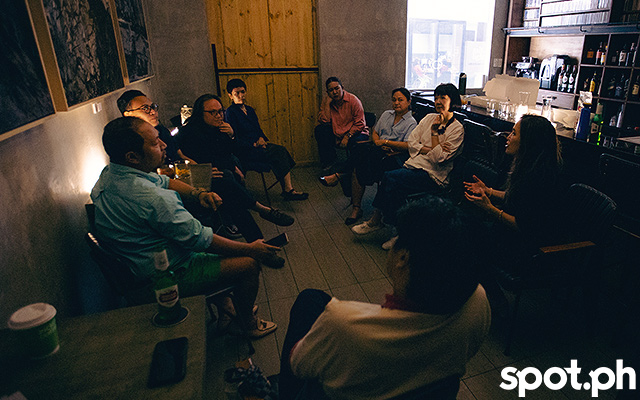
Tina: And also because after the show is over, and the collector takes home that work, you still need to see the work from the context of the entire exhibition. It’s not just one work. You need to see it from the point of view of the artist presenting an entire exhibition and it is the essay that glues that all together.
Cocoy: Theres no denying naman that fundamentally we're here for two personalities: the collectors or the acquirers, and the artists or the producers. Everyone else is a conduit to that transaction. And that is why we need to inform collectors, educate them, make sure their appreciation is also at par to what is best for the whole community…Di ba sinasabi nila 'Do you still need galleries, you can just post it on Instagram?' Pero in a way through the gallery, like what Mawen is saying, the artist is offering the work to the community first before somebody gets to acquire it as a personal possession. I think that’s an important part eh. When you’re collecting you don’t want na parang conniving ka lang, like you acquired something secretly. You want to share the work first before it becomes someone's sole possession.
SPOT.ph: Can anyone just open a gallery?
Tina: Some people who open galleries or attempt to open galleries they don’t realize exactly what goes into a gallery the way we do. Because other galleries are called galleries but really they’re just stores or spaces, they don’t really care, it’s all about selling the work. In our case, as far as the ALT galleries are concerned, we are concerned about what we show, about the artist’s career, how we present the works so the audience understands, and we always want to show something new and champion artists that would change the point of view of other people. Personally, I don’t want to show works that are just pambenta. It's boring. But there are people who put up galleries thinking only that it's profitable. Akala lang nila.
Jay: I feel that a lot are putting up galleries for the wrong reasons. It should be centered on the value of exhibitions, the value of artists, instead of mere business transactions. I think the ALT galleries, Tina, Mawen, will agree that’s the easier route. It’s just so easy to see what’s trendy and stick to that and it will sell but it’s more challenging to create that shift for collectors, to make them see something they might have overlooked.
SPOT.ph: This is also the vision for ALT I suppose. Does the group have the same vision as when it started in 2019?
Tina: Well our vision remains the same in terms of who we are and what we want to present. That’s how Art Fair Philippines started, because we encouraged them, the AFP ladies, to put up an art fair. We attended Manila Art and we all came together and we said—because it was Trickie Lopa and the AFP ladies running Art in the Park— they have the machinery na so we encouraged them to do the Art Fair. That was a vision we had and that vision still continues: to show something new and champion artists that would change points of view. By we, I mean the ALT galleries, we want to continue that vision.
Photos by Jason Tan. Special thanks to Jay Amante's 78-53-86 in 142 Katipunan Avenue, St. Ignatius Village, Quezon City for providing the venue for the roundtable.