(SPOT.ph) In March 2020, Joy Belmonte was canceled. It was the early pandemic and she was under fire for Quezon City’s COVID response efforts. She was bashed for delays in food assistance and for distributing alcohol and masks in an ecobag bearing her name. Netizens were claiming she was hiding. Her citizens—and the onlookers—were relentless, loud, and angry.
She responded in a Facebook post, saying: “To those who hate me, you are under no obligation to accept any of my projects—housing, education, healthcare, social benefits.”
The implication that benefits were reserved only for her supporters was gas into the fire. Her Wikipedia page was defaced with new “facts” citing her incompetence and absenteeism. A police dispersal of hungry residents prompted journalist Karen Davila to tweet: “QC Mayor Belmonte, your constituents need you.” She became a punchline—a meme target. Her press briefing was even dubbed with the voice of the announcer from Ghost Fighter’s Taguro Tournament.
What counts as “canceled” might be debatable, but few will deny Joy Belmonte was canceled and canceled to oblivion. Few have crawled out of the deep garbage bin of social media, but Joy Belmonte is one of them.
PHOTO BY Jilson Tiu ILLUSTRATION War Espejo
Article continues after this ad.
ADVERTISEMENT - CONTINUE READING BELOW
Windows to her soul. "My work is my life, because it makes me happy. Being able to do this work is a very fulfilling activity for me, so there’s no such thing as work-life balance."
PHOTO BY Jilson Tiu
The apology
PHOTO: Jilson Tiu
Post a Comment
It began with an apology. In an age where we’ve grown used to the non-apology apology—such as Canon’s after they announced their sausage fest photography lineup, or Wantusawa’s Oysters with a side of veiled legal threat—Joy Belmonte gave a real apology.
“I sincerely apologize for losing my composure on social media,” she wrote. “You are correct that all the projects implemented by the QC government belong to you, as they are funded by your taxes... Inaamin ko po na nagkamali ako... When I reflect on these actions, I do not recognize the public servant that I aspire to be. The citizens of Quezon City deserve better. I will do better.”
This excerpt—part of a longer statement—has all the elements of a real “sorry”: an acknowledgment of fault, an expression of remorse, and a vow to do better. After saying all that, Joy did the hardest part. She did better.
“They were hurtful,” she says about the criticism. “But what I did was—I had a team monitor them. They would read everything; they would separate the constructive, and set aside ‘yung mga ‘wala lang’. Some really have something valid to say—masakit lang ‘yung pagkasabi nila. But kailangan mo pa rin sila bigyan ng attention.”
Article continues after this video.
ADVERTISEMENT
watch now
“So, kunwari may comment na negative,” she continues. “[We ask]: Ano ba talaga ang sinasabi nito? Hindi sila nakatanggap ng pagkain—okay, siguraduhin nating makakatanggap sila.”
The other part of it, though, was protecting her own mental well-being. “Yung important for myself is to stay shielded from all of that,” she says. “Kasi as a human, it’s very hard for me to do my job and absorb all the negativity. I got off social media. I did not read any post. Then I remained focused on my work. So that’s what we did. Umarangkada kami.”
Four years after, Quezon City Hall has not decelerated from that pandemic pace. In the early days of COVID-19, it would have been hard to imagine the embattled Joy Belmonte leading what has become one of the most progressive cities in the Philippines. But here she is.
To move on from the online hate she got during the early days of the pandemic, she said: "I got off social media. I did not read any post. Then I remained focused on my work."
PHOTO BY Jilson Tiu
Since being canceled in 2020, she has offered free bus rides to the public, distributed hundreds of thousands of Samsung Galaxy tablets to students, established a right to care card in QC—which allows those in the LGBTQIA+ community to be there for their sick partners—and was named by the United Nations as a “Champion of the Earth” for eliminating plastic pollution in QC. All this while receiving consecutive unqualified opinions from the Commission on Audit—a seal of honest governance that isn’t easy to obtain.
Article continues after this ad.
ADVERTISEMENT - CONTINUE READING BELOW
In her viral Facebook rant in 2020, Joy Belmonte told her bashers to just show their hatred in the 2022 elections. In the 2022 elections, she won by a landslide; 60% for her, and 38% for her opponent who made the news by distributing Ivermectin. The hatred had subsided. The memes had become passe. Every piece of good news in QC is welcomed with a new hashtag: #CharacterDevelopment.
It is hard to grasp the size of Quezon City. It composes roughly a quarter of Metro Manila, and is home to around 3 million people. That's more than countries like Slovenia, Qatar, and Lithuania, and half the population of Singapore. In fact, the city has a bigger population than about a third of the world’s sovereign states. So one might say that being QC’s Mayor means handling a portfolio that rivals that of 30% of the world’s Presidents and Prime Ministers.
Thus, Joy Belmonte skips breakfast.
“No breakfast at all,” she says. “I’d rather have sleep than breakfast.”
She works seven days a week. Mondays are considered “People’s Day” in QC City Hall. It's when the Mayor opens her doors to any citizen who needs a chat. Tuesday to Friday is flexible. “Papasok diyan ‘yung mga courtesy visit ng Ambassador, mga magtatayo ng negosyo, or advocacy groups presenting projects.” Saturdays are reserved for the community. “Inaugurations, ribbon cutting, kasal, binyag, lamay.” Sundays past noon are for family, which means she squeezes in a shift in the mornings. To run Quezon City well means a full schedule.
Her assistant Eric Rivera says they often push in trolleys filled with documents to sign. And because the Mayor personally prefers doing such work without air-conditioning, “basang basa kili-kili namin n’un,” Rivera says.
Article continues after this ad.
ADVERTISEMENT - CONTINUE READING BELOW
“I feel like I owe it to the people to be a full-time Mayor,” Belmonte says. “The beauty of QC is... I never reject a project. If there’s a project proposal, I’d like to know what it is. If there’s a pilot, I’d like to host that pilot.”
The position of Mayor takes a special place in Philippine politics. It is high profile, but not as high profile as President. It is local, but not as local as Barangay Captain.
The mythos of our nation’s best Mayors might reveal what Filipinos expect of them. One might remember Marikina Mayor Bayani Fernando stripping his city’s sidewalks of parked cars and vendors, or Naga Mayor Jesse Robredo, in his tsinelas, assigning a city hall employee to stand outside a cinema to manually count audiences to make sure the movie theater paid the right taxes.
Mayors, one might argue, are the politicians who can materially alter the most things in our day-to-day life. Everywhere they look in their city, there is work to be done. And Joy Belmonte runs the most populated city in the Philippines.
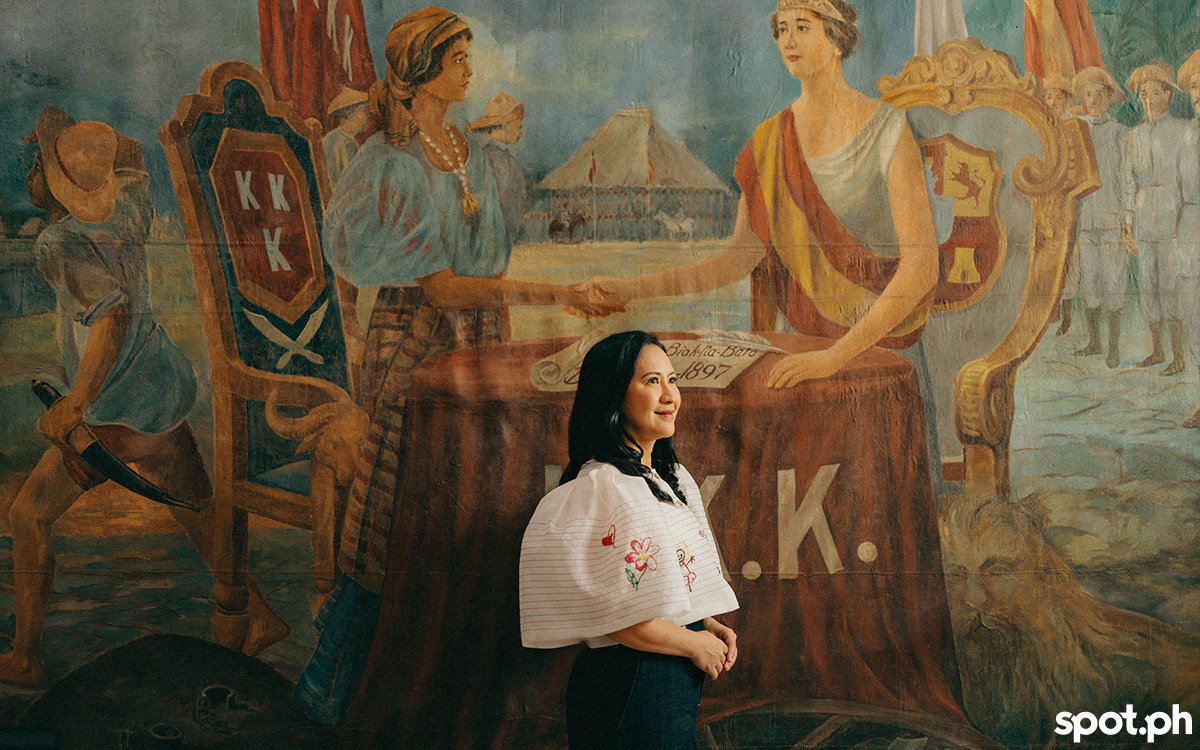
The Mayor walks by the quadrangle at City Hall and the people doing Zumba shout: “Mayor! Mayor!” They wave at her, and she waves back and smiles. A citizen ushers their kid toward her and they take a quick photo. She walks through the underpass to Quezon Memorial Circle and the citizens look. She is shepherded to a photoshoot at the City Hall Library (“award-winning ‘yan!” she says) and she greets the mothers who have brought their children there for a reading program. Perhaps if she were wearing civilian clothes, people would think twice about who she was. But she is in the midst of a photoshoot for SPOT.ph, clad in modern Filipiniana. She is a Mayor in a Mayor’s costume.
"Award-winning 'yan," the Mayor says proudly of the Quezon City Hall library behind her.
PHOTO BY Jilson Tiu
In all these settings, the Mayor would talk about work. In the quadrangle, she points out the ladies were doing Zumba to the song marking the 85th anniversary of Quezon City. In the underpass, she talked about the street artist who did the walls; and about plans to re-grass the cemented parts of Quezon Memorial Circle, and then perhaps an esplanade that might connect it to Ninoy Aquino Parks and Wildlife Center. In the library, she talked about the library’s awards and visited the ongoing reading program upstairs.
Immediately evident when talking to Belmonte is how everything circles back to work. Even if you ask something completely unrelated to work, her answer will eventually be about work.
You can ask about lunch, and she will talk about the vendors; how creative they are, how she wants to make more spaces for them. You might not notice it but soon you are talking about how one of QC’s ordinances forbids chain restaurants in Maginhawa, which helps promote small businesses.
You can ask about her favorite spots in the city, and she will talk about the thousand urban farms that exist in QC.
You can ask about the identity of QC in her eyes, and she will instead talk about focus group discussions they’ve conducted, her constituents’ perceptions of their city, and their tourism thrusts. Then she will add: “Then there is the perception that I want citizens to have when they’re in their city: sustainable and inclusive. That’s something I’d like to be the identity of the city.”
Pride & Joy
PHOTO: Jilson Tiu
Post a Comment
Before we began our sit-down interview, the Mayor’s assistant Eric gave some friendly advice. Sometimes, he said, all you will get is one question—because the Mayor will keep talking and talking and before you know it, your time’s up. I found that this wasn’t always the case, but there are indeed some keywords that will heighten the Mayor’s enthusiasm, and one of them is Pride.
“Our gender and development office is very, very strong,” the Mayor says. “And when you talk about gender, it’s not just women—it’s the LGBTQIA+ community.”
The Mayor then shifts to the SOGIE bill, and QC’s own initiatives for inclusivity. “[The SOGIE bill] hasn’t been passed. It’s been in Congress for twenty-something years, hindi siya pinapasa doon. Here, we don’t have the power to allow same-sex marriage because that’s a national law. But at least all services—kailangan nabibigay natin sa LGBTQIA+ community.”
“Kailangan ma-combat natin ‘yung discrimination,” she adds. “In the law, kailangan may all-gender toilets [ang establishments]. That’s because in the public consultations we had, ang daming nagsabi na restaurants only have toilets for male and female, so they have a hard time because they don’t know where to go.”
“Sa education, kailangan hindi sila discriminated against, so they should be allowed to go to school even if they are biologically male but their gender expression is female. Education is a basic human right. It’s a basic service that everybody must be able to avail of, even those that come from diverse genders.”
“Ganun din sa healthcare—dapat walang tinatanong sayo that you will feel uncomfortable about. Our healthcare workers are trained to be gender sensitive. Also, we looked at our data and of course ‘yung bilang ng HIV+ are usually men who have sex with men. But we don’t discriminate against them—we educate them to be responsible in their sexual practices.”
“Even sa housing—before, there were reports that if you were a same-sex couple, you couldn’t rent homes in some condominium buildings. We fight for those as well.”
“We will never stifle who you are,” she says, finally. “That’s your right. Government’s job is to protect that right.”
Quezon City’s progressive streak under Joy Belmonte is well-documented. From the strict implementation of QC’s Bawal Bastos Law, which promises jail time for sexual harassers and stalkers, to their anti-plastic waste initiatives and refilling stations; from their high-grade bicycle network which has drawn praise from cyclists across the Metro, to the livelihood programs for women detainees, and even to the Mayor publicly criticizing her own police department for giving a platform to the viral ex-cop who threatened a cyclist with a gun.
Of course, talking about progress is tricky. In this era polarized by social media—like or dislike, upvote or downvote, laugh react or angry react—it is tempting to portray a city only as a utopia or a wasteland. But bad things happen in good cities, just as good things happen in bad cities. What Mayors can do, realistically, is allow us to look around our neighborhoods and see one or two things that are better. The progress they pursue is incremental—digital city hall services, tumblers for kids in school, the ability to walk to work without being catcalled.
Joy Belmonte’s work is not found in revolution, but in one thing done well, and then another thing. Slowly, this allowed her to be more than the formerly-canceled-but-now-revered. It helped her shape a better city—one streetlight, and one home at a time.
Work is life
PHOTO: Jilson Tiu
Post a Comment
When we get a moment of quiet, I ask her what she does for fun.
“I always get that question,” she answers. “It comes from the presumption that your work is different from your life—as if work is tedious, negative, and not a good thing. I want to change that perception. My work is my life, because it makes me happy. Being able to do this work is a very fulfilling activity for me, so there’s no such thing as work-life balance.”
“There’s no real rest,” she adds. “You’re always on call—if may sunog, if may emergency sa barangay. That’s why I tell people who are entering politics—especially if they come from a political dynasty, where they feel it’s their obligation to follow in their parents’ footsteps—'If you don’t like this job, it can be hell.’ If this isn’t something you like, it can be terrible.”
Being Mayor is a 24/7 job for Joy Belmonte. “There’s no real rest,” she says. “You’re always on call."
PHOTO BY Jilson Tiu
She says “terrible” with the weight of knowing what it’s like to go viral for the wrong thing and just what it takes to win everyone over again. She has done so. But it feels as if she never stopped trying to win us over. As if to say: “Look.” As if to say: “Let me show you a well-run city.”
As we walk back from the Quezon Memorial Circle Underpass, Mayor Joy Belmonte trips and falls. Time stops. The security guards are alarmed. Her staff rushes to help her up. But she gets up quickly and on her own and dusts off her elbows. She checks on the Filipiniana dress she’s wearing to make sure nothing was damaged—and then continues walking back to City Hall.
Photographs by Jilson Tiu. Styling by Mika Reyes, assisted by Vianca Ozabel. White top with butterfly sleeves by Daryl Maat; denim top with native textile butterfly sleeves by Muse Project; jeans and skirt both by Yoya. Art direction by War Espejo. Sittings editor: Pat Villarica-Adriano. Special thanks to the Office of the Mayor of Quezon City.
We use cookies to ensure you get the best experience on Spot.ph. By continued use, you agree to our privacy policy and accept our use of such cookies. Find out more here.






Comments