
Bye, Floy Quintos: Dearest Friends Recall His Love Languages
A mentor, a collaborator, and one of his favorite actresses say their goodbyes.

(SPOT.ph) If you were somewhere else and didn’t know where all the singing and speeches and laughter were coming from, you’d think there was a birthday party and the speakers were roasting the celebrant. But we were in a funeral home, the speeches were eulogies, and were memorializing the life and times of Floy Quintos, Filipino theater icon.
Blame the eulogists and their jokes. But also the priest who delivered the mass and actually set the tone for the evening’s program. His homily was such a laughter fest it felt like we were watching a standup comedy act. He didn’t personally know Quintos and had to ask, before the mass, what kind of homily he should give. “Serious?” The audience gave a solid no.
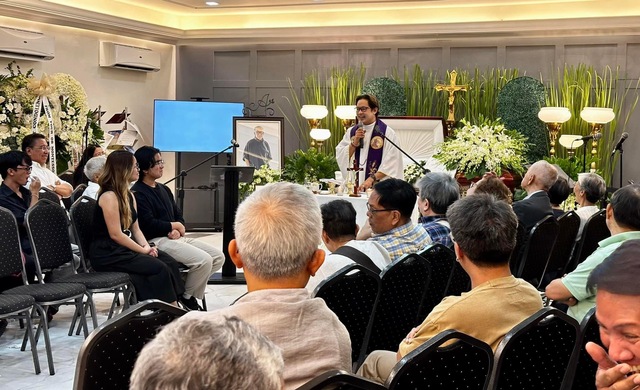
But none of it was unwarranted or out of line. In fact, it did justice to the honoree, the master playwright whose last play The Reconciliation Dinner sent audiences rolling on the theater floor laughing.
Also read: Floy Quintos, Award-Winning Playwright, Passess Away at 63
It was the second night of the wake for the seven-time Palanca awardee who passed away from a heart attack Saturday morning, April 27. The five eulogists were all exclusively from Quintos' theater circle. Three were Quintosian actors—actors who’s performed in a few of his plays—one was a director and a longtime collaborator, and the last was a mentor.
A common refrain from the eulogies was how Quintos detested false sentimentality. Although I’m not sure anyone in the audience, or even Floy, would doubt the authenticity of the tears that just needed to be shed on the podium that night. The speakers were some of the best working theater veterans in the country, and while they tried their best to keep their emotions in check, their skills were no match to the kind of force Floy was in their lives.
The actress
“Hold on ha. Ayusin ko lang blocking ko,” actress Stella Cañete-Mendoza began her eulogy. “Kasi magagalit yan siya. Sasabihin niya, back acting lang ang napapanood [niya].” And so she moved the podium and the mic from the middle of the room to a spot closer to the half-open casket. She planted it a bit to the side so that Quintos can have a better view of her—and this also gave the crowd a better view of the coffin.

Cañete-Mendoza then spoke fondly of Quintos’ different love languages, starting off with food. “Sino dito naka-experience ng kanyang pa-pizza, chicken and mojos? Pa-kwek kwek? Pa-fishballs? Pa-ice cream? Pa-seafood?” Some raised hands after each item but it seems the seafood was reserved for a very select few.
Giving away his fashion stuff — clothes and bags — was another love language. “Last you gave me was a clutch bag with a floor plan,” the actress said. “You heard it right, a floor plan, as in construction site plan. Ang tanong ko: ito ba ang lupain na ipapamana mo sa akin?”
Of all of Quintos’ love languages, though, Cañete-Mendoza considers language itself as the most important of all. His words. His stories. His complex characters.
She had the honor of playing a string of those complex characters for which he thanked Quintos: Simone in Fluid, Rina and Dita in Shock Value, Lorena in the EDSA Living Museum, Ade in Angry Christ, Tita Helen in The Kundiman Party, and the BBM-supporting Dina in The Reconciliation Dinner. She will also play the lead character, Sister Teresing, in Grace, which is due for the stage this May. It’s the last play Quintos finished writing, the bookend to a well-decorated theater career.
“He writes plays with specific actors in mind,” Cañete-Mendoza noted, “and when Floy Quintos writes a character for you, that is his most precious love language to actors.”
Also read: Floy Quintos' Take On 'Lipa Miracle' Is Next Big Theater Event
Grace has been in development as early as 2016 and Quintos has talked about it with the actress several times over the years. It was only last August, however, when the two had what Cañete-Mendoza called an impromptu pre-production meeting for it.
“Sabi niya sa akin, ibibigay niya ang script by November. So siyempre tumawag ako ng November. Siyempre hindi niya nabigay yung script,” she divulged, sparking a burst of laughter from the crowd.
Turning serious to cap her eulogy, she said Quintos’ body of work is his ultimate love language not only for the theater community, but for the country. “You left, satisfied, with a finished piece,” the actress said as she turned to face the casket. “God lent us your well-lived life because I believe you are his love language to us. Our Undeserved Favor. You are our grace from God.”
The collaborator
Director Dexter Santos, who has been working with Quintos since 2012, was less successful in keeping the waterworks from flowing. He was choked up with emotions almost from the beginning of his speech. “How do you pay tribute and say goodbye to Floy Quintos at the same time?" he began. "The former, effortless. The latter, extremely difficult. But I will desperately try."
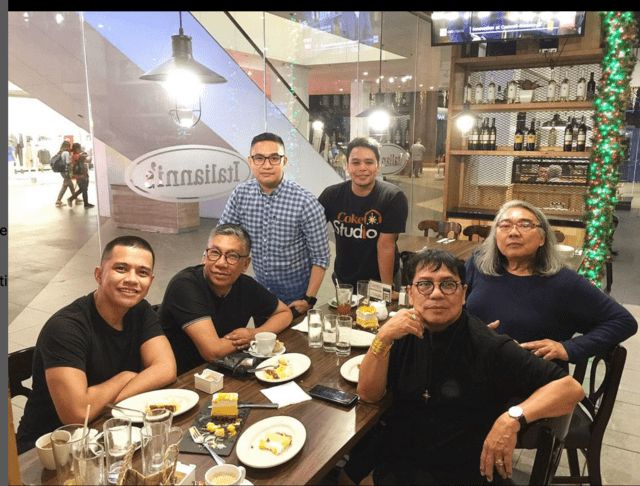
Santos gave a brief history of his roots in theater until he got to their first project together. “In 2012, kinapalan ko na ang mukha ko: I asked him if he was open to writing a play for me to direct for Dulaang UP.”
To Santos’ surprise, Quintos said yes. That first project was as playwright-director for Collection, a play about the absurdity of auctions and how even pieces of our history are sold to the highest bidder.
Santos gave a glimpse of how a collaboration with Quintos went. “From his text, I come up with an image. We discuss. Sir Floy suggests. I block or stage. He watches. He suggests. We discuss. I adjust. I suggest. We discuss. He adjusts. In the end, we always agree.
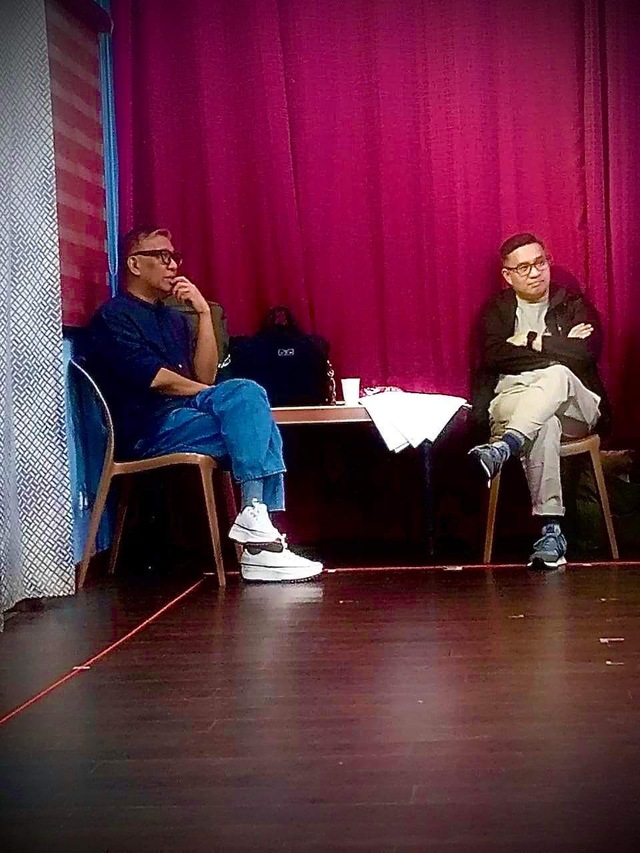
"For some artists, the process of collaboration between the playwright and the director seems impossible. But in Collection, our overwhelming passion for theatre has been responsible for making sure that every idea is explored, and every possibility is saturated. We were never too in love with our work. We believe that the show must always come first. And change was always good and always for the better.”
To Santos, Quintos was a “master playwright, a genius who can impeccably mix history, culture, and fiction and elevate it to iconic scenes. An actor’s playwright. Masarap katrabaho. Walang pagpapanggap, walang yabang, truthful, sincere, maalaga. The audience always experiences his brilliance on stage.”
That brilliance will be on display again in Grace, their latest, and now last, collaboration. Santos calls the play a most fitting swan song for his friend, noting that despite all the challenges and difficulties he encountered writing it, there were many signs it has heaven’s blessing.
“Mula sa paglabas ng imahe ng Birhen na ukit ni Irineo Cristobal sa Facebook, mula sa pumutok na news tungkol sa apparition sa Lipa, at mula sa maraming taong dumating upang iyong makausap upang finally matapos mo na ang dula, eto po pala iyon. Kaya po pala ganito eh may basbas ng langit ang lahat.”
Santos admitted he now feels a bit lost without Quintos around, and has asked him to intercede for and guide him through Grace. “Sabihin mo lang, ibulong o iparamdam mo lang. Multuhin mo na rin ang mga artistang magdidiva at yung mga pasaway na ayaw makinig sa akin.” The crowd broke into laughter.
The mentor
And more laughter and theatrics came from the last eulogist, Philippine theater icon Anton Juan who gave the longest, most literary, most sprawling speech of the night that touched the private and the public, the poetic and the prosaic, the scholarly and the pedestrian, and everything in between in Quintos’ life as only a eulogy by a dear friend and mentor of 40-plus years can. Juan directed his friend in the staging of Portrait of The Artist as Filipino, where the latter played the journalist Bitoy Camacho, chronicler of history.
Juan ended the series of eulogies magnificently. Referencing Quintos’ most recent work, the political comedy The Reconciliation Dinner, which is about the great divide that gripped the country during the 2022 national elections, Juan lamented, “There are no reconciliations really because we are a country bifurcated between traitors and heroes, between the true and the false, between half a heart of love and half a heart of stone.”
Juan saw his friend as the playwright who had the power to influence how a public thinks. “As a mentor, I shared Khalil Gibran. You followed the prophet and in your journey became a prophet yourself.”
In what seems like a distillation of Quintos’ full embrace of life that somehow also sounded like a call to action directed towards his audience of artists and various creatives, the theater veteran said: “Do not live half a life and do not live half a death, and do not die half a death. If you choose silence then be silent. When you speak, do so till you’re finished. If you accept then express it bluntly. Do not mask it. If you refuse then be clear about it, for an ambiguous refusal is but weak acceptance. Do not accept half a solution. Do not believe in half truths. Do not dream half a dream. Do not fantasize about half hopes. Half the way will get you nowhere. You are whole that exists to live a life, not half a life.”
And his last note to his friend of 40 or so years: “May the chants of our nation raise you to God’s theater.”