(SPOT.ph) For TV weatherman and trivia guy Kim Atienza, it was collecting and riding vintage motorcycles that got him deeply fascinated. For content creator Icoy Rapadas, it was his friends who indulged their curiosity first—there was a full decade before the food influencer finally caught up. “It took me a while to understand it,” he confesses. Meanwhile, broadcast journalist Atom Araullo seems to be trying it on for size, and a recent trip to Japan is the culprit. “I geek out over the history of clothing. I didn’t use to care about fashion at all,” says the I-Witness host.
We’re talking about Amekaji, and how the three men above, along with a growing number of Manileños, have been dressing themselves up in the style—showing up in pop-up events to check out what they can add to their rotation; going around the city in their vintage bikes sporting the smartest-looking pair of unwashed denim jeans and army-style jacket; or just generally having the time of their lives putting together a look that evokes vintage old-timey Levi’s ads, or what we can safely describe as a Very. Thoughfully. Put-together. Casual OOTD.
cover design and LLUSTRATION Warren Espejo
Article continues after this ad.
ADVERTISEMENT - CONTINUE READING BELOW
“I traveled to Tokyo last year and realized that people there dress really well,” Atom tells SPOT.ph. “Then I also learned that some of the best quality apparel in the world, particularly denim, is produced in Japan. This led me down a rabbit hole and I slowly discovered the fascinating world of Amekaji.”
PHOTO: Jason Tan
Post a Comment
What is Amekaji style?
Amekaji is, very loosely, the Japanese interpretation of popular American casual styles, among them the Ivy League-preppy look and the workwear look inspired by the uniforms of American miners. According to Japanese Fashion Wiki, it was “originally introduced as Japanese Preppy in the 1960s” but has evolved over the years. You’ve most likely encountered the style in your online feeds, in social events, in your brother's or boyfriend's or tito's closet but just didn’t know it has a name and a growing following among Pinoy men.
“It combines classic American elements like selvedge denim, workwear and rugged jackets. The result is a style that feels both vintage and modern at the same time,” says Kichi Sibue of Amekaji Philippines who identifies himself as a stylist. Born and raised in Japan, he started living in the Philippines in 2022 and now organizes Amekaji events. Not very tall, he was looking for a fashion style that suited his built and found Amekaji fit him best.
“What I like most about the Amekaji style is that it is timeless,” says Kichi-san. “It’s a style that can be enjoyed regardless of age or gender, which is its greatest appeal.”
It’s easy to see the draw of Amekaji in men: it speaks to their nature of being hunter-gatherers, of being collectors. It speaks to their propensity to explore—or some may say geek out on—how things are made, how things began, and the stories behind our objects of desire.
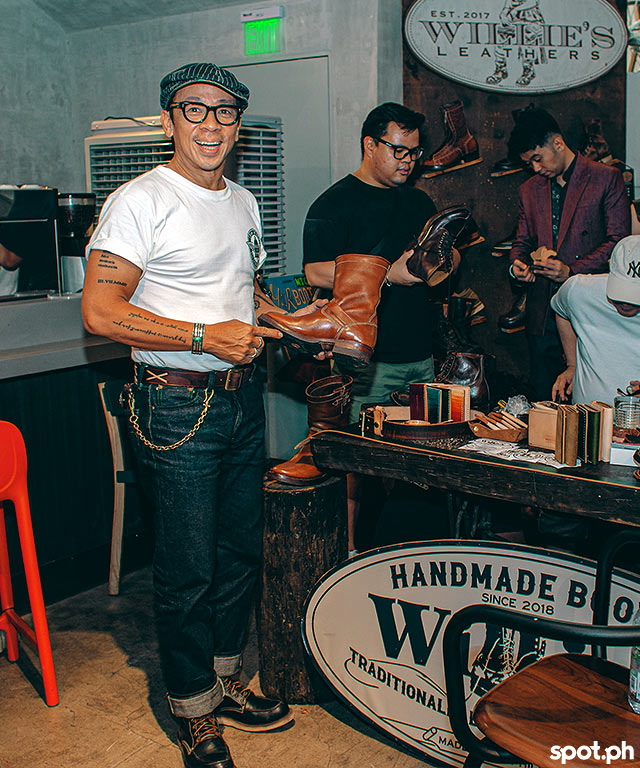
Kim Atienza at the Amekaji event last October.
PHOTO BY Jason Tan
For Kim Atienza who is a known collector of art, midcentury modern furniture and, as mentioned, vintage motorcycles, he seemed to have been naturally attracted to Amekaji style. “Dressing in this style is multi dimensional,” he says. “Number 1, it’s aesthetically pleasing. Number 2, the clothes I wear have historical value. I like researching about what I wear, the history of my boots, my jacket, the history of my Navajo bracelet [he was wearing a piece from 1910 during this interview; he gets his Navajo pieces from Sonnyboy Vintage on Instagram]. It’s of value because it’s never obsolescent. It will stay forever. And I’ve always been a vintage guy. I like stuff with meaning. I like studying what I have, what I wear.”
Article continues after this ad.
ADVERTISEMENT - CONTINUE READING BELOW
And he also likes a ritual, something that Amekaji dressing allows for. “It’s a ceremony setting them aside at night,” everyone's Kuya Kim tells SPOT, referring to the elements of his wardrobe. “Putting them together, planning on what to wear the next day, planning the motorcycle that matches the clothes. For me it’s not a chore. It’s a pleasure.”
PHOTO: Jason Tan
Post a Comment
How they got into Amekaji
As has been said earlier, it was because of riding and collecting motorcycles that got Kim into Amekaji. “I discovered it because of riding motorcycles. I collect vintage motorcycles and there's a certain way of dressing up for certain motorcycles,” shares the TV presenter, speaking like a true unapologetic collector. “Cause I got into Harley Davidsons, and then there’s BMWs. It started with denim, and then you learn about the boots that go well with the denim."
He's convinced the Japanese have the best interpretation of American workwear. And riding wear. "They put so much passion in it that everything I have now is not even American," adds Kim. "Well, they’re 99 percent Japanese.”
Atienza with riding buddy and fellow Amekaji fan Ed Kalaw.
PHOTO BY Dondi Narciso/Jay Taruc
Where does he get his Amekaji stash? He’s already familiar with the shops in SoHo, New York that specialize in Navajo cuffs and bracelets. Here in Manila, he goes to that specialty men’s fashion boutique Signet which has two outlets: Powerplant Mall, Rockwell and Mitsukoshi Mall in BGC. But he also does a lot of thrifting, he says. “What I wear is a combination of thrifted stuff and Signet stuff, and things that I bought abroad, and things that I bought from collectors—because [Amekaji items are] collectibles, especially the Navajo stuff.”
The ‘fits can come at a steep price. A pair of unwashed jeans from premium local selvedge denim purveyor Leon Denim starts at around P9,500; a pair of the same at Signet can set a guy back some P23,000. A denim jacket at Leon Denim costs around just a little less than P10,000, and at Signet a denim sports jacket from known Amekaji brand Samurai is priced at a cool P17,800, while a military style jacket from Orslow is P28,800.
Icoy Rapadas in Amekaji.
PHOTO BY Jason Tan
“If you’re not at a point where you have a deep appreciation for it, you’d ignore it completely. You'd think it's ridiculous,” says Icoy Rapadas. "But once you discover other ways to acquire good, pre-loved stuff, na pwedeng affordable naman pala, and once I bought my first pair of good Japanese denim that fit me perfectly, wala na, mahirap na magsuot ng ibang pants.”
For Amekaji believers, what’s good about the style (movement?) is it’s not a trend. “The style is timeless,” says Icoy, “so worth it naman ang investment mo. The style and the make of the clothing are really made to last so if you choose to buy at retail, it’s worth it. If you have access to the secondhand market—cheaper pero minsan mahal pa rin yan—it’s even more worth it.”
PHOTO: Jason Tan
Post a Comment
Ties to history
That the style is tied to some kind of history is part of the charm of Amekaji. "There are many factors behind why Amekaji fashion is so interconnected with history, economics, and global affairs," says Kichi-san [pictured above with fellow organizer Whena]. "Once you understand the history behind it, the connections become much clearer."
We'll just let Kichi-san expound on it.
"For example, denim, which is central to Amekaji style, was originally just workwear for miners during the Gold Rush in the United States because of its durability. Over time, it evolved from being purely functional into a global fashion trend. Today, denim is worn across different styles and brands, yet it all traces back to that humble miner’s workwear. Japan, in particular, adopted denim and perfected its production, making it famous for high-quality denim craftsmanship.
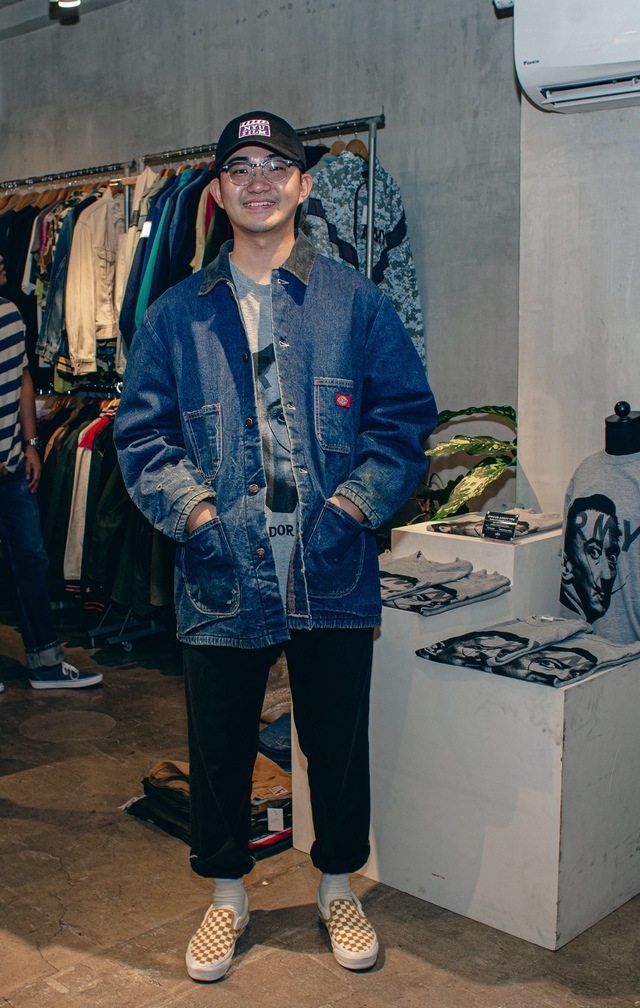
Sean and Axel at the Amekaji event.
PHOTO BY Jason Tan
Radley Santos.
PHOTO BY Jason Tan
"When we talk about Amekaji being rooted in American casual wear, we’re referring to products made in the USA. But as we transitioned into an era of mass production and consumption, clothing became more efficient to produce. By the early 2000s, fast fashion had spread worldwide, and companies like Levi’s and Converse, which once manufactured in the U.S., began shifting production to Asia and Latin America in search of cheaper labor.
"Military wear also saw numerous innovations during different wars, with fabrics and designs adapted to specific climates and regions. GORE-TEX, a popular material today, has been used by the U.S. military since the 1980s. More recently, brands like Patagonia and New Balance have supplied military gear, showing how many brands closely tied to American casual fashion also have military roots.
Ryodai Hanai at Amekaji event.
PHOTO BY Jason Tan
John Parungao.
PHOTO BY Jason Tan
"This evolution is deeply linked to historical events like American industrialization and economic relationships, such as the post-World War II ties between Japan and the U.S. Through these factors—trade, cultural exchange, and economic shifts—Amekaji fashion reflects a blend of global influences, transforming simple workwear into a symbol of style."
Amekaji action in Manila
The increasing popularity of the style in Manila can only mean a world is slowly being created around and for it, and by its devotees too like Kichi-san who puts together Amekaji pop-ups in the city, gathering different clothing and accessories purveyors who specialize in, or at least complement, Amekaji items. In the last quarter of 2024 alone, two successful ones were staged in Makati, and there’s already a next one coming up. When asked about the turnout of his November pop-up, Kichi-san says he was very happy with it.
Ame
PHOTO BY Jason Tan
Sean Punzalan and Moira Pineda at the Amekaji event.
PHOTO BY Jason Tan
“I felt that more people than ever attended the event with a clear sense of purpose and appreciation for the culture. These were not just casual attendees; they came specifically to experience and learn about Amekaji fashion. Exhibitors mentioned that customers went out of their way to come all the way to Makati, which was incredibly gratifying to hear. Many customers expressed gratitude for the event, and I felt the support from the Amekaji community. Their passion for the culture was satisfying and highlighted the growing connection to Amekaji fashion, making the event truly special for me.”
Apart from the events and the pop-ups and the trunk shows, there are communities, group chats big and small, that keep this “movement” alive and thriving. Kim, for example, has his group of riders he hangs out with, proving that indeed the style is very much attached to biker culture (a lot of the Japanese denim makers have founders that are into motorcycles: Iron Heart, Samurai, Momotaro). This group includes Senator JV Ejercito and broadcast journalist Jay Taruc.
Thr riding group in full Amekaji attire: (from left) Dondi Narciso, Eric Yapchanco, Ed Kalaw, Jay Taruc, Kim Atienza and Senator JV Ejercito.
PHOTO BY Dondi Narciso/Jay Taruc
“I hang out with guys with the same passion: we ride vintage bikes, we dress vintage, we like Amekaji.” They meet up Sunday mornings in full-on “the best of what wehave” Amekaji get up. “We’re all middle-aged,” Kim volunteers. He calls what they do “cosplay for adults.” “Kasi we dress up once a month, with our costumes. We dress up daily, we cosplay daily.”
The full-on Amekaji look might come off as funny to some, especially in Manila’s warm weather, what with all the heavy denim, the layering, the scarves, the boots. But when you have a commitment to style—to Amekaji in this case—you easily find yourself shifting to a perspective that agrees with your passion. Because why the hell not?
Jacob, Joshua and Jeho at the Amekaji event in Makati.
PHOTO BY Jason Tan
To address the Manila heat, one could always choose pieces from the “spring-summer” collections of brands anyway, advises Icoy, pieces that are lighter and breathable, made of fabrics like linen and seersucker, kinder to the wearer during warm weather. “Pero madalas tiis-ganda na lang talaga, LMAO. If anything, most places that’s good to wear the style in would be the offices naman, so there’s airconditioning.”
Says the novice Atom: “One of the challenges of pulling off the Amekaji style in the Philippines is the climate. Ang init kasi, haha. But I’m learning about simple ways of layering clothes for tropical weather. Maybe a less direct effect of learning about this style—and other fashion ‘languages’—is being more intentional with the clothes that I purchase and wear. One day, I hope to have just a few nice pieces on rotation.”
Atom Araullo is a new Amekaji convert following a recent Japan trip.
PHOTO BY Atom Araullo
For Kim, there's an unmistakable thrill in wearing his Amekaji heart on his sleeve. "You know what’s amazing when you’re old? You’re unapologetic," he says. "I don’t care, I just wanna be happy with what I wear. Ang sarap eh. I could wear a silly hat, I'm happy wearing it. I love tying my boots. I never knew I was gonna turn fashionista this way. It’s like a 'reverse fashionista.' It’s not a trend eh. It’s an appreciation of good stuff!"
We asked Kichi-san how he would describe the typical Amekaji fan. “People who like Amekaji tend to prioritize quality and the story behind the product rather than just following trends,” he says. “They enjoy the aging process of items through long-term use and express their individuality by wearing vintage pieces." For the Japanese stylist, Amekaji culture in the Philippines is still just starting to spread and people are still exploring its possibilities. And to hear Kichi-san say it, there's still a lot more to discover. "In Japan, the definition of Amekaji is much broader, and I would love to see people here challenge themselves with a wider range of styles. You never really know the charm of an outfit until you wear it, so I encourage everyone to try different styles!”
We use cookies to ensure you get the best experience on Spot.ph. By continued use, you agree to our privacy policy and accept our use of such cookies. Find out more here.








Comments