

How an Artist-Run Space in Teachers Village Brings the Community Together
It's at the site of the old Leona's Art Restaurant.

(SPOT.ph) Tucked away in Teachers Village, a block from the famous Maginhawa Street, is NO. It's an independent community-run space created to encourage and support emerging artists in their practice.
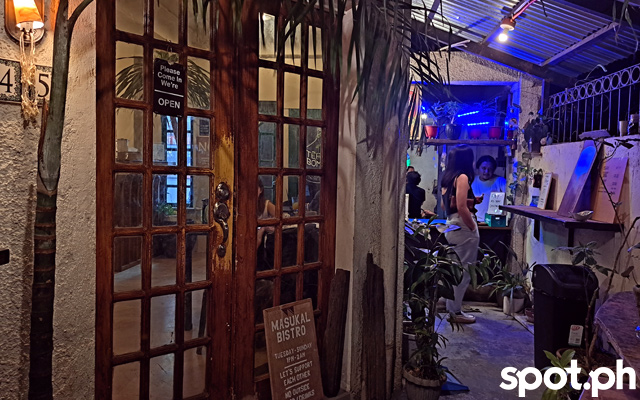
Faced with the struggle of finding gallery representation and space for exhibition, the team behind NO Community-run Space decided to transform the old site of family-run Leona’s Art Restaurant into a shared space with Masukal Bistro, which houses Gedli Coffee, Riot Grrrill, Alugbati Vegetarian Kitchen, El Hermano Loco, and Loob Cocktails. They hope to find the solution to the problem that mainstream art practice is often daunting, with larger galleries enjoying resources, connections, and established networks. NO tries to navigate this art world that's often subject to gatekeeping and, at the same time, provides a starting point for incipient ideas and experimental practice.
Also read:
Orange Project and Art District: Creating Bacolod City’s Contemporary Art Hub
Beyond the Kiping: Project Space Pilipinas Makes Space for Contemporary Art in Lucban
From Leona's Art Restaurant and Into an Artist-Run Space
Gino Javier was one of the chef-owners of now-defunct Leona’s Art Restaurant. At first, they offered the space for rent, then opened the gardening supplies store Terra Bomba. Finally, in February 2023, Javier, together with fellow artists-friends Franchesca Casuay, Mike Olea, Aris Santiago, Richard Ortizo, and Francis Espiña decided to dive in and open the alternative art space.
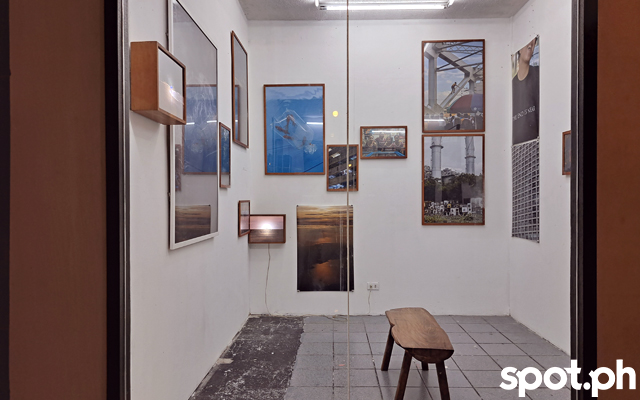
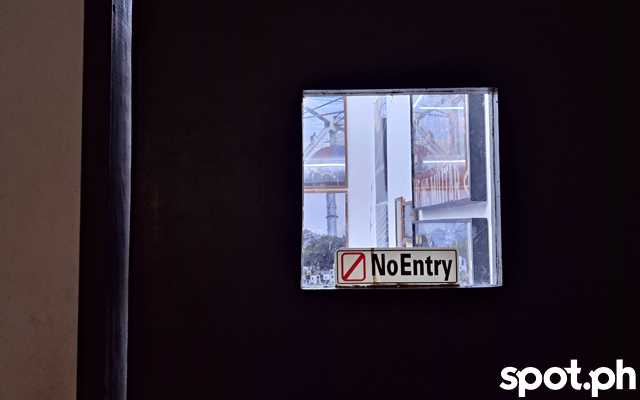
The intimate exhibition area used to be a storage room, while the existing glass wall allowed them to play around with how exhibitions are seen from the outside. The framed vantage point, in addition, gives a cohesive preview of the overall exhibition. Entering the gallery from a black door ironically marked "No Entry" puts the viewer on view as well, framed within the artworks of the space. The tight layout suggests a liminal space for reflection and transformation.
Memories, Community, and Photographs
Francis Espiña's Random Access Memory, which runs from May 31 to June 24, features a collection of photographs that give viewers the impression of informal randomness. But, in fact, it tells a cohesive story of Espina’s experiences, artistic growth, cultural exposure, and political action and narratives.
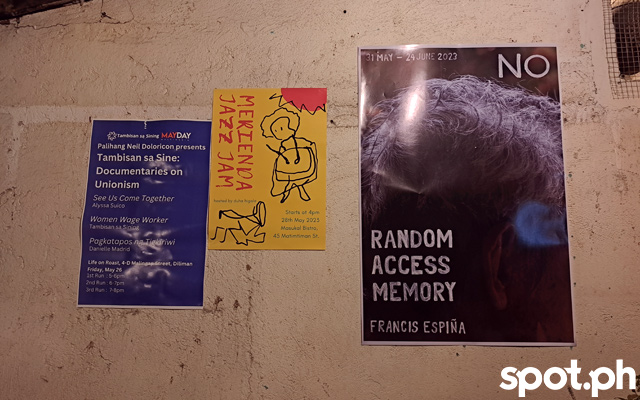
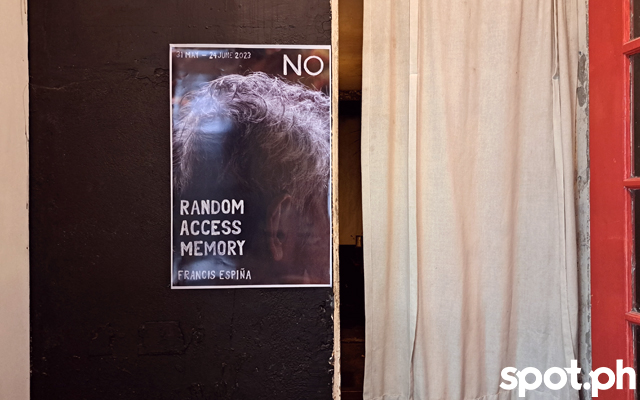
With the encouragement of NO to finally exhibit his works, Espiña worked on developing his concept, going back to his thousands of photographs covering the past decade or so. He delved deep into his collection, not necessarily looking for his best works, but rather, for key memories, events, and ties that bind his personal and social accounts.
Memories of Home and Mentorships
The left wall looks back into his family life, parental relationships, and early mentorships. "Caramoan, Camarines Sur. 11 August 2013 / 3:19 PM" captures an image of a mother looking out into the sea. Not captured is the child playing on the beach. It is reminiscent of Espina’s relationship with his mother, who was also from Caramoan.
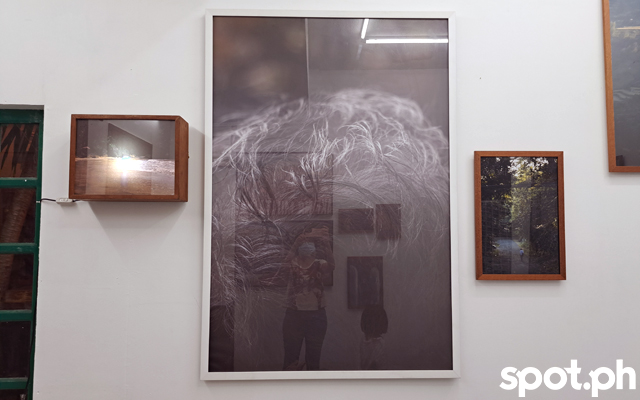
But his most emotionally charged piece is "Kalookan. 4 July 2021 / 1:49 PM," which is representing the image of his father’s hair. Espina's father, at the time, was diagnosed with a terminal illness. The light, movement, and flow of his father’s hair encapsulate the depth of connection.
Next to this is "Area 2, UP, Diliman, Quezon City. 26 February 2016 / 5:27 PM," which conveys the image of twilight in the homey and restful area of campus. Included in the photograph is an image of his mentor, artist, and production designer Cesar Hernando, who passed away in 2019. The poignant relationships captured in random photographs, establish the possibilities of preserving and unlocking critical memories.
Society and Politics in Photographs
Growth and social awareness are key to the images on the central wall. The small image, "Tenement, Taguig. 9 April 2015 / 8:08 PM" provides a glimpse into the housing situation of the underprivileged and a picture of the disparity of access to resources.
"Krus na Ligas, Diliman, Quezon City. 12 January 2016 / 8:59 PM" is a familiar image for those who shared the university experience as it features the servers of Sarah’s, a local watering hole. The cozy hangout place is known to students, artists, writers, musicians, and other creatives with ties to campus life.
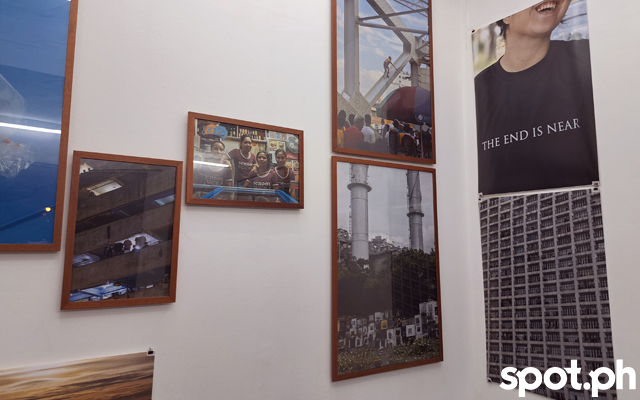
Another identifiable scene is "Quezon Bridge, Quiapo, Manila. 9 January 2018 / 10:48 PM," where Espina covered the Traslacion or the Feast of the Black Nazarene. Participation in the annual feast is critical for the devotees, as the belief intertwines with faith, religiosity, quality of life, and the afterlife.
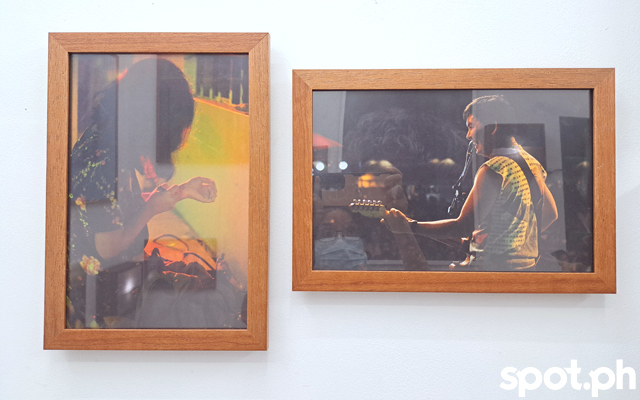
Exposure to culture and politics are critical concepts as the exhibit transitions to the right wall. Two small photographs in the center show Chickoy Pura of The Jerks and MC Sacay of The General Strike, with "Sunken Garden, UP Diliman, Quezon City. 18 February 2011 / 7:58 PM" featuring the UP Fair, an annual concert tied with activism and call to action for causes.
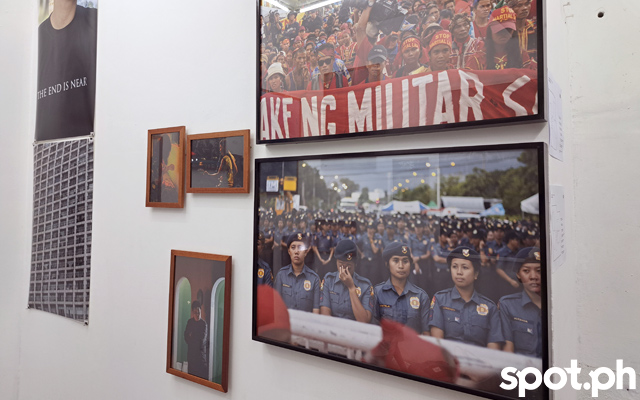
In a similar vein, two large photographs—"Batasan Hills, Quezon City. 24 July 2017 / 5:45 PM" and "Batasan Hills, Quezon City. 24 July 2017 / 5:45 PM" show contrasting scenes in the same place and same time of the State of the Nation Address. On top is a photograph of the Lumad community protesting Martial Law and the harsh rule of then-President Rodrigo Duterte. On the bottom is a photograph of young police officers on the front lines, blocking the protesters in Batasan Hill.
Call to Action and Community Archive
Ultimately, Espina’s exhibition is also a call to action. With the popularity of taking photos, Filipinos end up with thousands of images over the years—from "selfies" to "groufies," random snapshots in the streets, landscape photographs, and community engagements. Just as important is to make sense of the documentation and create a cohesive, if at times, random archive.
Espina ideates a community archive, where personal, social, and political memories are organized and tied together to tell a story, and to communicate the story back to the community who contributed to its formation. Though the idea is far from reality, it emerges from NO’s alternative space.
Exhibition Space as Communal Space
The intimate, liminal space gives a complex presentation of Espina’s photographs. The uneven floor, a small bench in the middle, and framed perspective provide a textured experience of the exhibition space and by extension, of Espina’s story.
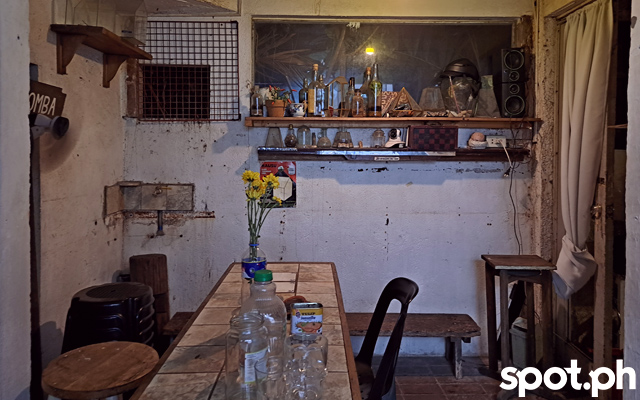
Right outside the exhibition space are a communal table and chairs meant for meals, drinks, and conversations. Oftentimes, food and drinks are limited to opening and closing events. The communal area blurs these lines, inviting a continued exchange, often anchoring on Filipino culture of sharing a meal and a few (or a lot) of drinks. Ideas and collaborations are often formed in the informal setting of a communal table, enhanced and encouraged in the NO spaces.
As part of making NO a communal space, public programs are scheduled in the coming weeks, including a talk on Public Presentation of Community Archiving Practices by Tel Delvo of the Philippine Labor Movement Archive, Erick Calilan of Ancestral Swamp Sound Archive, and Adrian Mendizabal of UP Film Institute Film Archives and Library; and Loops and Samples performance by drummer Benny Carrot with Espiña on June 17. There's also the closing program on June 24, which coincides with the launch of Bomba Radyo featuring in-house DJs.
Needs and Struggles in Filipino Communities
Consciousness and formation of the community become critical entry points for NO. Often leaning towards the sociopolitical, the exhibitions and events are sensitive to the needs and struggles of the Filipino community.
Their inaugural exhibition, Khalil Verzosa’s Umaapoy ang Lupa kung Saan Ako Nakatayo, in February responds to the image of a comet in Esteban Villanueva’s 14-painting series "Basi Revolt." At the same time, it layers the continued struggle and oppression experienced by the Filipinos until the present. Verzosa’s acrylic on canvas pieces unveils a burning, complicated aspect of existence.
Vulnerabilities and Strengths of Women
NO’s program for the year also included Kababaihan, Sa Bagong Mukha ng Lipunan, which was a group show in March. Aside from hosting a visual arts exhibition, they also supported community-based programs such as a workshop for cardboard loom-weaving and an educational discussion on the socioeconomic situation of Philippine peasant women. There were also critical conversations about women and the environment, particularly those in vulnerable situations amid the climate crisis.
Responding to Social Conditions
In April and May, NO hosted Mity dela Peña’s solo Bahala Na Kayo (stylized). The show, where art and music collide, was a sociopolitical commentary on the everyday experiences of the Filipinos. The concept "bahala na kayo" is often attached to Filipino’s carefree nature; but contextually, it is often the lack of options and resources that drives the reaction. With limited access to necessities, many Filipinos make do with what they can get, thus the saying "bahala na."
Alternative Path Forward
With less than half a year since opening, NO managed to create an exhibition space, a collaborative and discussion network, a place of exchange, and even income possibilities for a group of creatives. Though obviously challenging, the potential to grow is palpable as artists gravitate towards independent and socially conscious networks intent on growing a practice that centers on community. The collaborative nature of NO and its partners would hopefully turn into a sustainable and alternative model of art and creative spaces around the country. Beyond an exhibition space, NO is an explorative space, growing ideas and encouraging artists to forge a path forward in the creative and artistic spaces albeit outside the mainstream.
NO Community-run Space is at 45 Matimtiman Street, Teacher's Village East, Diliman, Quezon City. For updates, follow NO (NO Community-run Space) on Facebook.
UPDATED (June 11, 7:30 p.m.): This article has been edited to include NO's upcoming events as well as clarify other information about the community-run space.