

National Library's New Permanent Gallery: What To Do + See
View over 80 cultural treasures spanning 300+ years of PH history for free.

(SPOT.ph) For a well-needed dose of culture and knowledge to combat brain rot, the National Museum complex within and surrounding Luneta Park in Manila has always been a go-to. In tours, it is often grouped with a trip to nearby Museo Pambata or Intramuros. But although Luneta Park covers its bases with the Rizal walk plus entire museums dedicated to Natural History, Fine Arts, and Anthropology, not a few will perhaps note that there isn’t just one building solely dedicated to history.
Or at least, this was the case until the National Library of the Philippines launched its own Permanent Gallery. The clincher: it’s now officially open to public viewing, free of charge, this September.
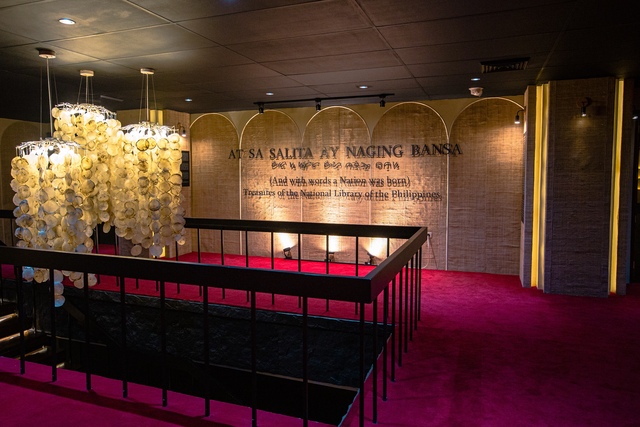
The Philippine National Library opens its new Permanent Gallery
First founded by royal decree as the Museo-Biblioteca de Filipinas in 1887, the National Library of the Philippines has been around for 137 years—and it’s definitely seen its fair share of history as well as preserved precious documents and artifacts from various eras of our country’s past. Officially, it has over 1.6 million pieces in its collection.
That said, the National Library of the Philippines celebrated its 137th anniversary in August with the opening of its Permanent Gallery, where it unveiled 80 historical treasures from its archives that document pivotal moments in Philippine history. The majority of these are documents, books, and original manuscripts—some even written (and drawn) in the hand of prominent figures like Dr. Jose Rizal and Emilio Aguinaldo—and the full collection is now on permanent display for absolutely free in the library's home in Ermita, Manila.
Also read: Ateneo's Rizal Library is Home to These 10 Cultural Gems

Beyond learning from these historical treasures however, the gallery gives you a glimpse of the work it takes to keep these documents in good condition when time makes it difficult to even keep them in one piece. In the gallery, visitors can also get the chance to view preservation in action, with a literal window giving visitors a glimpse of conservators at work.
What to see at the National Library’s Permanent Gallery
The 1743 Murillo Velarde Map, "The Mother of All Philippine Maps"

Fun fact: a 300-year-old map is one of the make-or-break documents that won the Philippines its landmark victory against China at the Hague in 2016. And it proved our sovereignty by doing something very simple: including today’s Spratlys as part of our archipelago.
The first-ever scientific map of the Philippines ever drawn, the 1743 Murillo Velarde Map is the work of Spanish Jesuit friar Pedro Murillo Velarde and two Filipinos—Francisco Suarez and Nicolas dela Cruz Bagay, who drew and engraved the map respectively.
But this map’s story doesn’t end there. Over the centuries, the map would find itself in the possession of the Duke of Northumberland Ralph George Algernon Percy, and was put up for auction in 2014. Learning about it, Filipino technology entrepreneur and educator Mel Velasco Velarde (of no relation to the Velarde behind the map) would join said auction and would win it for approximately P12 million—after which he promptly donated it to the Philippine government and returned its ownership to the Filipino people.
Mi Ultimo Adios in Rizal's Own Handwriting + the Original Manuscripts of Noli Me Tangere and El Filibusterismo
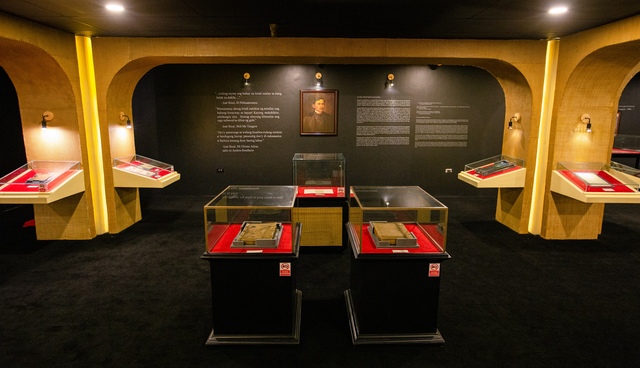
At the Gallery's official launch during the Philippine National Library's 137th Anniversary, three historical documents were given the long-overdue honor of being named cultural treasures--and all of them were written by National Hero Jose Rizal. These are his original manuscripts of Noli Me Tangere and El Filibusterismo (with the former's iconic cover illustrated by Rizal himself, and the latter's actually blank), as well as "Mi Ultimo Adios"--Rizal's famous last work handwritten in his prison cell in Fort Santiago and hidden beneath a gas lamp (now at the Rizal Library of Ateneo) before he was executed.
The gallery also keeps lesser-known Rizal works on display. This includes his handwritten copy of his own speech congratulating Juan Luna and Felix Resureccion Hidalgo for their medals at the Exposicion de Bellas Artes in Madrid—where he famously said that “Genius has no country, genius bursts forth everywhere like light and air–the patrimony of all”—as well as documents showing that the hero had one heck of a sense of humor. Exhibit A: his own hand drawn comic of a farting man. No joke.
Issues of La Solidaridad

When we think of the Propaganda Movement advocating for Spain’s better treatment of the Philippines, we think of the newspaper La Solidaridad. Founded in Barcelona by Ilustrado liberals and students, La Solidaridad was the first publication of its kind that aimed to make Spain more aware of the needs and aspirations of Filipinos—advocating that the Philippines become a province of Spain, that Spanish friars be replaced by Filipino priests, and that both Spanish and Filipinos be given equal rights in the eyes of the law.
In its six years of publication under the editorships of Graciano Lopez Jaena and Marcelo H. Del Pilar, some of the most famous figures of Philippine history contributed to its pages including Rizal, Antonio Luna, and Ferdinand Blumentritt. The issue on display now at the Permanent Gallery is one of its earlier issues still under the editorship of Lopez Jaena before Del Pilar took over.
The Trial of Andres Bonifacio
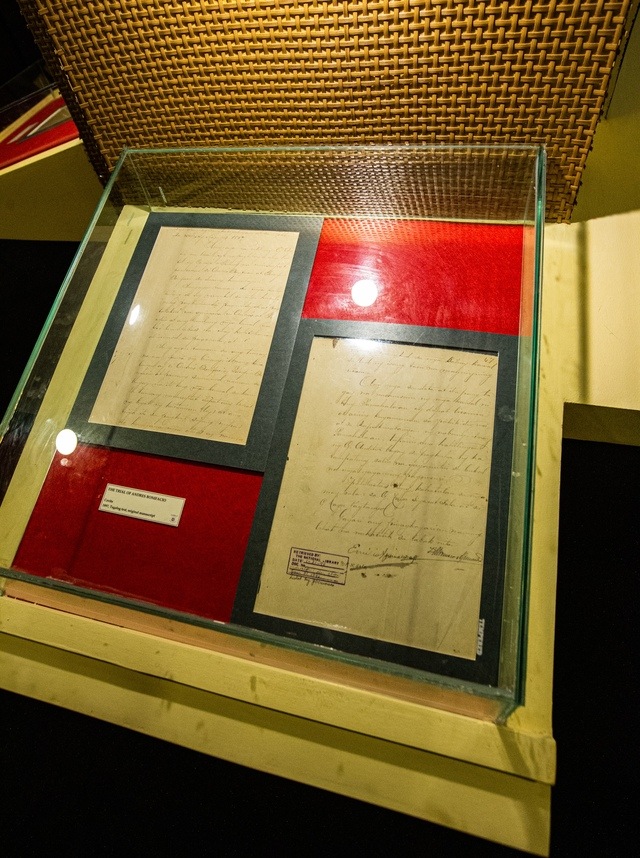
One of the greatest what-ifs of the Philippine Revolution revolves around the death of Katipunan Supremo Andres Bonifacio and his brother Procopio—what would have happened had the national hero not been sentenced to death for sedition? The answer is actually written on the official trial record now on display at the Permanent Gallery, plain for everyone to see. When the military court wanted the Bonifacio brothers executed, then-President Emilio Aguinaldo suggested they be exiled instead. Completely handwritten, the original record remains proof of one of the greatest controversies in Philippine history.
The Katipunan Oath, Signed in Blood
There would be no Philippine Revolution without the Katipunan, which started out as a secret society before it was discovered by Spanish authorities in 1896 and then the fighting began. Operating incognito, the Katipunan had initiation writes that included signing a blood compact where a new member would swear to defend the cause. One example written in Ilocano and signed in blood by one Benito Lardizabal in 1900 exists to this day and is on display at the National Library alongside the Katipunan’s own book of rules and regulations, as well as an actual certificate of membership written in Tagalog.
Ninay, the First Novel Written by a Filipino
Pedro Paterno is often infamously remembered as one of Philippine history’s OG balimbing, starting off on the side of the Spanish before jumping ship and somehow ending up president of the Malolos Congress—only to become a member of the first Philippine Assembly when the Americans took over. But before his name was marred in political notoriety, Paterno was actually one of the Philippines’ most important authors. His works Ninay: Costumbres Filipinas and Sampaguita y Otras Poesias Varias are credited as the first novel and first collection of poetry written by a Filipino—-making his works on display an important part in the early stages of the Philippine Revolution.
Constitution and Treaty of Biak-na-Bato
Though it referred to itself as the Republic of the Philippines, many refer to Aguinaldo’s second revolutionary government as the Republic of Biak-na-Bato to avoid confusion. Though it was never able to be recognized internationally, this revolutionary state did have a constitution. Said constitution is now on display alongside the document that ended it just over a month after it started: the Treaty of Biak-na-Bato.
Signed by Emilio Aguinaldo and Spanish Governor-General Fernando Primo de Rivera in 1897, the (short-lived) Treaty of Biak-na-Bato would temporarily halt the hostilities between the Filipinos and the Spanish—one of the conditions for which was the exile of Aguinaldo and his men to Hong Kong. Spoiler alert: Aguinaldo would come right back when the Spanish-American War started in 1898.
Also read: 10 Libraries in Metro Manila That Are Open to the Public
Acta de la Proclamacion de Independencia des Pueblo Filipino and Emilio Aguinaldo’s Act Proclaiming Philippine Independence
Did you know that the Philippines proclaimed its independence from Spain not once but twice in 1898? The first time, and the one people will be most familiar with, was on June 12, 1898 in Kawit, Cavite, where Aguinaldo famously unfurled the Philippine flag for the first time.
However, the Acta de la Proclamacion de Independencia des Pueblo Filipino from that day was actually written and delivered by Aguinaldo’s confidante Ambosio Rianzares Bautista. It would be signed by 98 people in attendance—though eagle-eyed visitors will notice that Emilio Aguinaldo himself was not one of them!
Also noticeably absent is the signature of Apolinario Mabini, who became Aguinaldo’s main adviser on June 12 but arrived too late to stop the proclamation from happening. And too late to remove dangerous statements in the original proclamation that stated Philippine independence was under the protection of the “Mighty and Human North American Nation,” underscored by the presence of American officials on June 12.
Mabini would correct these flaws himself by drafting Emilio Aguinaldo’s Act Proclaiming Philippine Independence, which would be signed by 190 elected officials—and finally, made “the legitimate version” by Aguinaldo itself. Both 1898 proclamations of independence are on display now at the Permanent Gallery.
Himno Nacional Filipino by Julian Felipe
On June 12, 1898, the Philippine flag was revealed for the first time—and on that day, so was the Philippine national anthem composed by Julian Felipe. The musical score that you see on display in the National Library is one of the copies given out to people so they could follow along, set to lyrics from a Jose Palma poem called Filipinas. These were actually originally in Spanish—and decades later, President Ramon Magsaysay would form a commission to revise the lyrics to give us the Lupang Hinirang we know and sing today.
Manuel L. Quezon's Desk and Chair
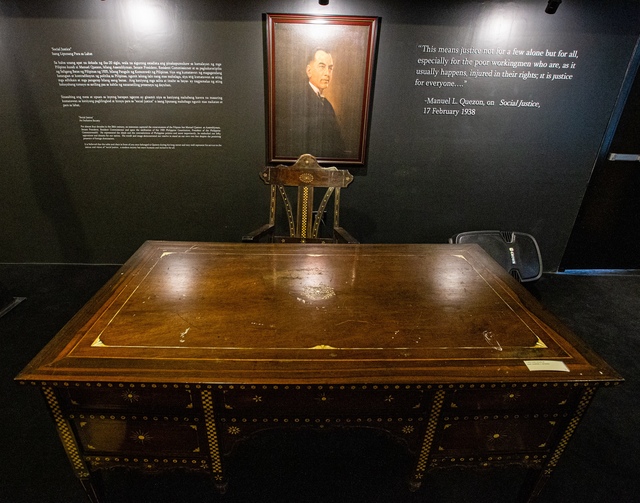
As the first president of the Philippine Commonwealth, Manuel L. Quezon started his term working towards the country's independence from the United States—a plan that was promptly derailed by the events of World War II. Many of his plans and decisions were made from behind this capiz shell-embellished desk and chair that now sits in the Philippine National Library Gallery. And though many will assume the scrapes and gashes on the wooden surface were made over time, with historians knowing that Quezon was a heavy smoker, there are also theories that they might be from the late president cutting cigarettes and cigars with a knife.
How to access the gallery
The Permanent Gallery is on the 4th floor of the National Library of the Philippines, which is located along Kalaw Drive in Ermita, Manila, and is also part of the Luneta Park complex. Take note: there is limited parking, and as with anywhere in the park complex, it's generally best to hail a ride or use public transportation. Entrance is free—though you’ll have to present one valid ID to get a stub to enter the library itself. Another option would be to register for a Reader’s ID.
For more information for your visit, follow the National Library of the Philippines on Facebook and Instagram, or visit its official website.
Special thanks to archivist Eruel Olvina from the National Library of the Philippines for his assistance in creating this feature.