

PH History Bites: This Warehouse Hides One of the Oldest Houses in Cebu
A marker of history obscured by time.

(SPOT.ph) Along Zulueta Street, just a stone’s throw away from the Heritage of Cebu Monument, is a warehouse full of tubes, hoses, and wires. From the outside, there is little to suggest that it contains anything else aside from the mundane—the sign that identifies it as a museum is easy to miss—but take a closer look and you’ll find an entirely different story. Within this warehouse lies the Museo Parian sa Sugbo - 1730 Jesuit House, one of the oldest houses in Cebu, hidden in plain sight.
Also read: This Ancestral House in Cebu Is One of the Oldest in the Philippines
How the 1730 Jesuit House was obscured, and brought back, by time
According to Jaime “Jimmy” Sy, the current owner of the property, his father the late Nicanor Sy, bought the estate from the Alvarez family sometime in the 1960s. The house, which consists of two buildings, wasn’t purchased to be used as a family home, however, but as a place where his father could work and take breaks while the rest of the compound was turned into a warehouse.
So that's where you will find the Jesuit House now, located within a warehouse. It's not where you'd expect it to be, but hey, at least it's still there; for a small fee, you can even take a tour of this marker of Cebu's rich heritage.

At the time it was bought by the Sy family, no one suspected it to be a Jesuit residence. They knew the house was old, of course, for while both buildings had undergone several changes over the decades, certain architectural details, such as the limestone walls and wooden floorboards, hinted at its senescence.
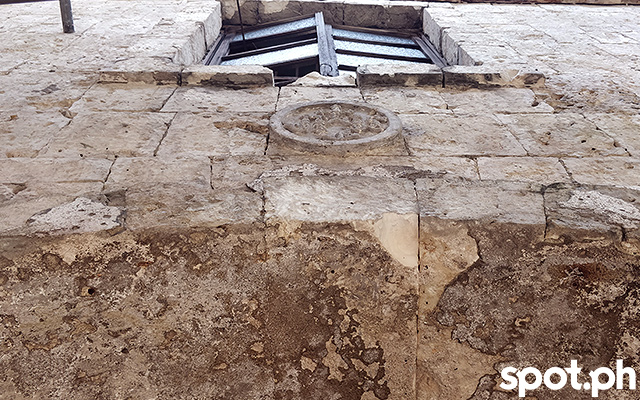
Another important clue to the house’s antiquity is the medallion inscribed with the year 1730, found on the wall right above the connecting bridge that leads visitors from House A, the building with an exterior of limestone, to House B, the second building that is theorized to have been an azotea or balcony where the Jesuit priests might have prayed in solitude or held community gatherings.

A third building, which is purported to have been a watchtower, is located at the end of House B. Only the base remains today, but a tattered painting of the residence reportedly shows what it might have looked like in the past.
While little is known about this building, history has long documented the presence of watchtowers along Cebu as a defensive network against possible Moro raids. “Don’t forget that from the area, you can see that we are actually facing the Mactan channel,” Sy explains. “That’s where most of the vessels would [have] come in from.”
An accidental discovery
Despite the apparent history of the house, it wasn’t until much later, when Sy was in university, that he and his family realized that the house had once been a Jesuit residence. To this day, he finds the circumstances of his discovery remarkable.
“In the ‘70s, I was in Ateneo doing research in the library when by accident I pulled out a book that talks of the house,” he says. According to Sy, the book had nothing at all to do with what he needed to look up. It had been written by a Jesuit priest named Father William Repetti who had a passion for researching old Jesuit houses and churches in the Visayas.
The moment Sy saw the photo of the house, he immediately recognized it as his family’s property along Zulueta Street. “I was shocked,” he recalls. “Without mistake, I knew it was our house.” The strange connection wasn’t lost on him either. It wasn’t just the fact that his family owned a Jesuit house and that he ended up studying in a Jesuit university. Back then, Father Repetti was also connected with the Manila Observatory, which was then located inside the campus.

Sy had the pages photocopied and sent back home to his father. Unsurprisingly, the former Sy patriarch showed little interest in the discovery. “My father wasn’t a collector of antique stuff, so to him it was nothing. To him this house was just a house for his own purpose as a warehouse—nothing else.”
Nevertheless, the house’s identity had already been revealed to Sy, and throughout the years, there would be constant reminders that the house was at one point an important Jesuit residence. After he graduated from university, he noticed more and more Jesuit priests stopping by and asking to see the house. One of those priests was Father Rene Javellana S.J., a Jesuit art historian and archivist, the same man who would later be instrumental in the preservation of the house.

The restoration process
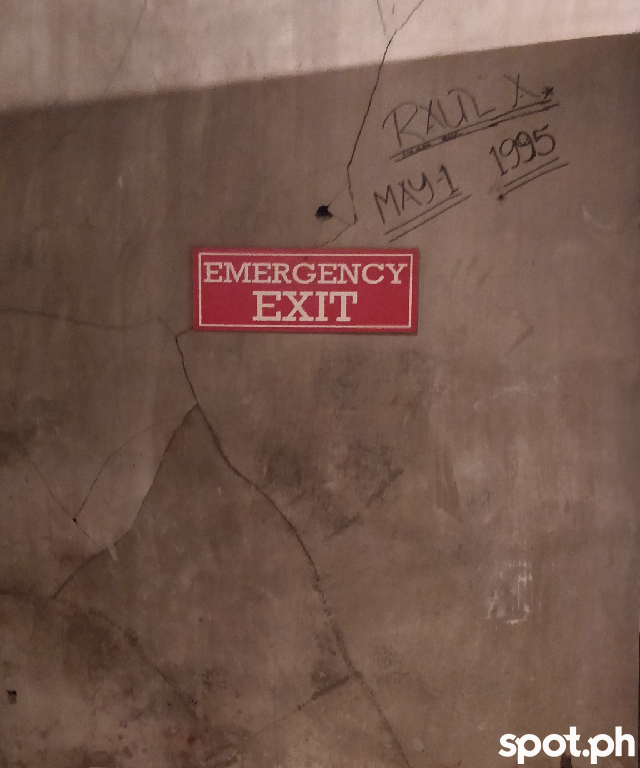
Decades after discovering the house’s provenance, the family continued to use the compound and some areas of the property as a warehouse. In fact, visitors today can still see traces of its previous incarnation on the ground floor walls of House B left behind perhaps by some workers. It would have likely kept on being used as a storage facility had it not been for an unexpected and devastating incident.
In 2007, the family’s shop in the Carbon area burned down. The fire cost them nearly everything. What little they had left was whatever remained in the warehouse along Zulueta Street.
Sy, who was already 56 years old then, began to give serious thought to doing something about the house. Not knowing how to go about it, he talked to his friend, Bobby Aboitiz, the owner of Casa Gorordo Museum, who urged him to open the house to the public and invited him to see how they had done it with their own historic property.
Sy had also not forgotten Father Javellana, one of the Jesuit priests who had talked to him about the house a long time ago. “I asked him to come down, and he came down with two architects. He told me, ‘Okay, I’ll write a concept paper on it. All you have to do is just follow what I’ve written.’”
Two weeks later, Father Javellana emailed him with a complete plan. Sy asked his cousin, an architect, to go over the paper, who also suggested that they check the integrity of the house. They then discovered that the wooden pillars that have been holding the house up for hundreds of years were in dire need of repair.
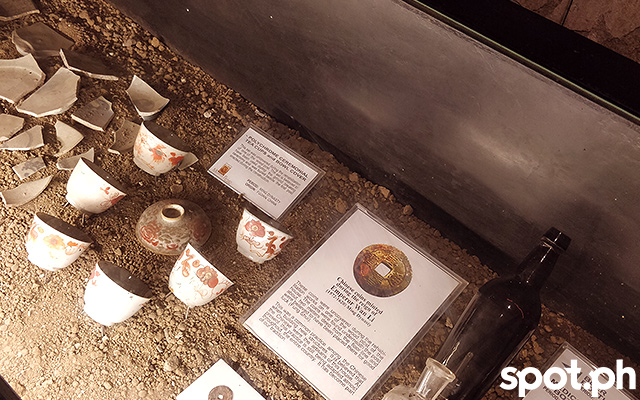
In the process of fortifying them, they ended up discovering a lot of important historical artifacts by accident. These include ceremonial tea cups from China, perfume bottles, animal bones, shells, and even a Chinese coin minted during the Ming Dynasty.
One could say that these artifacts aren’t the only remnants left in the house. Before pushing through with his project, Sy enlisted the help of a friend from Manila who could communicate with spirits. After all, a house as old as theirs was bound to have at least one. What he didn’t expect, however, was the number of the dearly departed that the house allegedly had under its roof.
“As soon as [my friend] got in, he was already waving his hand,” Sy recalls. Later, his friend told him that there were spirits from all walks of life and different age groups—enough to probably fill 10 cemeteries—in the house. Fortunately, they weren’t opposed to Sy’s plan to turn the house into a museum. In fact, when Sy’s friend asked them about it, the spirits had apparently replied, “It’s about time!” Sy jokingly adds that his father might have even been one of them.
The residence’s original entrance along Binakayan St. has been closed off, but if you look closely, you might still be able to make out the medallions of Our Lady, the Society’s IHS, and St. Joseph.

Intricate histories
While Sy’s father didn’t care much about the house being a Jesuit residence when he was still alive, he did show an interest in one important historical and architectural detail: the craftsmanship. Despite not having had any formal education in architecture, the older Sy had no doubt that the house had been built by Chinese artisans. Architects today have reason to come to a similar conclusion. “Look at the corbels. Look at the beams. These are Chinese-style,” says Sy. “And if you’ll notice the door of the Jesuit Gallery, the door is typically Chinese, the way the lock is made.”
The furnishings in the house are no longer original, but the family has tried to recreate the past as much as possible by sourcing antique pieces and commissioning replicas.


The fact that the house is in Cebu’s Parian district, a prominent Chinese mestizo settlement during Spanish colonial rule, lends credence to the speculations. When the Spanish government first sent the religious orders to the Philippines, the Jesuits were reportedly assigned to the eastern Visayan islands, and according to the research by the late Jesuit writer and historian Miguel A. Bernad S.J., they felt the need to establish a central house, which was why they settled in Cebu.
Building a Jesuit house specifically in the Parian district, however, could have been strategic in other ways, according to Sy. It was said that when the Jesuits came to Cebu, they were given the mission by their bishop of christianizing the Chinese. “And the Jesuits were [apparently] more than happy to do that,” Sy says. When he asked Father Javellana why, the priest gave him a simple answer. “‘Because when the Jesuits came, they had their eye on China.’”
Perhaps their efforts to evangelize the Chinese community had led the Chinese craftsmen of the time to donate their skills in building the house. After all, the Jesuits appeared to have successfully assimilated themselves in the community, even learning to speak the language in the process. Perhaps said efforts had even contributed to the group’s mission to China.
However the house first came to be or how important its location was to the overall Jesuit mission, it’s clear that its history isn’t just invariably connected to a time period or place, but also to the lives and circumstances of the people who had been involved in it. Perhaps in finding these connections and unearthing their context, we may better understand the motivations that helped shape the political, religious, and social landscape we move in today.

The Museo Parian sa Sugbo - 1730 Jesuit House is registered as an Important Cultural Property, which means that whoever owns it in the future will not be allowed to demolish it. It is located at 26 Zulueta Street, Parian District, Cebu City. For more information, visit their Facebook page.
Museum Hours:
8 a.m. to 12 noon
1 p.m. to 5 p.m.
Monday to Saturday
Admission Rates:
Php 100 - Adults
Php 50 - Students
*Senior citizens and PWD get 20% discount