
Crosta's Chef Yuichi Abellare Ito Is Raising the (Pizza) Bar to New Heights
The Japanese-Filipino chef brings his flair to the rising pizza scene in Manila.
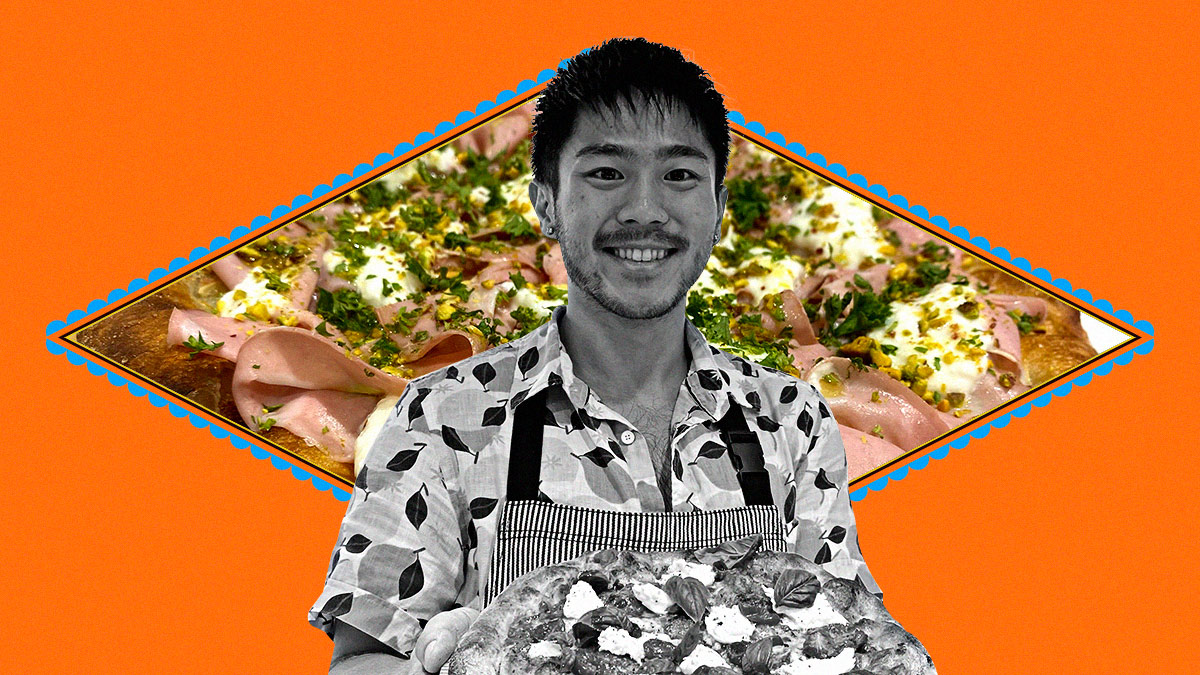
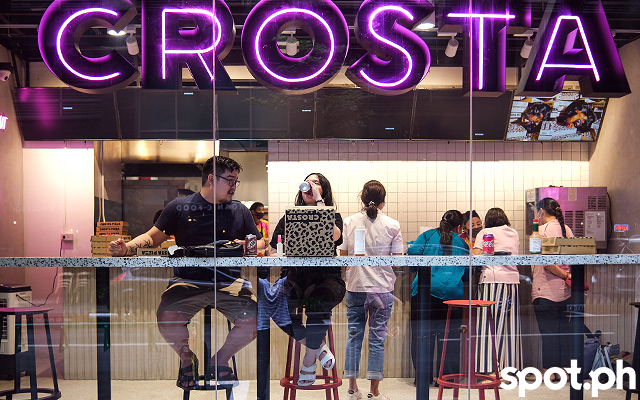
(SPOT.ph) It was a fairly busy Wednesday for Crosta Pizzeria’s Salcedo Village outpost, which opened just last year but has gone on to become one of the area’s most popular gems. Old-school Japanese city-pop and 70s disco tunes played from the speakers as hungry diners would come and go; and even on a weekday afternoon (usually lull time for other restaurants), tables were occupied for the most part. The Crosta team, of course, was prepared for this, dishing out pizza after pizza, all hot out of the oven. But perhaps the hottest topic surrounding the pizzeria in recent months was the welcoming of Chef Yuichi Abellare Ito into the Crosta team as their new head chef.
Ito, after all, has worked the kitchen of no less than the Mandarin Oriental Tokyo’s Pizza Bar on 38th—which has been awarded and/or included in lists of the likes of the Michelin Guide Tokyo (specifically the guide’s Bib Gourmand award in 2022 and 2023), Italian food and wine magazine Gambero Rosso (who gave them three-slice ratings—the highest possible “pizza score”—in 2022 and 2023), and 50 Top Pizza (where they placed third in the Asia-Pacific region in 2022, among other awards).
Crosta, too, has long had a cult following locally, from their beginnings as an under-the-radar stall serving killer sourdough pizzas at Poblacion’s The Social on Ebro in 2017, to their surge in popularity over the course of the pandemic (during which time the brand also expanded to have more crust styles and even vegan pies to choose from). Ito’s joining the Crosta roster in February would signal a new era for the pizza shop—one that still features the stellar slices and topping combos they’ve long been known for, but also new numbers showcasing Ito’s creativity and culture-crossing approach to the Italian classic.
Also read:
Famed Brand Crosta Teaches Us the Art of Cheese-Crusted Pizza at Their Salcedo Outpost
Crosta, a mano + Wildflour Italian Named Among Best Pizzerias in Asia-Pacific
Chef Yuichi Ito shares his story and what you can look forward to at Crosta Pizzeria:
At just 30 years old, Ito—who was born in Japan, to a Japanese dad and Filipina mom, but spent much of his early years in the Philippines—has had quite the journey getting to where he is now. He’s long loved food and cooking, having been influenced by his mom who’d take him around the palengke in the Philippines, and who would have him try all sorts of foods and ingredients whenever they’d visit Japan. “That was very memorable,” Ito relays. “I think I developed my appreciation for food [because of those].”
It's also in his genes: his Filipino grandfather used to own a lechunan, and his mom used to own bars in Tokyo; Chef Yuichi’s sister is also a chef, herself. In his youth, he would also often prepare pulutan to go with alcoholic drinks he’d serve to his friends, whenever they’d visit his home—beginning with playing around with canned goods, to making more elaborate dishes using fresh ingredients (e.g., sisig using pig’s ears and maskara and all!).
By the time Ito was about to enter college, he became torn between pursuing Culinary Arts or going into Accounting. He ended up going the latter route based on his parents’ advice. “They said, ‘It’s better to take up Accounting ‘cause in the end you get a lot of money, you get to settle down early in your years…’ I said, ‘Yeah! I’m a good son,’” he laughs.
Ito did enjoy studying Accounting in some ways, being into subjects like Physics in high school, and stayed the course for three years—but started having doubts once he started training and seeing the reality of working in a corporate setting. “Once I saw people sitting in the office, seeing people sitting down… [I realized] I don’t think I can contain myself in one spot for [even] an hour. I need to move,” he chuckles. “I’m very physical—I move a lot, I go up and down our office, I walk a lot. For me, staying in one place, I think it’d give me body ache.”
He didn’t automatically throw in the towel, though; Ito spent his last semester doing cooking school in the mornings, then his Accounting studies at uni in the evenings; the phase lasted about three or four months. But it was at cooking school that he shares he “felt like home."
“Like usually when I’m at school [taking other subjects], things just go in and come out. But at cooking school, all the things I remember. Everything. What my chef told me, everything every day.” Knowing the culinary route was the true way to go, he opted to just finish that semester in Accounting; he left the university right after, and decided to go full throttle into the professional kitchen.
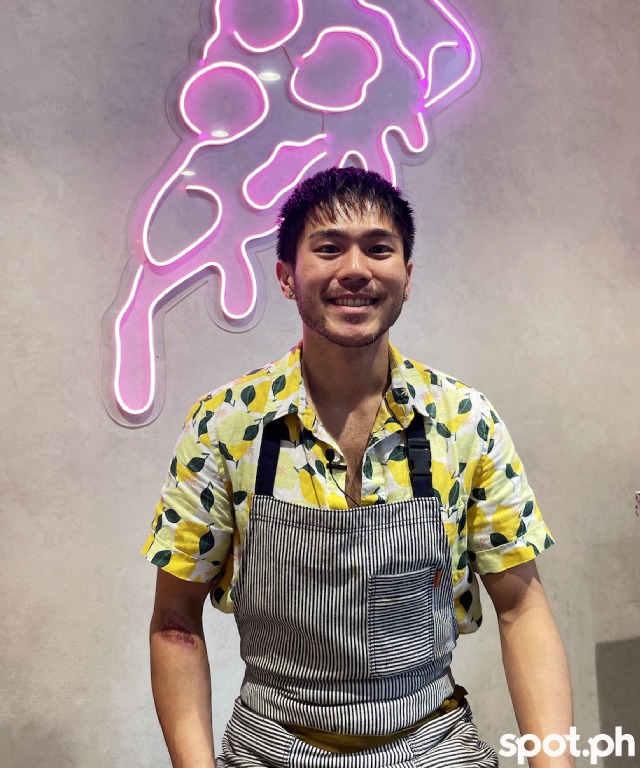
By cooking school, he's talking about the International School for Culinary Arts and Hotel Management (ISCAHM)—where Ito got to master French basics and learn Asian techniques. “I just fell in love with all the things that was happening—about the food, about the science behind this and that. And I think it challenged me as a person as well, [because] working in a professional kitchen is very hard—it’s not for everyone. You stand up for like 16 [to] 18 hours… sometimes not even [get to take] a break. And for me, it’s okay. I don’t care ‘cause I love what I’m doing.”
Beyond being taught the fundamentals of cooking, they were also given a feel of the real-life literal and figurative heat of the kitchen. “[I learned] not only about cooking, but [also about] the mindset that we really needed… I think the kitchen is a tough environment,” he shares, admitting the media-depicted scenarios on TV with the likes of Gordon Ramsay isn’t too far from reality. “So what they did at ISCAHM was prepare us for this kind of situation.” Still, Ito found himself loving the energy and the craft and would spend almost every day at school—so much so that at one point, his mom got “upset,” as she thought he was just playing around. “I think they were just worried that I wasn’t taking it seriously.” He’d even spent his weekends as a student assistant to his mentors teaching short cooking courses to folks of all ages.
It didn't take long before he landed a stint in the kitchens of EDSA Shangri-La, working with Roberto Cimmino. “He was my first boss… and that was my training [in Italian cuisine],” Ito shares. “I really enjoyed working with him [and] I didn’t think of the money… it was about learning something.” Cimmino soon suggested it be best he let his talents shine outside the country, encouraged him to pack his bags, and introduced him to a chef friend in Tokyo who owned a restaurant.
“It [sounded like] a good idea because, first of all it’s a Michelin-starred restaurant, and [the chef] was a friend of his so there’s already familiarity.” Ito moved to Tokyo and got an interview the next day. “And after that I worked right away,” he says, chuckling.
Japan, of course, isn’t foreign to Ito at all given his half-Japanese roots—though it’s nevertheless home to a completely different audience as the Japanese are more after excellent quality than affordability per se when it comes to their food.
But persevere he did, and he eventually came to work for Pizza Bar on 38th, helmed and mentored by Chef Daniele Cason (who he deems “family” to this day!). In the 10 years he worked with Cason, he’d learn all the nitty-gritties of Italian classic that is pizza, working his way up from the bottom to becoming sous chef and soon head chef of Pizza Bar. The restaurant, of course, which would go on and rake awards left and right.
Crossing Paths With Crosta
Ito came to know Crosta’s Ingga-Cabangon Chua and Tommy Woudwyk at the 50 Top Pizza awarding in Bangkok in 2022, where Pizza Bar placed third and Crosta, 32nd (they were one of the only three Philippine spots on the list!). Cabangon-Chua and Woudwyk would soon visited Ito’s restaurant in Tokyo—where they came to discuss the lagging state of the Philippines’ food scene compared to its neighbors.
“It’s 10 to 15 years behind the food scene in Japan… [while] Bangkok and Singapore and Hong Kong are moving so fast. It feels like the Philippines has always been behind,” he laments. “I think there's a perfect time doing something unique where you can open up people to be more experiments on what they're eating and to introduce them to something or better quality.” (More on that shortly.)
With that, they’d decided it be the perfect time to try and bring Ito to the Philippines—so as to introduce his spunk and creativity into the Manila scene, and to raise the standards on how Filipinos view their pizza.
Chef Yuichi’s Approach
Ito’s experience at Pizza Bar taught him infinitely many things about producing spectacular pizzas, from crust to topping and from edge to edge. He’s not necessarily looking to replicate the exact same pies at Crosta, however. “Pizza Bar… it's a very big company inside. So we had a lot of guidelines to follow,” he explains. “Lots of dietary restrictions. Lots of rules.”
At Crosta, it’s the opposite: “Like, there's no rule. Everything goes. Everything will go as long as it's good. As long as it's exciting. As long as we think that it will sell for people who would like to.” Of course, Yuichi still keeps the resulting flavors in mind. “We always follow a [guide]line where we have to set our standards before we put out a certain pizza. Doesn't [necessarily] mean [if] it's crazy, it's good… We want to be crazy, but same time, good.”
Some stay true to tradition, as Ito still pays respect to Italian cuisine. “The way I see Italian cooking is very, I would say almost very Italian… I would say because I worked with a lot of Italians,” Ito (who, fun fact, can also speak Italian) relays. “I learned a lot of classic flavors. And for me, [when] learning different foods from another countries… learning [about their] culture is very important. Because the way they think affects the way they would put food’s flavors into [a dish].”
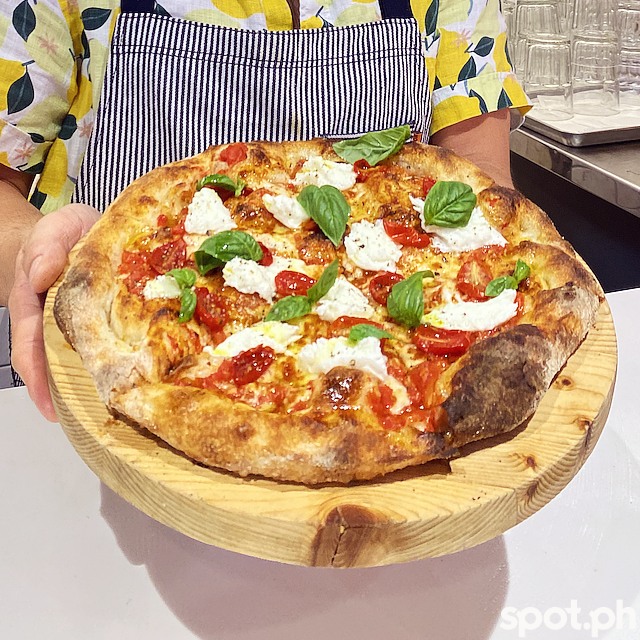
Still, he admits his approach to Italian is “still Japanese in a way.” You’d sometimes find him adding Japanese ingredients to his pies—ikura, Japanese swordfish, sakura trout, and so on (keep an eye on Crosta’s socials for updates on those specials).
“Because I worked with a lot of Japanese chef's Italian restaurants. So I have a lot of techniques where I apply Japanese cooking in Italian or other way around, if I think [a certain] technique would be better for [a certain] dish,” he explains. “But I wouldn't say my food is fusion… I just describe it as Italian food with a touch of Japanese technique.”
And where he goes playful, he goes all-out mischievous, in many ways mirroring his own frisky personality. Together with the rest of the team, they make pizzas with more contemporary toppings and components (beetroot, Marsala-marinated cherries, even pumpkin!), techniques, and so on that expand on the notion of what belongs on a pizza—in many ways expanding our knowledge on how versatile the pizza medium really can be.
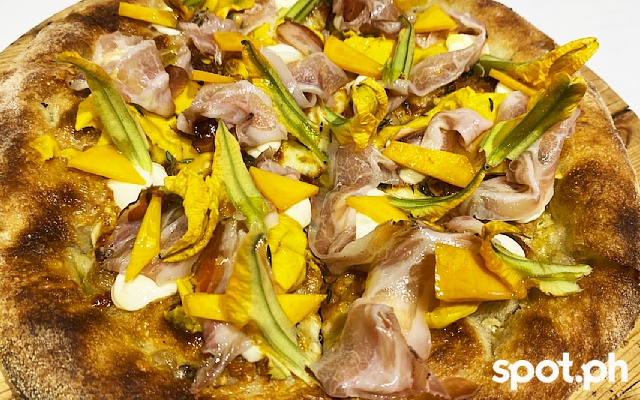
Chef Yuichi makes the effort to make what they can from scratch, even their charcuterie where applicable—e.g. house-made prosciutto in the aforementioned Pump-Cetta, and duck prosciutto on another special they once had dubbed the Duckin’ Good. They’re not afraid to put fine-dining caliber elements on their pizzas, either—some examples being fresh black truffles (which you can opt to have shaved on top of their Morty & Ella 2.0 pizza as an add-on), a foie-gras mousse (on the Duckin' Good), even Amur sturgeon caviar on a Mother’s Day Pie special they released just a few weeks back.
Raising the (Pizza) Bar, and What We Can Learn From the Land of the Rising Sun
Chef Yuichi brings up the more focused approach Japanese chefs tend to take, and how we could take a page from it. “[In Japan,] chefs think so deep about everything [and] we always try to specialize in one particular item,” he explains. “When you go to Japanese restaurant [there], you don't get sushi and tempura at the same place… [Here in the Philippines] you get tempura, sushi, and ramen in one place, but this one [almost] never happens for us [in Japan]. Unless you go to fast food… But in general, if you go to the higher end [it’s more focused.]” He takes a similar approach for himself, taking “one step, one cuisine at a time, one product at a time.”
“Because the way I see it is something similar to how Japanese chefs would learn something… you learn it one by one because you can focus on what you're doing. You can put on your time, you can actually work on your stress or your energy on one particular item. And you end up having a high-quality product. And then after doing [that] and reaching a certain level, you study something else.”
This emphasis on quality and keen attention to detail is a theme that’s apparent across our interview. Ito cites Toyo Eatery as an example of an establishment that’s raising the stakes and becoming “very welcomed by a lot of people” from it. “But still, what we’re trying to offer is something we could also bring everybody else—not just restaurateurs, but consumers—to learn [aspects like] ‘Why do you have to use this product?,’ and [the value of food that’s] better quality and not always think about, ‘How cheap is it for?’”
“Compared to Tokyo, we’re still far away,” Ito admits when asked about the Italian food scene here. “But I think it’s not because of the chefs, [but because of] our [limited] access to products.” The caliber of products Japan gets, he explains, is very different from what weget in the Philippines. “Because again, our market is different, right? There, [the] market is high. People know what it is. So I think that's one of the main problems.”
He acknowledges—and laments—the tendency of Filipinos to think imported is necessarily better. “Of course they're better, because we're not taking care of our own,” he says. “[But] whenever I say [a certain ingredient or component is] local people sometimes get surprised… So I like going into the markets. I like seeing my own products.” Ito then takes these Japanese techniques and applies it to local ingredients where applicable.
He likewise admits that quality can cost more. Still, he explains, educating diners is one of the keys to raising the stakes for the Philippines’ state of dining. “At the end of the day, if you're eating better quality, everything goes better… and we want to educate people as to why you'd be on this product and why they have to have this product in the country.”
“Hopefully, we can catch up as far away. I'm sure [we can]. It's not impossible.”
Hey, Spotters! Check us out on Viber to join our Community and subscribe to our Chatbot.