

Iai
G/F The Montane, 8th Avenue corner 35th Street, Bonifacio Global City
Instagram: www.instagram.com/iai.manila
Open from 6 to 10 p.m., Tuesday to Sunday
(SPOT.ph) With his martial arts background, it's not surprising Chef Bruce Ricketts is someone who directs his focus toward the mastery of his craft—even if that craft is something as seemingly simple as making sushi. I see this in practice from our seat at the chef’s counter of Iai, his new restaurant in BGC where he is joined by his partner Jae Pickrell. We're some three-fifths into the omakase (during its nigiri arc which I elaborate on later) and I see a member of the kitchen team hold a metal tray from which smoke emanates; her other hand holds a netted mat with fish. Ricketts scoops out rice from a special donabe (clay pot) by Ippentoh Nakagawa ("I think it makes for nicely textured rice and also pulls out a lot of the rice’s natural sweetness," the chef says) and uses his hands to shape a wad that would form the sushi's base. It doesn't take long before he places a muted pink Smoked Otoro on the slate in front of us.
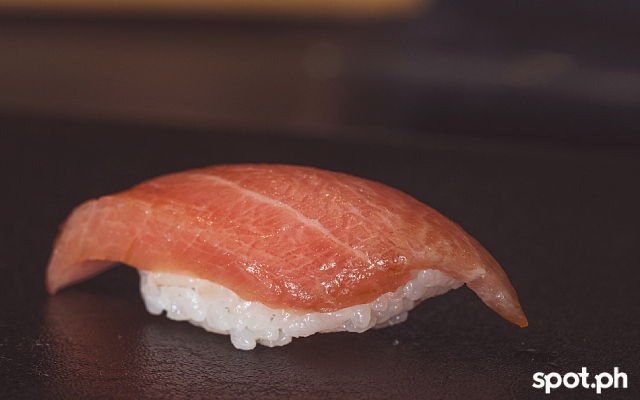
A subtle smokiness issues out of the fatty tuna, which has been dry-aged until Ricketts felt the oils and meat have become "harmonious"—and the meat is no longer oily. After the dry-aging, the meat is then smoked in its fat trimmings, which is what we witnessed just a few minutes ago. The pale-pink, fat-streaked flesh gleams now against the restaurant's soft light. The fish looks so delicate you could almost feel it quiver, but I pick up the piece with my fingers and place it in my mouth. Cue fireworks: the tuna is just meaty enough that it gives a soft bite before unleashing its characteristic butteriness on the tongue. Then it just about melts onto the rice underneath, which is seasoned ever so slightly and is a touch warm from being shaped by hand. A strip of the gari (pickled ginger) on the side refreshes the palate just enough without obliterating the memory of what preceded it.
This harmony can only come from paying attention to every part of the nigiri equation, and executing each of those parts to perfection—which can only come with practice and lots of hard work.

And Ricketts has definitely put in the hard work, going by the Japanese ethos of shokunin (loosely translated as devotion to one’s profession, and striving for perfection), which the chef has always espoused.
Ricketts' sushi-making pursuits are years in the making. We recall his first job at Japanese fusion resto-club-bar Robot in the early 2010s, and him whipping up modern-style maki and nigiri at BF Homes hole-in-the-wall Sensei Sushi (although this covered more general Japanese-inspired fare, he clarifies). It was on a 2015 trip to Japan, however, that he began studying sushi more seriously. "After encountering masters in Japan, that’s when I felt a strong connection to the craft, instantly being able to relate to the day-to-day work and the reality that comes with this kind of work," he shares. True enough, we saw a leveled-up Ricketts pulling out his best chops at Mecha Uma; and as that closed, we witnessed him assembling top-rate donburi at his temporary Go by Sensei at The Grid earlier this year.
"It’s repetition, time, and experience that really plays a key role," Ricketts says. Yet this doesn't boil down to following a formula as one might assume. "I think with making nigiri, it’s about striving for a certain feeling within the bite, and the intention or what we’re trying to bring out," says Ricketts. "So yes, we may have a recipe for making sushi rice and curing fish, but it’s important to be sensitive and make micro adjustments daily. The rice-to-water ratio can change; the salting and manipulation of the texture of the neta [or topping] based on the fish size and oil content can always vary. I also have to consider pressing and shaping for the customer, like how tight or loose should I pack it depending on how I want the rice to spread in the bite."

Also read:
Bruce Ricketts to Bring His Martial Arts Philosophy + His Stylish Wife’s Eye to Next Restaurant
Bruce Ricketts & Jae Pickrell: How a Magazine Editor Upped an Already Formidable Chef’s Game
Welcome to Iai, Chef Bruce Ricketts and Jae Pickrell's new restaurant in BGC
The restaurant name takes after iaido, a form of Japanese martial arts. Iai is primarily a sushi kappo, with kappo referring to small restaurants with bar counters serving multicourse meals that are somewhere in between laid-back izakaya fare and high-end kaiseki. This highly anticipated next chapter to Ricketts’ opus Mecha Uma (which closed late last year) is as much a professional endeavor as it is the result of the labors of love of Ricketts and Pickrell. It marries Ricketts’ impressive culinary knowledge and Pickrell’s impeccable eye for design.

Pickrell's eye for knockout visuals—a natural byproduct of her years in fashion media—comes through in Iai’s interior design. “The main inspiration is brutalism and wabi,” Pickrell explains in an exchange with SPOT.ph.
Per the recommendation of friends in F&B, they enlisted the help of Studio Ong, who’s also behind the interiors of Inato and the renovation of Toyo Eatery. That Studio Ong is comprised of a young team worked in Iai’s favor. “They were very receptive to everything," says Pickrell. “I told them that I have a very specific idea of how I want the place to look like, and the vibe and energy that I wanted to achieve." She even made a mood board and sent the design studio books to help illustrate her vision. “I had very key references—Axel Vervoordt, Tatsuro Miki, all of these different artists.”

It took some three months to arrive at the design Iai flaunts today—one that evokes a grandness despite the intimate space and low ceiling; a space at once serene and refined. This being an omakase spot, a chef’s counter is right smack in its center, from where you can see the Iai team in action preparing your dishes. Private (ish) tables are available too, right by the glass windows that give you a glimpse of the BGC at night.
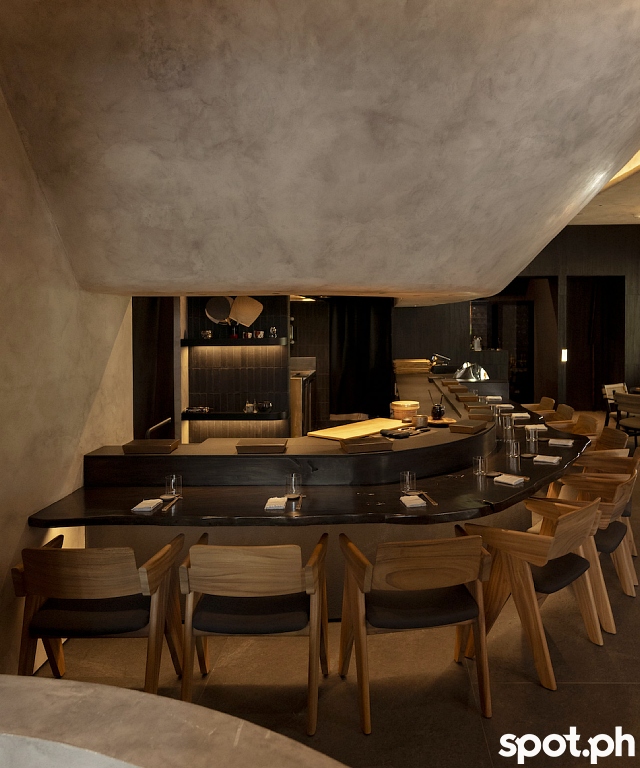
The Japanese motif is evident, albeit subtly expressed, with their use of Japanese elements that have been reinterpreted by local hands. The walls, for one, made with discarded panels of banana tree trunks that were dehydrated and painted black, is an ode to the traditional technique called shou sugi ban or yakisugi—which involves burning wood to strengthen it and give it a charred appearance. Look up and you’ll see pendant lamps that emit a soft light against the dim backdrop. They resemble Japanese hanging lanterns gone contemporary with their framed paper makeup and helix-like form (they even evoke the shake of the local salakot). The team also dons sleek black kimonos by Filipino-British designer Prince Padilla.

This weaving-together of Filipino and Japanese worlds is reflected as much in the cooking side of things. The direction and treatment are still largely Japanese, with traditional techniques and fresh Japanese ingredients peppering the lineup. At the same time, especially compared to Mecha Uma, Iai exhibits Ricketts' Filipino-ness as he uses homegrown ingredients (particularly seafood) from time to time.
“I think the way I see [my approach at Iai] is [that the goal is] really more to further my craft, then at the same time explore other ingredients that are more available and accessible to me here locally—but not force them,” says Ricketts. “I use them if I feel like it's fit, and then experiment and learn about them.”
In particular, Ricketts employs seafood from Basilan, whose waters remain largely “untouched” by outsiders given the years of political conflict in the area. Ricketts tells us he got connected with Basilan's marine life through a fish seller named Twinkle, who reached out to him and shared what the area has to offer. “Before we knew it, we went on an ocular na to meet, to see the place, and to meet different fisherfolk,” says Pickrell.




Comments