
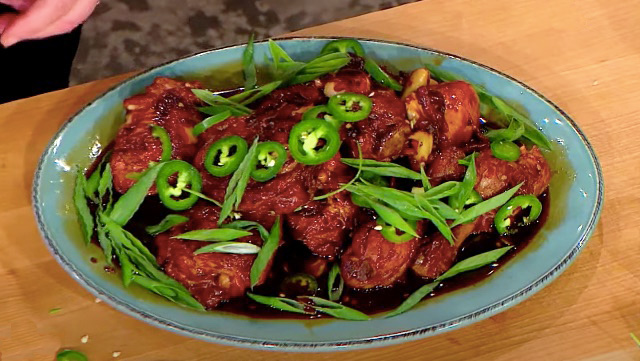
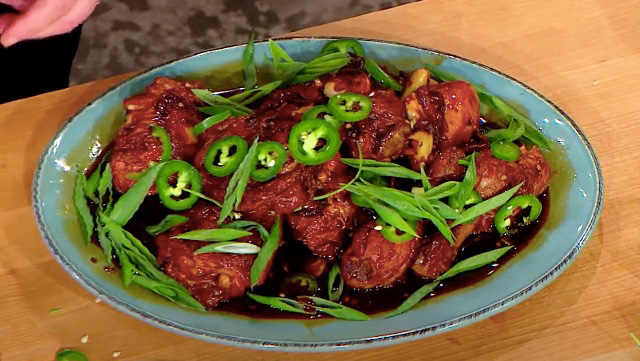
(SPOT.ph) Adobo is one of the Philippines’ most beloved dishes, and gaining international recognition is generally a good thing. So Rachael Ray making adobo on popular American show Good Morning America should be good news, right? Er, we’ll let you be the judge of that. Ray cooked adobo, all right, but let’s just say it’s unlike any other version we’ve seen before.
In the video description, the dish is described as "the ultimate Filipino comfort food" and "a saucy dish of dark meat spooned over rice and garnished with fresh greens", Rachel Ray’s take includes the typical vinegar, soy sauce, garlic, black pepper, and bay leaves—but also a couple of uh, interesting touches. She browns chicken pieces in extra-virgin olive oil, includes jalapeño peppers and green onions, and tops the braised dish with more jalapeños and green onions, plus cilantro (she suggests parsley as a substitute). Ray also serves it with "garlic rice"—deemed by Ray as "a big deal in Filipino cooking"—and her version is flavored with coriander seeds and topped with sesame seeds.
Based on the comments on the video, Filipinos are not so happy about Ray’s version. "It's not a bad adobo recipe. But you cannot claim this as a Filipino style adobo," says user Nikki Reyes. "That's not a Filipino dish. Who in the world gave you that freaking recipe?," says user Vianna Francisco. "Commenting from the Philippines! This is not FILIPINO CHICKEN ADOBO and Garlic rice is cooked with day old rice!," says user Lani Ayala.
People on Twitter were not exactly pleased, either:

Now, there is no one adobo in the Philippines—you’ll find different variations of from different parts of the country, such as adobong puti (with no soy sauce) in Visayas, adobo sa gata (with coconut milk) in Bicol, and adobo sa dilaw (with turmeric) in Cavite. Adobo is mainly a dish of protein that's braised in vinegar and flavored with garlic and black peppercorns—so Ray’s version still does count as one. And hey, it’s 2020; food, as with all art forms, evolves, and people should be free to adapt recipes (especially in other countries, where Filipino ingredients might not be so common!) and play with tradition in their kitchens.
Still, it would’ve been great if Ray explained how it's traditionally made and called her unconventional take “Filipino-inspired”, so as not to confuse her mostly foreign audience. Trying to cook dishes from other cultures is great; misrepresenting it is not. If the goal was to highlight the well-loved dish, then the least they could do is to at least give respect to adobo’s origins.
Hey, Spotters! Check us out on Viber to join our Community and subscribe to our Chatbot.