
All 10 Cinemalaya 2024 Movies, Reviewed
This 20th year edition seems particularly tuned in to concerns about the state of the nation.
(SPOT.ph) The Cinemalaya Independent Film Festival, in its twentieth edition, is screening ten new original full-length films from Filipino filmmakers. While the festival has always been a place for films that offer political commentary, this year’s edition seems particularly tuned to concerns about the state of the nation, offering up works that speak on electoral malfeasance, the rights of indigenous groups, the plight of desaparecidos, marijuana legalization, and more.
Here are our thoughts on the Cinemalaya lineup of full-length features:
An Errand - Immaculate vibes, missing plot
Sid Lucero stars in An Errand, written by Sarge Lacuesta and directed by Dominic Bekaert. Lucero plays a driver for a lawyer lying low in Baguio, and the plot kicks off with him being tasked with driving to Manila to pick up a T-shirt. The drive is mostly uneventful, but it gives him time to reflect on his plight and of those like him.
The vibes are immaculate, the visuals and the music combining to suggest a hidden world of long drives and conversations that aren’t meant to be heard. At some point, though, it might start hitting that the movie doesn’t really have much of a plot. The main character is an observer, and ultimately a small part of the world he navigates. That’s part of the point, even: the film seems to suggest that his work is a prison, his loyalty to his boss a chain that keeps him from ever approaching anything that resembles freedom. And maybe there’s something to that, but it keeps the movie from gaining any meaningful narrative momentum. In the end, he really is just running an errand.
Balota - Marian Rivera shines, in spite of toothless satire
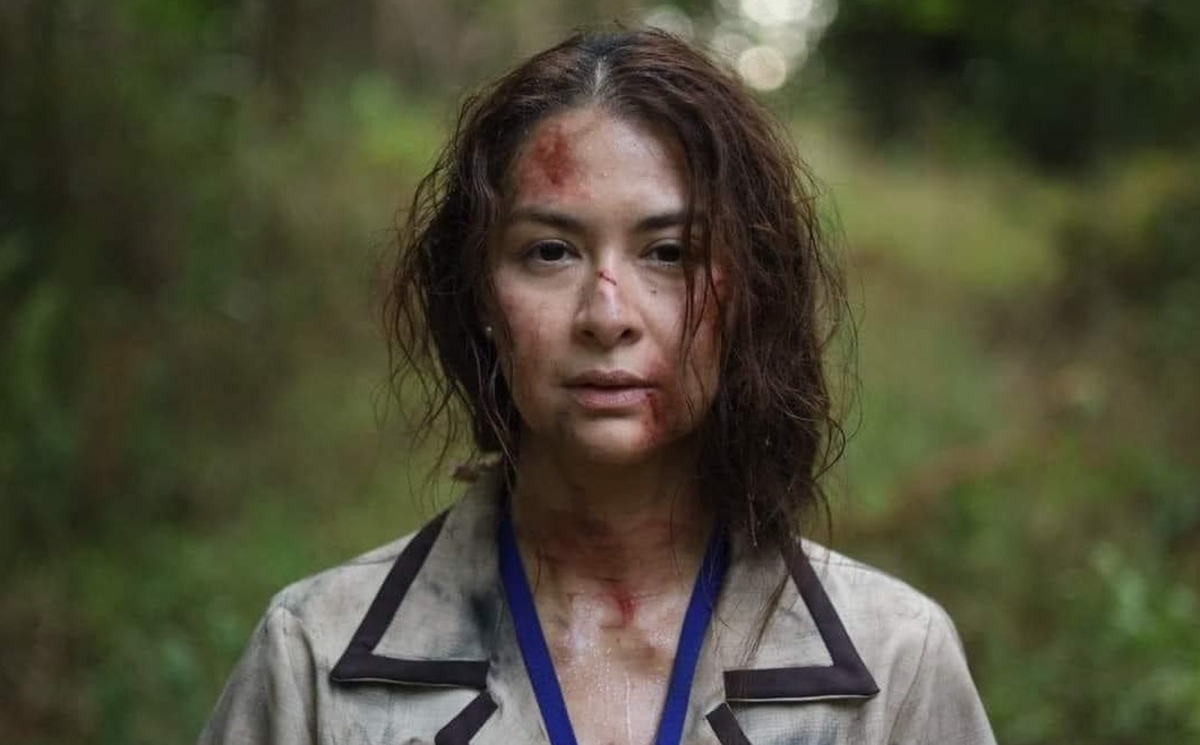
Kip Oebanda's Balota takes place in 2007, in some unnamed town having a mayoral election. The usual electoral shenanigans play out, and caught in the middle of all of this is teacher Emmy, played by Marian Rivera, who was working as a poll watcher and ends up hiding in the wilderness carrying the last untampered ballot box.
The movie says things that are very agreeable: our elections are a farce, there are rarely any good candidates, and teachers are good. It wraps it all up in a broadly comedic package that tends to involve people yelling at each other. As a piece of political satire, it feels kind of toothless, playing into cynical talking points and just pointing out things that people already know. As a bit of mainstream entertainment, it could pass as edgy. It helps a lot that Marian is so fun in this. She plays the moral center of the movie as a profane, at times boy crazy whirlwind of a woman prone to flipping people off or yelling at them. That’s great.
Tumandok - Speaks plainly of big issues
Tumandok, co-directed by Kay Sumagaysay and Richard Jeroui Salvadico, concerns the plight of the Atis, the indigenous people of central Panay. Private interests are encroaching on their ancestral lands, and they are in danger of losing their homes. The movie is mainly told through the perspective of the chieftain’s sixteen-year-old daughter, played by Jenaica Sangher. We follow her as she navigates the local bureaucracy, and sticks by her father as he tries to fight for rights of the tribe.
The movie speaks very plainly about the issues at hand. The Atis are being driven from their homes, basically at gunpoint, and no one really seems to care. There are governmental means through which they might be able to secure their ancestral lands, but the process is slow and indifferent. It requires resources they do not have, and it involves going down to the city, which in itself is quite the burden. They are being shot at while trying to harvest crops, and are losing more and more of their land as time passes.
It’s all kind of suffocating, as it’s hard to see how this can be resolved in favor of the Atis. The film makes it pretty clear that it isn’t just them that’s losing out. Their plight is part of a broken system that favors the rich and powerful, and leaves no room for those who simply want to maintain their humble way of life. They are losing their homes to loggers and miners; to the venal forces that seem to want to hasten the destruction of the environment for the sake of capital gain. At all points, with its visuals, the movie makes it clear what we all have to lose, capturing the natural beauty of the place that the Atis want to protect.
Love Child - Mainstream sweetness
Jane Oineza and RK Bagatsing play the central couple in Love Child. They're young parents who had a kid out of wedlock. The film, directed by Jonathan Jurilla, follows the couple as they put their dreams on hold to raise their special needs child. They’ve moved to Negros, and try to find some way to get their son the kind of care that he needs, in spite of their limited resources.
This feels very much like a mainstream film, and the movie knows it. At points, the two will refer to their story as a romcom, inviting comparisons to the genre formula. This talk does not benefit the movie at all, as it exposes the artificiality of its construction. The film is much better when it just talks about what’s real: the difficulty of raising a child these days, especially one with special needs; and the general insecurity of young people, having to navigate a society that only really cares about you if you have money.
It’s ultimately a sweet film, which is quite a feat given the subjects it tackles. Here are these two, trying to make it work in spite of everything. Love Child suffers from some of the shortcuts that mainstream films tend to take, landing on resolutions that don’t quite feel earned. But there is something to its sweetness, the movie projecting a cautious optimism that can feel pretty rare these days.
Gulay Lang, Manong - Strong character work
BC Amparado’s Gulay Lang, Manong makes a case for the legalization of marijuana in the Philippines. Cedrick Juan plays a Region II cop hungry for recognition during the drug war. He stumbles into a major lead, and he goes undercover, joining a dealer on a delivery from the region’s largest grower Haring Damo (Dong Abay) to a major client.
The plot is pretty loose, the film relying more on character work than telling a solid story. That said, these are some great characters. You got a vain cop with daddy issues seeking glory, a vegetable farmer who doesn’t really know what’s going on, a happy-go-lucky dealer who seems to genuinely care about his trade and wants to help people out, and the genius grower prone to hugging strangers and telling them about their auras.
A really solid cast of actors makes these characters pop, and there’s a lot of fun to be had as they enter all these strange situations. It just kind of fizzles out, though, the movie ending on a thud as it fails to imagine a resolution that’s as fun and carefree as the buildup.
Alipato at Muog - Essential viewing
JL Burgos directs a documentary about his brother Jonas, who in 2007 was seen being abducted at Ever Gotesco Mall in Quezon City, and was never seen again. The film tells the story of the search for Jonas and others like him, exploring the dark reality of enforced disappearances in the Philippines.
The documentary plays the story of Jonas Burgos as a focal point, but it very smartly expands to include the stories of other desaparecidos and their families. In so doing, it presents a much larger story. The movie methodically builds its case, showing audiences a series of events that expose corruption and in a better society would bring justice to these families.
But justice never comes. The film is a frustrating watch, in spite of how well assembled it is. It is a testament to how difficult it can be to find the truth in this country; how so much of it seems set up to hide the obvious, and protect those that do harm to other people. It is incredible the film can still somehow conjure some hope, speaking directly to us with a voice that is weary, but not broken. This, I think, is what makes it essential viewing.
Kono Basho - Troubling developments
Jaime Pacena II directs Kono Basho, which stars Gabby Padilla as Ella, who arrives in Rikuzentakata City, Japan to attend the funeral of her estranged OFW father. She is made to stay with her father’s second family, who she meets for the first time. And she learns that her father has left her a property that she is meant to share with her younger half-sister Reina (played by Arisa Nakano). Ella is forced to reckon with her feelings of grief and abandonment, in a city bearing a memory of a natural disaster.
The movie is beautifully put together, every frame a postcard suggesting a memory of something that is no longer there. The story it tells, though, gets a little problematic. The conflict between the sisters feels compelling enough but the way the film decides to resolve it involves a troubling development that cheapens whatever they went through. It’s hard to talk about it without spoiling it, but the way it plays out, it feels like a switch was flipped, implying that relationship problems can be solved by doing something truly terrible.
The Wedding Dance - Stuck in one place
Julius Lumiqued’s The Wedding Dance adapts the short story written by Amado Daguio. The story is mostly set in 1947, among an Igorot tribe in Mountain Province. Mai Fanglayan plays Lumnay, who fell in love with and married the warrior Awiyao (Arvin Balageo). Lumnay has been unable to bear a child, and Awiyao intends to remarry so that he may have an heir. The film largely takes place on the night of the second wedding, when Awiyao tries to comfort Lumnay, and invites her to dance with the others.
The back half of this film feels endless, so much of it taking place in one space, with the two main characters talking in circles about why they can no longer be together. The film occasionally cuts to a flashback, showing something that happened in the last seven years. Crucially, though, it shows very little of this couple’s happiness together. All discussion revolves around Lumnay’s inability to conceive, and Awiyao’s desire to have an heir. The film has them going through a big emotional blow out, but it never really feels earned. Sloppy production makes a tough watch even tougher.
The Hearing - Compelling roughness
Lawrence Fajardo returns to Cinemalaya with The Hearing, which stars Mylene Dizon as a mother of a deaf boy sexually abused by a parish priest. She decides to pursue justice, and the film meticulously details the difficulties of doing so, when so few resources are available for deaf children in the provinces.
There’s an extra subplot in here that has Ina Feleo as a sign language interpreter stuck in an abusive marriage, and it feels extraneous. The film finds something really vital in depicting the challenge of filing a criminal case in the Philippines when the victim is deaf-mute, and has received no formal instruction. The boy in this story doesn’t know sign language, and has to go through two interpreters just to communicate his story. The film presents some horrifying statistics at the end, but it’s already made its case pretty clearly before then. This is a story of a systemic failure, the government not doing nearly enough to protect those who need it the most. The film can be rough around the edges, but that roughness almost feels appropriate for what it’s talking about.
Kantil - Admirable ambitions
Joshua Caesar Medroso’s Kantil concerns a coastal village made up of informal settlers who are being made to relocate by the landowners who plan to demolish their homes. There, a fisherman (Perry Dizon) discovers a strange alien rock that inexplicably causes a miraculous event. The people try to get to the bottom of this mystery, while also trying to find a way to preserve their homes.
There is a lot going on here - maybe much more than the budget of a Cinemalaya film can really handle. But the film goes for it anyway, attempting to weave together a set of seemingly disparate narrative threads. There is a queer romance, a story of people losing their homes, a mythological tale of sea snakes and magic rocks, a tale of a political family, and even a brief aside involving the fisherman and the growing tension between him and his wife. With so many plates spinning at the same time, the film ends up leaving a lot of it underdeveloped, ultimately choosing to flesh out the mythology part of it at the expense of the others.
This ends up being pretty unsatisfying, especially since the story begins and ends with the queer romance, which we hardly get to see. It’s easy to appreciate what the film is trying to do, though, and it delivers a lot of intriguing detail that manage to enrich the milieu, even if it doesn’t really matter much to the story it ends up telling. It’s kind of all over the place, but it’s hard not to admire the ambition.
This year's Cinemalaya films will be shown in Ayala Malls Manila Bay Cinemas up to Sunday, August 11. For tickets to the Cinemalaya movies, click this link.
Also read: Here's What Buzzy GMA Documentary Los Sabungeros is About