

Conclave: How a 2016 Novel Imagined a Filipino Cardinal as Pope
Robert Harris' thriller delivers the most startling twist for Filipino readers.
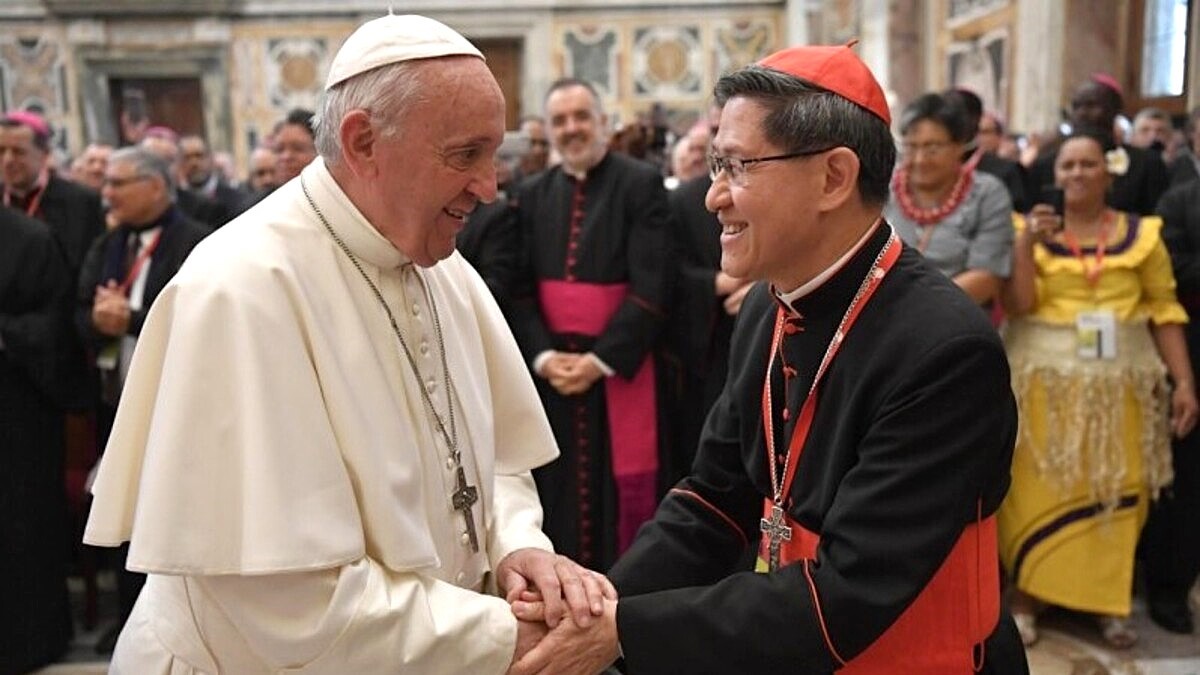
(SPOT.ph) As Filipino Catholics eagerly speculate about the possibility of Cardinal Luis Antonio Tagle, Cardinal Jose Advincula, or even Cardinal Pablo Virgilio David ascending to the papacy, many have revisited the 2023 film Conclave, curious to see if it accurately depicts the secretive process of electing a new pope. What many don’t realize, however, is that in Robert Harris’s original novel—the source material for the film—a Filipino cardinal actually gets elected pope.
With Pope Francis’s papal conclave officially convening on May 7 to elect his successor, interest has surged not only in Church procedures but also in Harris’s thriller, which offers a fictional yet gripping portrayal of a conclave. The film adaptation, directed by Edward Berger and nominated for several Oscar awards, including best picture, also sparked fresh discussions on how faithfully it mirrors the actual protocols outlined in Universi Dominici Gregis, the apostolic constitution issued by Pope John Paul II in 1996, which governs the transition when the Chair of St. Peter is declared sede vacante—vacant.
Also read: Could Filipino Cardinal Tagle be Successor to Pope Francis?

Who is Archbishop Vincent Benitez?
Yet, while the film makes certain narrative shifts, it’s Harris’s novel that delivers the most startling twist for Filipino readers: a Filipino cardinal, Archbishop Vincent Benitez, is chosen as the new pontiff, taking the name Innocent. In the book, Benitez's backstory is rich with quiet heroism. He is depicted as a Filipino prelate secretly made cardinal in pectore (in the heart) by the late pope, because revealing his rank while he serves in Muslim-majority Baghdad might endanger his life. Before his mission in Iraq, Benitez was known for his humanitarian work in the Philippines—establishing shelters for abused women—and his earlier service in the Congo.
As the cardinals gather in the Sistine Chapel to elect a successor after the sudden death of the pope, Harris’s novel follows Cardinal Jacopo Lomeli, the Dean of the College of Cardinals, who grapples with personal doubts even as he oversees the election. With 118 cardinals casting ballots under Michelangelo’s looming frescoes of the Last Judgment, political factions emerge, ideological lines are drawn, and secrets threaten to derail the sacred process.

Just as the conclave seems destined for chaos, Benitez’s heartfelt appeal for unity and moral clarity shifts the tide. In a dramatic final vote, the Filipino archbishop is elected pope.
From Filipino to Mexican
The movie adaptation, however, reimagines this narrative to reflect broader geopolitical themes. Benitez is portrayed not as Filipino but as a Mexican archbishop (played by Carlos Diehz) stationed in Kabul, with the slightly altered backstory clearly meant to underline current global tensions. The Italian Cardinal Lomeli is transformed into Cardinal Thomas Lawrence, a British dean portrayed by Ralph Fiennes. Other leading contenders mirror the ideological rifts tearing through the modern Church: Aldo Bellini (Stanley Tucci), a progressive Italian; Joshua Adeyemi (Lucian Msamati), a socially conservative Nigerian; Joseph Tremblay (John Lithgow), a moderate Canadian; and Goffredo Tedesco (Sergio Castellitto), a hardline Italian traditionalist.

As ballots unfold and no clear winner emerges, Lawrence, like his literary counterpart Lomeli, becomes entangled in the moral failings and political intrigues of the contenders. Tremblay’s campaign is tainted by allegations of vote-buying, Adeyemi's hopes collapse amid scandal, Bellini compromises his ideals for backroom deals, and Tedesco's rhetoric grows dangerously incendiary against the backdrop of terrorist attacks sweeping Europe.
Into this volatile mix steps Benitez, whose late arrival introduces a new spiritual force to the conclave. His impassioned plea for the Church to reject violence and political gamesmanship resonates, shifting the assembly's momentum and leading to his election as pope. While Berger’s film retains the suspense and intrigue of Harris’s novel, it amplifies the geopolitical stakes, broadening the narrative’s relevance by touching on religious extremism, global identity politics, and the fragile state of moral leadership today.
Inside the real conclave: How ‘Conclave’ mirrors Vatican tradition
But how accurately does either version—book or film—reflect the real-life rituals that will unfold when cardinals gather behind locked doors this May?
Surprisingly, both versions track closely with Universi Dominici Gregis (UDG; in English, “The Shepherd of the Whole Flock”), the document that governs the interregnum and election of a new pope. When the pope dies, the Camerlengo—the cardinal chamberlain—first verifies the death and secures the papal apartments. He then oversees the transition, including the destruction of the Fisherman's Ring, an act designed to prevent misuse of papal authority during the sede vacante. Both Harris’s novel and Berger’s film dramatize these moments, underscoring their canonical significance while heightening their narrative tension.
The depiction of the conclave’s opening rituals is especially faithful. Cardinals process into the Sistine Chapel, chanting Veni Creator Spiritus, invoking the Holy Spirit to guide their votes. They take solemn oaths of secrecy—an obligation laid down explicitly in UDG—before the master of ceremonies utters the command Extra omnes! (“Everyone out!”), signaling the start of the closed-door deliberations. These authentic details ground the fictional intrigue in the grandeur and gravity of real Church tradition.
However, where the novel and film take creative liberties is in the personalization and dramatization of the cardinals’ internal politics. While real-life conclaves are shrouded in secrecy—cardinals are bound not to reveal discussions under penalty of excommunication—Harris and Berger imagine a conclave rife with factionalism, scandals, and ideological horse-trading. This makes for gripping drama but also echoes the quiet reality that national and theological blocs have historically shaped papal elections. From the election of Karol Wojtyla in 1978 to that of Joseph Ratzinger in 2005, conclaves have always balanced faith, politics, and global considerations.
The novel’s concept of a cardinal created in pectore is not fictional, either. Pope John Paul II famously appointed several cardinals in secret during his papacy, often in regions where public acknowledgment would have put them at risk. The idea that such a figure could emerge from the margins to unify a fractured conclave carries both dramatic and theological weight.
What Conclave—both in print and on screen—captures most effectively is the paradox at the heart of the process: while the election of a pope is guided by centuries-old law and ritual, it is ultimately a profoundly human event, marked by ambition, fear, faith, and the search for moral clarity.
Lito B. Zulueta, veteran journalist and professor of journalism at the UST Faculty of Arts and Letters, has covered key Vatican events, such as the papal conclave of 2005 that elected Pope Benedict XVI and that of 2013 that elected Pope Francis.
Also read: Explainer: What Happens When a Pope Dies?