
(SPOT.ph) Katips, a Filipino period musical drama film written and directed Vincent M. Tañada, had its commercial premiere on August 3. Given that it is about a group of student activists during the oppressive regime of former President Ferdinand Marcos, it obviously earned the ire of the supporters of the Martial Law years as well as of current President Ferdinand Marcos Jr.
While Katips is a fictional narrative, it is based on interviews of those who lived through the Marcos years. The director, after all, litigated some of the cases of Marcos victims who were qualified for compensation amounts. Much of the film also gives homage to the heroism of those who challenged the dictatorship and paid for it with their lives.
And if you're looking for more information about this specific period in Philippine history, there are several documentaries, interviews, and dramatizations that portray critical events during the Marcos administration and the Martial Law years.
Also read:
Here's Where You Can Watch the Movie Musical Katips
Here’s Where You’ve Seen the Katips Cast Before
10 Essential Martial Law Films to Watch
Done watching Katips? Here are 20 movies, short films, and documentaries about Martial Law that you can stream for free:
Liway (2018)
Where to watch: Liway on YouTube
Liway is based on the real-life story of Cecilia Flores-Oebanda, better known as Commander Liway of the New People Army, during the thick of Ferdinand Marcos' dictatorship. The titular role is played by Glaiza de Castro, who won the Film Academy of the Philippines Award for Best Actress in 2019. Just how true is this Cinemalaya film? The Filipino director and co-writer, Dakip "Kip" Oebanda, is the son of Commander Liway; and he spent his childhood years in prison after his mother was caught by the military while she was eight months pregnant with him.
In a 2018 interview with CNN Philippines, Oebanda said about the film: "Some of the people from the left are asking me, 'Is this about the struggle? Is it about the NPA?’ In parts it is, but that is a context of where this family came from more than it [is] the actual story... It's really just, how do you find and keep yourself resilient and hopeful even in a situation when you're in prison with your child?"
Awards: Audience Award, Special Jury Commendation, and Special Jury Prize at Cinemalaya 2018; Best Actress (Glaiza De Castro), Best Screenplay (Kip Oebanda and Zig Dulay), and Best Editing (Chuck Gutierrez) at the 2019 FAP Awards; Movie Child Performer of the Year (Kenken Nuyad) at the 2019 Star Awards
The Kingmaker (2019)
Where to watch: The Kingmaker on YouTube
The Kingmaker features American filmmaker Lauren Greenfield's interviews with Imelda Marcos, who herself narrated how she met the late Ferdinand Marcos. how she later turned an inhabited island in Palawan into a safari after seeing the wildlife in Africa, and how she dealt with the public as the wife of a government official. She also recalled the time that she was sent to a psychiatric hospital in New York when "[she] was on the verge of a mental breakdown" because "it came to a point that [she] could not take politics." Greenfield was also able to interview Ferdinand's grandson and Bongbong's son, Sandro, who was quoted as saying "[Bongbong] wanted to do physics, maths, biology, but my grandfather was like 'There's no money in that so switch to politics.'"
The film made its international debut in August 2019 at the 76th Venice Film Festival. It was also screened at the Telluride Film Festival in Colorado, the Toronto International Film Festival in Canada, the whole of the United States in a limited release by Greenwich Entertainment, and through the American premium television network Showtime. It finally made its Philippine debut in January 2020, when it was shown at the Cultural Center of the Philippines, then later at the University of the Philippines during the commemoration of the People Power's Revolution that year. The Kingmaker was released on streaming platform iWantTFC on May 15, 2020, then later became available only on-demand by August in the same year.
Awards: Most Compelling Living Subject of a Documentary at the 2019 Critics' Choice Documentary Awards; Audience Award for Documentary at the 2019 Warsaw International Film Festival
Imelda (2003)
Where to watch: Imelda on YouTube
A documentary by Filipino-American filmmaker Ramona S. Diaz, Imelda follows the life of the former First Lady of the Philippines. The film incorporates interviews with her daughter Imee and her son Bongbong, as well as other interviews and archival material surrounding the Marcoses. In one of the segments, the camera zooms in on Imelda as she says, "We have no human rights cases in the Philippines," then cuts to statements of witnesses, political detainees, and journalists describing how they were tortured under the Marcos regime.
Award: Excellence in Cinematography Award Documentary at the 2004 Sundance Film Festival
Batas Militar (1997)
Where to watch: Batas Militar on Vimeo
Batas Militar, which was directed by Filipino filmmaker Jon Red and written by Jose F. Lacaba and Lito Tiongson, is one of those documentaries typically shown to grade school and high school students every year during the commemoration of the People Power Revolution. (Well, at least, back in the day.) It is based on interviews with former senator Jovito Salonga, National Democratic Front founder Satur Ocampo, former Armed Forces of the Philippines Chief Romeo Espino (from 1972 to 1981), former Armed Forces of the Philippines Chief Manuel Yan (from 1968 to 1972), Imelda Marcos, Corazon Aquino, Fidel Ramos, former congressman and senator Joker Arroyo, and other people who lived through the Marcos regime (journalists, filmmakers, economists, etc). Some of these first-hand interviews are interspersed with archival footage, dramatizations, and a voiceover by Joonee Gamboa.
Award: Best Documentary (Bronze) at the 1998 New York Film Festival
Signos (1983)
Where to watch: Signos on Vimeo
This short documentary filmed on Super 8mm was directed by revered Filipino filmmaker Mike de Leon. It features interviews with those who challenged Marcos' dictatorship, including former senator Jose W. Diokno; journalists Joe Burgos, Letty Jimenez Magsanoc, and Ceres Doyo, activist nuns Sister Christine Tan and Sister Mariani Dimaranan; human rights lawyer Rene Saguisag; labor leader Ka Felicing Villados; film director Lino Brocka; and Jaime Cardinal Sin. Some of the footage was taken by Rody Lacap, Joe Cuaresma, Lito Tiongson, and Ding Achacoso; while the narration was done by Jose Almojuela.
Keep in mind that this was produced when media was still restricted under Martial Law, so the film was circulated back then through home video.
Bakit Dilaw ang Gitna ng Bahaghari? (1994)
Where to watch: Bakit Dilaw ang Gitna ng Baghaghari? on YouTube
Bakit Dilaw ang Gitna ng Bahaghari? or Why is Yellow the Middle of the Rainbow? is a three-hour opus by National Artist for Film Kidlat Tahimik. The collage film follows the filmmaker and his eldest son, Kidlat de Guia, during major events in the Philippines from 1980 to 1994. Completed after 10 years, this documentary film is more of a compilation of everyday events, family scenes, random observations, and travel clips vis-a-vis the political turmoil in the country.
Coup d'Etat: The Philippines Revolt (1986)
Where to watch: Coup d'Etat: The Philippines Revolt on YouTube
Coup d'Etat: The Philippines Revolt is an Australian television documentary that follows the four-day People Power Revolution, hailed around the world as a peaceful uprising that overthrew an authoritarian regime. It was presented by Australian journalist Peter Couchman, who is known for ABC's This Day Tonight and Four Corners.
Edjop (1986)
Where to watch: Edjop on Cinemata
The documentary Edjop follows the life of student leader Edgar Jopson, who was killed by the military in September 1982. A graduate of Management Engineering with Latin Honors from the Ateneo de Manila University and former president of the National Union of Students of the Philippines, he was once called by Marcos as "only a son of a grocer." He led the student movement that sparked the historic First Quarter Storm.
Edjop was directed by Joe Cuaresma and was originally made in U-matic. The original U-matic tape is of the AlterHorizons AV Collection under the care of Jose Cuaresma. Its digitization was initiated in 2019.
Awards: First Prize at the 1987 Cultural Center of the Philippines Film and Video Festival
In Search of the Marcos' Millions (1987)
Where to watch: In Search of the Marcos' Millions on YouTube
Part of PBS' Frontline documentaries, In Search of the Marcos' Millions was originally shown as episode 11 of the series' 1987 season. It features how the media outlet tracked "hundreds of millions of dollars of the Marcos money," which the Philippine government claimed was "plundered wealth of the nation [that were stashed] in fake companies and secret bank accounts."
Sabangan (1983)
Where to watch: Sabangan on Cinemata
Sabangan shows the struggles of the Remontados indigenous community in Tanay, Rizal as they face displacement from their ancestral land. This was due to the Kaliwa-Kanan-Laiban Dam project that was originally conceptualized during the administration of Marcos.
The documentary was made by Federico Espiritu, Jose Cuaresma, Bernadette Libres, Robert Gruta, and Lito Fischer. It was originally shot in Super 8mm, then digitized for preservation and access.
Award: Second Place at the 1983 Experimental Cinema of the Philippines Annual Short Film Festival
Betamax '83 (2020)
Where to watch: Betamax '83 on Facebook
Directed by Marcial Bonifacio and produced by Erwin Romulo, Betamax '83 tells a story of resistance during a period of media censorship in the Martial Law years. The piece is made live on the Facebook account of Active Vista, which hopes to "bring attention to stories of human rights struggles to enable the public to help dismantle barricades that hinder the pursuit of human rights."
Portraits of Mosquito Press (2015)
Where to watch: Portraits of Mosquito Press on Facebook
During the Marcos administration, media ownership was in the hands of people close to the regime; with this, it could easily follow that stories that came out in newspapers, televisions, and radios were easily controlled. Mosquito press, a term in journalism coined during the Martial Law, came about as a way to show the people what was really happening in the country and criticize the government. These publications, no matter how small they are, have a stinging bite—just like mosquitos. Portraits of Mosquito Press documents the history and struggle of the alternative press that emerged at the time.
Marcos: A Malignant Spirit (1986)
Where to watch: Marcos: A Malignant Spirit on YouTube
Narrated by the late Filipino broadcaster Angelo Castro, Jr., Marcos: A Malignant Spirit shows rare footage, recorded conversations, and deposition of the Marcoses in the United States. It looks into "the inhuman manner in which Marcos and his henchmen systematically drained the economy […] in their greedy and unrelenting quest for fortune," according to ABS-CBN.
The Imelda Tapes (2022)
Where to watch: The Imelda Tapes on YouTube
This Hawaii News Now digital documentary compiles recently discovered archival footage in a nondescript banker's box marked "Marcos." "The 'Imelda Tapes' were so old there weren’t any machines in the newsroom that could read them. So documentary producer Jonathan Saupe sent them out to be digitized to 808 Burners in Aiea," reported writer Jonathan Jared Saupe through the Honolulu media outlet. The clips, which show the luxurious lives of the Marcoses, are weaved with news footage of Filipinos living in poverty.
Arrogance of Power (1983)
Where to watch: Arrogance of Power on Cinemata
This 38-minute documentary and film essay from 1983 exposes human rights violations during the Marcos regime. Clips shot through the old-school Super 8mm show how militarization normalized abduction, torture, and killing during those times.
"The military mind is not used to debate and dissent. [...] That's why they're not used to people who would reason out, to the free exchange of ideas, that's totally alien to the military blind, which is trained to obey blindly," to quote the film.
Daluyong (1984)
Where to watch: Daluyong on Cinemata
Daluyong documents the historic "Lakbayan" or "Lakad ng Bayan Para sa Kalayaan" (People’s March for Freedom) held from March 1 to March 7, 1984. The protest, joined by 40,000 people, called for a boycott of the May 14, 1984 Batasang Pambansa elections, which were believed to be rigged by Marcos. Three marchers in Manila were abducted, and their beaten bodies were later discovered in Cavite.
No Time for Crying (1986)
Where to watch: No Time for Crying on Cinemata
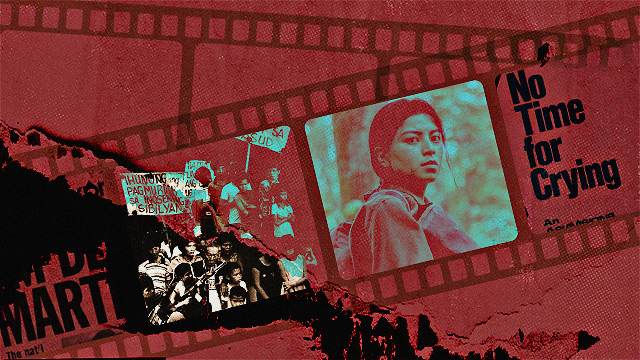
Directed by Lito Tiongson, No Time for Crying is a 1986 documentary about the human rights violations in Agusan Del Norte, particularly in Butuan City and in the municipality of Magallanes.
Award: First Prize in the Documentary Division at the 1987 Alternative CCP Film and Video Festival
Ang Pasiong Mahal ni Beverly Apostol (2017)
Where to watch: Ang Pasiong Mahal ni Beverly Apostol on YouTube or Cinemata
Directed by Patricia Almencion and Miguel Louie de Guzman, the short film Ang Pasiong Mahal ni Beverly Apostol dramatizes the life of Beverly Apostol. She was one of the many activists abducted by armed men to uncover crucial information about other dissidents.
Awards: Best Picture, Best Direction, and Best Screenplay at the 2017 Lipa City Film and Video Competition
Remembering Martial Law in Escalante (2015)
Where to watch: Remembering Martial Law in Escalante on Cinemata
Back in the 1980s, famine struck Negros—yes, that island that produced half of the country's output in its heydays. Multiple news accounts pointed to the cronies of Marcos as contributors to the decline of the sugar industry, loss of jobs, and, eventually, the suffering of its people. As with any group of people going hungry, sugar workers, farmers, fisherfolk, students, urban poor, professionals, and the church community staged a protest at the town center in Escalante, Negros Occidental on September 18, 1985. Authorities bombarded them with high-pressure water from fire trucks and tear gas; then later, opened fire. More than 20 protesters were killed in what became known as the Escalante massacre.
Remembering Martial Law in Escalante is a reenactment by Sining Banwa of the events leading to this massacre.
Alaala: A Martial Law Special (2017)
Where to watch: Alaala on YouTube
First aired on GMA on September 17, 2017 Alaala tells the life of Bonifacio Ilagan (Alden Richards), an award-winning screenwriter. This short film written by the real-life Bonifacio Ilagan is combined with interviews with personalities who experienced the atrocities of the Martial Law period firsthand. Gina Alajar, Bianca Umali, and Rocco Nacino join in recreating that time in Philippine history through this film within a documentary.