
My Food, My Identity: The Late Clinton Palanca Reflects on Chinese-Filipino Cuisine
The award-winning author talks about his background and fondest food memories in My Angkong's Noodles.
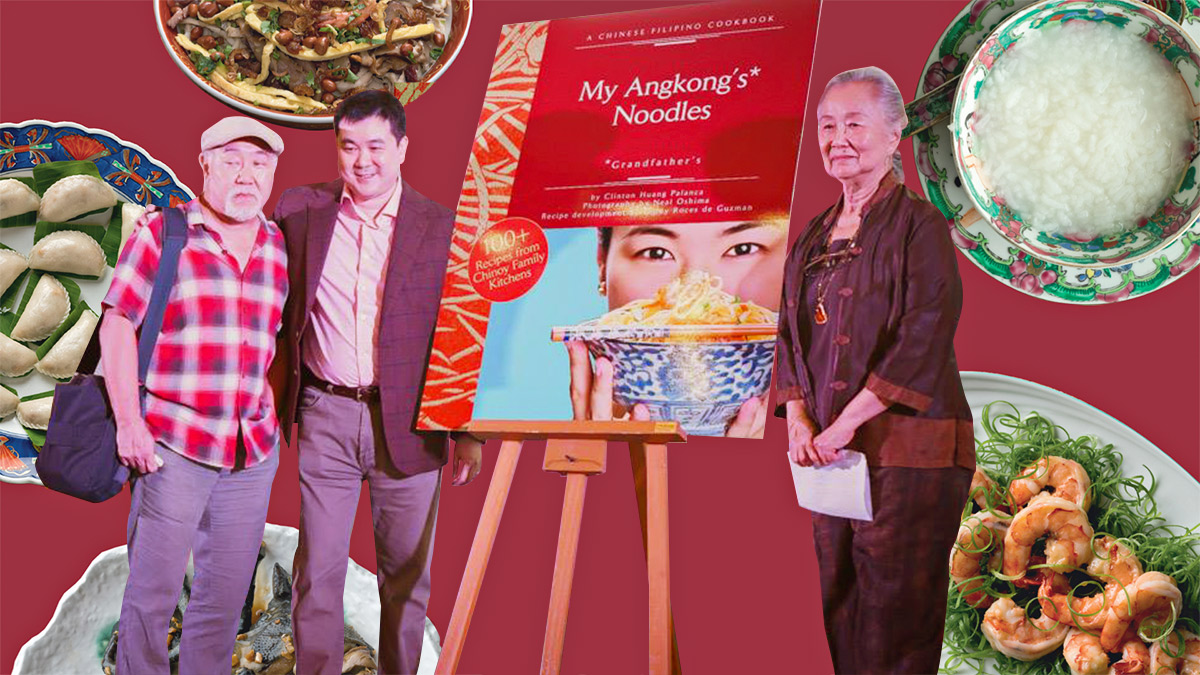
(SPOT.ph) Before he passed away in 2019, award-winning author and SPOT.ph columnist Clinton Palanca finished one of the last major works of a long and storied career in literature: My Angkong’s Noodles. It was both a cookbook and a celebration of Chinese-Filipino food, and of course, culture; more than hundred heirloom recipes gathered from the kitchens of Chinoy families (synthesized by restaurateur Ginny Roces de Guzman, and photographed by Neal Oshima), paired with insightful essays on culture from Mara Coson, Rafael Ongpin, the late Doreen Fernandez, and, of course, Clinton himself.
My Angkong’s Noodles was first released in 2015, a very different time indeed. Nearly a decade later, a new edition is now available for a new generation of foodies, cooks, and readers to appreciate. It comes with a new foreword from L. Ling-chi Wang, professor of Asian-American and Asian diaspora studies in the University of California-Berkeley, who praises the book as a "major and lasting contribution to Filipino culture and cuisine."
The new edition also includes a tribute to Clinton and publisher Elizabeth Yu Gokongwei, who both passed away in 2019.
Below, with the permission of the publisher, we are reprinting Clinton’s full essay from the book. If you’re interested in ordering a copy, please visit the Summit Books shops at Lazada, Shopee, and selected book stores.
My Food, My Identity by Clinton Palanca
The house where I grew up had an old-fashioned Chinese hearth stove with concentric iron rings to regulate the heat, and a hole on one side to feed fuel into. By the time I was old enough to peer over it, a conventional gas stove had been set atop for the day-to-day cooking needs; and my father did the charcoal cooking in a small clay hearth in the back garden: pork trotters slow-cooked over the coals to render them smooth and sticky, immense steamed radish or pumpkin cakes in round aluminum tins, grilled meat on skewers fanned over glowing embers.
I was rarely allowed to be part of this, the sharp knives and fire and pots of scalding water deemed too dangerous for a child. My father did the rounds of the wet market himself, selecting the fish and cuts of meat and vegetables on his way home from the office. When she was not working, my mother, aside from doing her share of the cooking, supervised the maids cutting and slicing and stewing. The tradition that was supposed to be at the heart of Chinese culinary tradition, of a dutiful daughter-in-law slaving away at the recipes she learned from her husband’s mother, didn’t really apply to us, nor did it to many other Chinese families in the Philippines who grew up more Westernized (or Filipinized) in the social turbulence of the 1970s and ‘80s.
Neither was I interested in our ancestral cuisine at that time, despite the best efforts of my parents. Other cuisines, especially French, Italian, and American, were more exciting than the subtle flavors and light broths that are the cornerstone of southern Fujianese cuisine. “Even if you don’t know how to cook, you must at least know how to eat,” my parents would implore me.
Unmoved, I, like an entire generation of Chinese Filipinos, grew up with only the vaguest notions of what constituted good Fujianese food, much less any idea of how to make it.
The cuisine the world forgot
Part of this had to do with the gradual but inexorable integration into Filipino society, which had been an ambition of Chinese migrants for decades. It was finally legalized when, in 1975, then-President Ferdinand Marcos enacted the Mass Naturalization Act. But another factor that played an important role in deprecating Fujianese cuisine was the relatively unimportant status of Fujianese cuisine in the world outside China during the decades when the mainland was closed off to the West.
Fujian lies on the south-east coast of China, across the straits to Taiwan, which is in turn so close to Batanes that people there can receive terrestrial television and radio signals from that island. The aboriginal people of Taiwan bear a remarkable physical resemblance to northern Philippine tribesmen. The aboriginal Taiwanese are not to be confused with the indigenous Taiwanese, who are Han Chinese from the mainland who settled there, with a language and culture similar to that of mainland Fujian. This was in turn subsumed when the Republicans fled there and Taiwan became the Republic of China, a Mandarin-speaking country whose culture was mainly that of the displaced government from Peking (now Beijing).
Fujian continued to be a backwater of China, and while Canton (now Guangdong) had become an important trading port due to its forced exposure to the outside world after the Opium Wars and the annexation of Hong Kong by the British, Fujian was a largely agricultural society with a strong military presence with its guns trained on Taiwan. In the years before the Communist Party came to rule China and closed it off from the world the port was a gateway to the outside world, through which many fled.
The Fujianese had always been traders, and had migrated to Malaysia, Singapore, and Indonesia, where they set up merchant firms. It was the Cantonese who migrated (many of them not by choice) to the United States and to Europe and engaged in small businesses such as laundromats and restaurants. What the world knew as Chinese food was, until recently, mostly Cantonese food.
As Hong Kong and, later, Guangdong province boomed economically in the 1970s and ‘80s, Cantonese food improved by leaps and bounds while Fujianese food remained family- bound and traditional, and a bit staid by comparison. It was a culinary backwater as much as the province was an economic backwater. The emphasis on light, clear broths, varying textures, starches and slurries, and fresh seafood ingredients made it a difficult cuisine to creolize and challenging to make. Yet in certain situations, it married well. In Malaysia, or specifically Penang, where the Fujianese migrants settled, the local Malay foodways and Fujianese cuisine creolized to become what is now known as Nonya cuisine, a coherent, distinctive set of flavors. Why this happened in Malaysia (and to a lesser extent in Singapore) but not in the Philippines is a subject of debate, but it is more likely that it is due to societal and structural influences, rather than to inherent compatibility or incompatibility of cooking habits.
Around the same time that the Chinese-Filipino women began going to college instead of staying at home and learning their mother-in-law’s cooking, the community began gaining a more secure economic foothold. This meant availability of household staff, and the recipes that didn’t get passed down to daughters-in-law were delegated to the kitchen help. Some of the help stayed with one family for several generations, but most didn’t, and recipes were passed from one turnover of staff to another until, like photocopies being made of photocopies, they were poor and far-off shadows of the original.
A lot of Chinese Filipinos ended up turning their backs on Fujianese cuisine because they hadn’t had good examples of it, or because they had only eaten it in a downtown canteen, greasy and made with “filler” ingredients and too much seasoning. Another reason is that with the growth of Hong Kong and the overseas Chinese in America, as well as the subsequent opening of China to the world beginning in the 1980s, other Chinese cuisines—especially Cantonese—were overtaking Fujianese food on the global stage in creativity and attention to detail.
Families and food memories
I only started hankering for Chinese-Filipino home cooking when I moved to London a decade ago. Aside from being the taste of home, Fujianese food had a clarity and purity of taste that the greasy Cantonese stir-fries and oil-based Sichuan hot-pots that were available in Chinatown did not have. I began to call home and ask for recipes for simple dishes, ones that could be replicated abroad. I also cooked Filipino food while in Oxford and London and couldn’t help but be struck by the similarity between Fujianese food from the Philippines and mainstream Filipino food. Not only were many of the ingredients similar, but so were many of the techniques. I was so intrigued by this that I proposed it as a topic for my Ph.D studies, and continued to eat, cook, as well as conduct more formal research on the connection between Filipino food and Fujianese food.
Here’s where the ideas of “influence” and “cultural transmission” become something of a touchy subject. A Chinese cultural chauvinist could say that there is very little in Filipino food in Luzon and the Visayas that wasn’t influenced (or taught) by the Chinese traders in some way or another. On the other hand a Philippine chauvinist could counter that Fujianese food is a simplistic cooking style that hasn’t been very popular even in its home province, and developed its complexity and was improved upon only in the Philippine setting. Neither would be completely wrong. The only fact we can agree on is that southern Chinese food and Philippine food were intertwined from very early on, from before recorded history when trading ships learned to cross the sea that separated the two cultures. There is ample proof that Filipino culture made an impact in Fujian, one of the few places in China where chocolate was imbibed as a stimulant, as well as in the architectural styles and materials (for example, Machuca tiles) of wealthy traders’ houses. Both of these, however, date from the Spanish colonial period.
In the capital, Manila, as well as in trading ports such as Vigan and Cebu, the influence of Fujianese cooking styles, terms for vegetables and cuts of meat, and even utensils is undeniable. However, the development of these Chinese-based cooking styles already diverged at this early stage from southern Fujian, as many New World products from the Columbian exchange made their way to the Philippines and on to Fujian, Guangdong, and Taiwan. As the Spanish colonial presence became more entrenched in Philippine life, the Chinese traders found their place in the social hierarchy. It was not a high one: they were neither the aristocrats nor the colonial subjects, but useful outsiders who were part of the fabric of local life as artisans, shopkeepers, and, of course, cooks.
I was born into an era when most of the Fujianese migrants in the Philippines had not only gained Filipino citizenship, but were born and raised as Filipinos even as they were connected to Chinese culture through their parents and community. During the war and afterwards it was not uncommon for the Chinese to be mocked as they walked down the street, with insults such as “Intsik beho, tulo laway!” My generation knows these stories but few of us encountered social denigration and exclusion first hand. Yet in our haste to assimilate into the Filipino culture and society that finally welcomed us after years of derision, there is also an eagerness among many to shed the isolationist mindset of their parents and grandparents.
The tight-knit, trust-based community was anchored on shared values as well as traditions and customs, and in moving outwards and upwards the delicate balance is in keeping the good while leaving the past behind. One of the comments that consistently came up while researching this project was how surprisingly diverse and wide Chinese-Filipino food is: many people, many of them Chinese-Filipino families, know only a small fraction of the vast repertoire of dishes and cooking techniques passed down through the generations. A lot of them were surprised at how good the food tasted, because the only versions they knew were pale shadows of the original that grandmothers had taught the maids but that the daughters-in-law had not been able to learn themselves; an unfortunate fallout from a generation who were educated and worked. I was quite lucky, in that sense, to have parents who loved to cook and did so despite hectic schedules, and continue to do so to this day.
The Chinese-Filipino table today
At around 6 p.m. in kitchens all over the Philippines, oil begins to sizzle, vegetables are chopped, and the dining table set. Restaurants begin their laborious prep work. In keeping with their roots from an agricultural society, Chinese Filipinos still like to eat early, though not as early as people in China used to do up to the 1990s, sitting down to dinner as early as 5 p.m., as soon as the sun begins to set. The Chinese-Filipinos still consider 7 o’ clock dinnertime, though urbanization and the younger generation have begun to push dinnertime later and later.
The Chinese dinner table is always round, sometimes with a “lazy Susan” in the middle (a turntable platter for spinning the food around), sometimes without. The traditional dining set used stools, but most households and restaurants among the Chinese Filipinos have replaced these with regular padded chairs with backs. The long dining table that evolved from the medieval halls are anathema to the Chinese, as is the custom of asking dining companions to pass a particular dish, or seasonings. The idea of one person having a single dish to him or herself is also very puzzling to the Chinese.
This is not to say, however, that Chinese Filipinos have not adopted some Western ways, or do not have customs of their own. In Fujian it would have been perfectly acceptable, as it still is today, to simply reach over and take what they wanted from the communal dishes set in the center of the table; but Chinese-Filipino households now put a serving spoon in each dish for the sake of hygiene. (At some very formal table settings you will find a longish spoon at every place setting, which is to be used for serving from the communal dishes, and not for eating.)
At banquets, and to a lesser extent in traditional households, the freshly cooked dish is set down in front of the most senior member of the family, a rank determined first by age, then by gender, then by consanguinity. He then serves himself or is served by the person beside him. In a very formal setting, the dish then travels to the next most senior person, and so on; but at most dinners, the food then progresses in a clockwise or counter-clockwise circuit around the table. You may begin eating as soon as the food is on your plate; there is no need to wait until everyone has served themselves.
At banquets, tea is traditional and generally available; it is the duty of the daughter-in-law to serve everyone tea at a small gathering, but not at a large banquet table. Thanking the person serving the tea is done by tapping two fingers on the table. The generational divide is visible with the younger generation enjoying cold beers and soft drinks, while the older generation, who believe that cold water is bad for the constitution, will drink tea, warm water, or warm water with a tiny bit of tea mixed in for flavor (cha shui). A very weak tea is known jokingly as put a dio (Buddha’s pee).
Chopsticks are placed either on the edge of the bowl or on the right hand side of the plate or bowl (not at the bottom, as is the Japanese custom). A sign of increasing assimilation is the prevalence of spoons and forks at more casual meals: in the Philippines, as well as Vietnam, Thailand, and various other countries in south-east Asia, spoons and forks are often the default place setting. Chinese culture has traditionally frowned upon the idea of having a knife at the table, and even Chinese kitchens only use the squared-off cleaver; according to legend, this was (allegedly) a relic of the Yuan Dynasty’s edict that common people were forbidden to keep weapons, including sharp tapered knives that could be used to wound.
Some families eat with great self-consciousness about origins and authenticity, while others simply throw old recipes together as they have always done. But every day, by means of food, they are, unwittingly, consuming, enacting, and affirming their identity.
And so, an aid to memory
We have striven for authenticity in writing this book, and tried to remain as true to the spirit of the recipe as we came across it, even as the non-canonical nature of Fujianese cooking means that there can be as many variations to a recipe as there are families. One thing we have not tried to do is be faithful to the original mainland Fujian version. This is a book, after all, of Chinese-Filipino recipes and foodways, and the recipes reflect the new world that the Fujianese migrants found themselves in, with ingredients that had to be adapted, substitutions that had to be made, and the natural evolution that occurs in a new environment. In many cases the recipes have been improved (or at least changed) from the original simple peasant fare whence it came and incorporates new local ingredients, as well as new imported ingredients that reflect the increasing wealth of the Chinese in the Philippines.
This book necessarily has to have some limits, and it focuses its attention on the Chinese Filipinos who arrived during the “sustained stage” of migration between 1918 and 1948, as Zhu Guohong calls it: “[B]etween 1918 and 1931, Chinese emigrants setting out from Shantou and Hongkong alone came to the number of 3,800,000 people [...] between 1935 and 1937 as many as 60,000 people went abroad from Xiamen annually.” Nevertheless, before this period of settling many Chinese traders had come and gone as sojourners, and had married into the local mestizo population (even though some kept a “real” wife in China). Many Cantonese came as well, especially during the American period, to build Kennon Road, among other labor-intensive projects, and many found their homes in Baguio and the surrounding provinces. And in recent years the outflow has no longer been restricted by access to the coastline, so we now have migrants from Sichuan, Hunan, and the northern provinces as well. It would take another book to do justice to their contributions and influences. Although the borders between various “waves” of migration are sketchy, it has become simplistic to speak of a single “Chinese influence” on Filipino cuisine.
We have also tried to remain as natural as possible in our approach: Chinese-Filipino food is at its heart about stocks and soups, and sometimes the poor quality of food in modern households is due to shortcuts taken with artificial flavorings and powdered “instant” soup bases. These are necessary improvisations for the home cook, but in most cases using genuine stock will improve the dish by leaps and bounds. I myself take a situational approach to this: good stock isn’t always available and sometimes you just have to get a meal out on the table; and
in these cases, tinned stock, bouillon, and even “chicken powder” (a popular Chinese flavor enhancer, bouillon in powdered form) can be a home cook’s best friend.
If this book can introduce a new generation of Chinese Filipinos to the cuisine of their parents and grandparents then we’ll be happy enough, but we have written and photographed this book in the hope that anyone with the inclination to browse and try a recipe or two will find something they like in this undeservedly neglected cuisine.
At New Year’s Eve my father makes a special dish from his hometown: oyster paste, just fresh oysters in a water-chestnut flour suspension, eaten with mustard and coriander. But immediately after the dish is placed on the table and before it is served, it comes with an incantation: “Ho lang lai kau; pai lang teh au!” It translates as “May good men come forward to the table, and our enemies be far away.” The authors of the book, by which I mean not we who merely transcribed the recipes and photographed them, but the real authors who created and cooked and shared these recipes, would like to invite the world to come forward, and take a seat at our table.