

LOOK: The Partial Solar Eclipse as Seen From the Philippines
Check out these shots from GenSan.
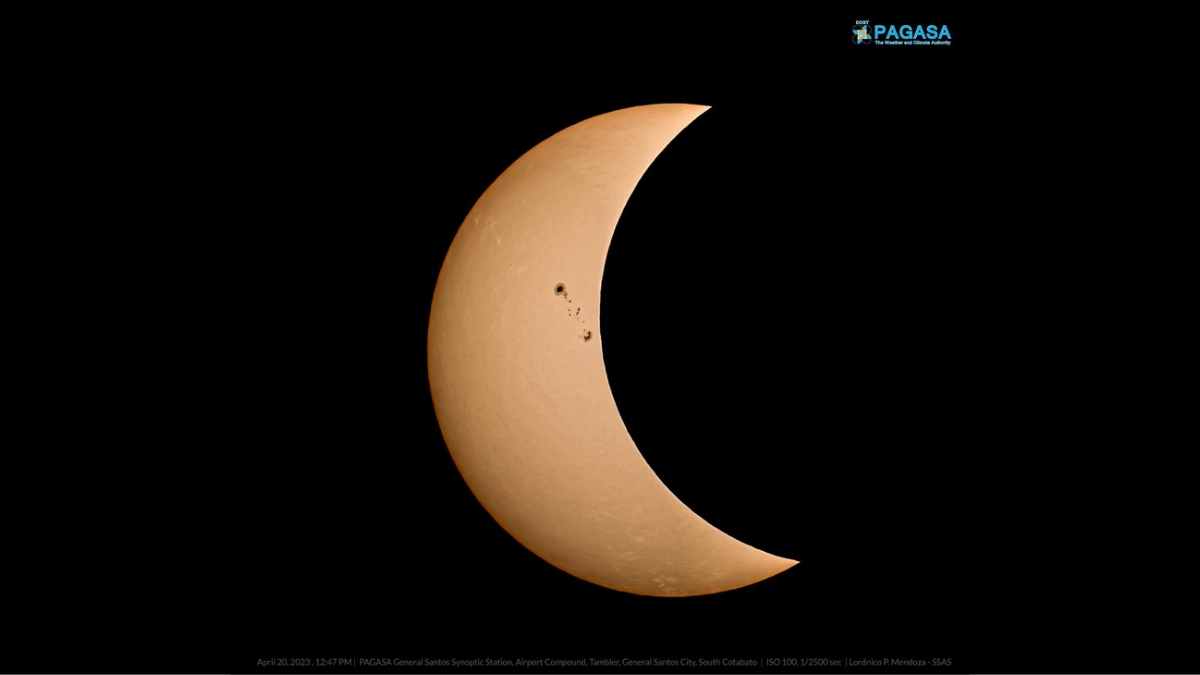
(SPOT.ph) Stunning shots of the partial solar eclipse that happened over the Philippines today, April 20, were taken from the PAGASA Synoptic Station in General Santos City. They shared what they were able to record of the hybrid solar eclipse via the Department of Science and Technology - PAGASA Facebook page.
Also read: Meet the Black Sheep of the Seaweed Family
PAGASA captures stunning shots of partial solar eclipse over General Santos City
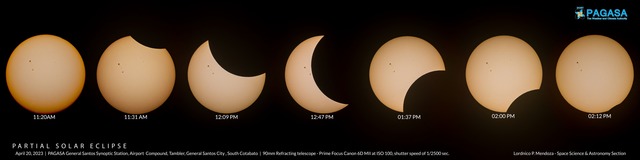
You can see the moon's passage between us and the sun via PAGASA's shots. Taken from between 11:20 a.m. to 2:12 p.m., you can see a bit of the sun get eaten up in shadow and then eventually released—harking back to tales of the bakunawa.
"The maximum obscuration (partiality) is 55.6%" wrote PAGASA in their caption. This means that from their observation point, the sun was covered by the moon at up to a total of that percentage, with the peak happening from 12:55 p.m. to 2:04 p.m., according to the government agency.
If you're in Metro Manila and wonder why it didn't seem to change much, that's because our peak obscuration was only at 23.7%; at the northmost of the Philippines, Batanes, it was at 12% while folks down south in Sarangani witnessed up to 58% obscurity.
What is a hybrid solar eclipse?
What occured today was a hybrid solar eclipse, a rare phenomenon which was only visible in totality from Western Australia, East Timor, and Eastern Indonesia. There are generally two main eclipses stargazers like to watch for: the annular and total—a hybrid is, of course, when both types can be seen depending on where you are on Earth. The former is when the moon blocks out the sun's center, leaving an awesome ring of light; the latter is when the moon completely covers the sun.
The hybrid solar eclipse means there was first the "ring of fire" then a total blockage of the sun, then a return to the annular eclipse. We in the Philippines only witnessed a partial, but no less spectacular, eclipse.