
Meet the Black Sheep of the Seaweed Family
One of the Philippines' youngest taxonomists has named another seaweed genus.

(SPOT.ph) Who are you? More than our name, we humans roam the earth on a personal mission to define who we are. It may be as simple as finding out our taste in music and films or as life-changing as accepting ourselves in our full rainbow-filled glory. This may take a lifetime: one day you like boys or girls; the next week or so, you identify as non-binary or express yourself as androgynous; and some years (and tears) later, you finally tell your closest friends and family. In an ideal world, we wouldn't even have to identify as one or the other; but in a society that has yet to grasp the idea of diversity, things have to start somewhere. And it all begins in the knowing, which in itself is a cause for celebration—a sign of great things to come.
Also read: Climate Crisis Is Real: 10 Worst Weather Events in 2022 (So Far)
Feeling Different and Out of Place
The same is true even for a lonely seaweed once called Hydroclathrus minutus. Sure, it has holes, looks like a clump of small nets, and is brown in color—much like the rest of its kind under the genus Hydroclathrus, the kind that you use for a fancy salad that's worthy of a dish in Masterchef. But Minutus has always known that something's off.
University of the Philippines Diliman professor Dr. Wilfred John E. Santiañez thinks so, too. One of the rare breed of seaweed taxonomists in the Philippines, he is also among the youngest scientists in his field. Santiañez holds a bachelor's degree (2008) in Marine Biology from Mindanao State University, a master's degree (2014) in Environment and Natural Sciences from the University of the Philippines Open University, and a doctorate degree (2018) in Natural History Sciences from Hokkaido University in Japan.
"Even before pa, nagdududa na talaga ako doon sa identity [ng H. minutus]. 'Yong professor ko kasi masyado kasi siyang conservative na ayaw niyang nagsi-split or nagde-describe ng mga bagong genera kung walang maraming evidence. Pero dati pa lang kino-convince ko na siya, iba talaga siya," he says in an interview with SPOT.ph.
It's a lot like coming out to Bible-thumping parents, minus the possibility of getting kicked out of the house or being sent to conversion therapy disguised as a Catholic retreat for teens.
Finding a Sense of Self
But Santiañez believes that everything starts with discoveries. More than naming an organism correctly, finding its correct genus is essential in revealing its true potential.
"Very important na malaman natin kung ano bang genus or kung ano bang species siya, kasi nga 'yung identification natin [o] pangalan na ibinibigay natin sa different seaweeds or different organisms, ini-introduce niya 'yong type or quality nung product na pino-possess or pino-produce nung seaweed na 'yon," he explains.
The phycologist cited an earlier example of how knowing the true genus of a certain red algae ultimately opened more doors in the Philippines' thriving seaweed industry.
"Pag mali kasi 'yong identification mo, essentially pag pinrocess kasi siya, mali din 'yong end-product na nakukuha ng seaweed industry. So may impact siya both sa industry-level at sa farmer-level. [...] Gano'n kaimportante na kailangan malaman natin 'yong identity ng seaweeds kasi may impact siya sa livelihood."
Searching for a Found Family
Years after his professor turned down his hunch, Santiañez was still convinced that Minutus has yet to find its true identity.
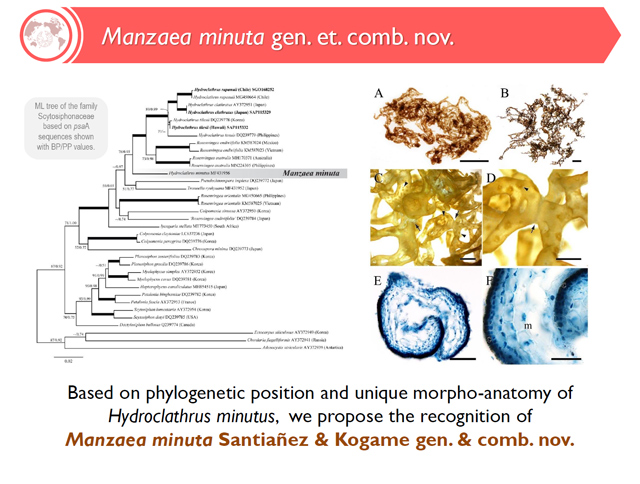
"Andon pa rin kasi 'yong question, lagi talaga 'tong naghihiwalay, naiirita na ako. Marami naman kasi talagang evidence na iba kasi talaga siya: sobrang nipis niya; nagdidikit-dikit 'yung membranes niya, pag tiningnan mo ang kapal-kapal nung kanilang cell walls; pag tingnan mo rin sa genetics, laging naghihiwalay; pag tiningnan mo 'yong range of difference ng genes nila in terms of substitution, ang layo din nung difference niya from other Hydroclathrus," the scientist explains.
Identities forced on us are always hard to shed. You may have grown your hair because it was required in your all-girls school, you may have dated the opposite sex because your family or religion said so, or you may have worn either a dress or a pair of pants because of advertisements told you to.
But Santiañez, along with Kogame, persisted in defense of the Minutus. On the outside, it may look similar to other members of its kind, but inside, there lies the blooming uniqueness that has always been there. Minutus is genetically different from the rest of its genus. And, finally, it was allowed the time to move out and make it on its own.
Paving an Own Path
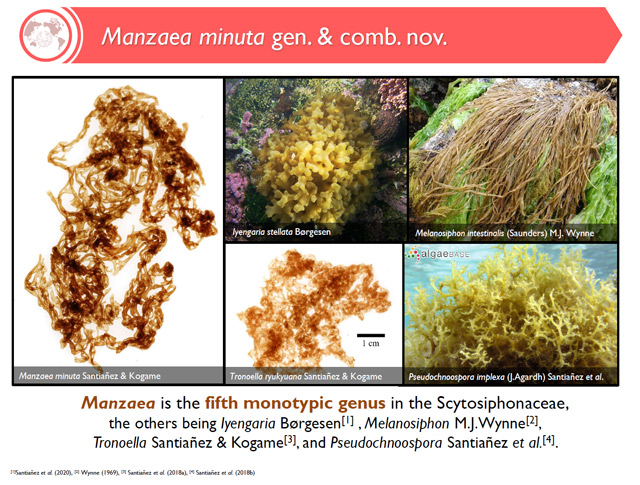
In a paper published by the Philippine Journal of Systematic Biology in July 2022, Santiañez and Kazuhiro Kogame from Hokkaido University not only renamed Hydroclathrus minutus, but also saw it fitting to have its own genus all to itself—for now, at least. They call this genus Manzaea, which is dedicated to the late Filipino scientist Dr. Artemio V. Manza (1896 to 1964) in honor of his contributions to global seaweed research.
"Usually kasi 'yong development ng isang resource, nag-uumpisa talaga siya sa tamang identification," says Santiañez, who finds joy in specializing in seaweed biodiversity and systematics, a field he likens to that of a detective.
"When you're working on seaweed taxonomy, you're actually trying to look at the code of nature. You're trying to make sense of nature. Ito sila—magkakaiba ba sila? Bakit sila magkakaiba? Magkakapareho ba sila? Bakit sila magkakapareho? Nagiging detective kasi ako when I work on seaweed taxonomy, trying to figure if we really are correct in our assumptions, especially when you look at the biodiversity of seaweeds," the scientist adds.
And celebrating this mind-boggling but rewarding search for identity only leads to untapped possibilities. The scientist pointed out that seaweeds have a number of bioactive compounds and derivatives, most of which can be looked at for food production, medicinal use, fertilizer, fodder, and even biofuel.
Right now, little is known about brown seaweed's specific economic implications. But putting Minutus (now Minuta) under the genus Manzaea—the fifth genus in the family of brown seaweed—is just the start of good things to come for Manzaea minuta.
It does get better, after all.
This story was written as a final output of the Blue Beat Initiative, a short course on marine science communication by the University of the Philippines Marine Science Institute (UP-MSI) and the Association of Young Environmental Journalists (AYEJ), under the National Security Council-funded project, "Upgrading Capacity, Infrastructure, and Assets for Marine Scientific Research in the Philippines."