
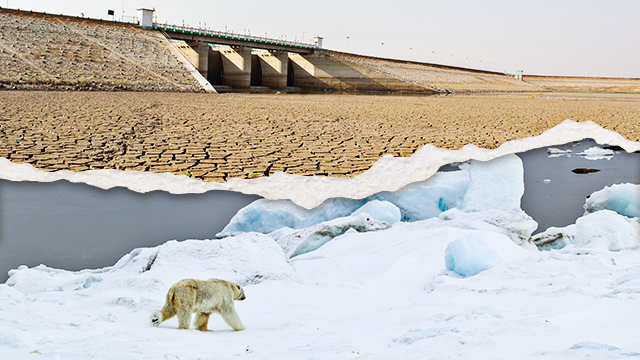
(SPOT.ph) Against the backdrop of political turmoil, territorial disputes, and price hikes, people worldwide still have to deal with another (but definitely interrelated) problem: the ongoing climate change, or—in more alarming terms—the climate crisis. The phrase describes global warming, which isn’t just about temperatures rising, but also about its effects: freak weather incidents, rising sea levels, melting of polar ice caps, loss of biodiversity, droughts, insect outbreaks, and the list just goes on. It’s basically the Bible’s Plagues of Egypt, but in real life; and it’s mostly caused by human activities that have been piling up since the Industrial Revolution. And more than two centuries later, all the fossil fuels we’ve been burning are heating the world too much that it’s almost at the point of breaking. We can already see major changes not only in Philippine weather, but all over the world.
Also read: 10 Nature Documentaries to Watch, Ranked by How Much We're F*cked
Here are some of the effects of climate change as we've seen so far in 2022:
Seoul's heaviest rainfall in decades (August)
Seoul experienced a record-breaking amount of rainfall at 497 millimeters (19.6 inches) of rain in the evening of August 9. They also recorded 141.5 millimeters (5.6 inches) of rain per hour, the highest rate since weather authorities began keeping records in 1907, according to reports. Flash floods across the city also occurred the Monday before that, August 8; and more torrential rains were felt the rest of the week. The monthly average of rainfall in Seoul is 348 millimeters for August, but the capital had more than 400 millimeters in just one night. This flooded homes, roads, and subway stations; and killed at least nine people, three of whom were trapped in a flooded semi-basement—a common type of residence in Seoul, as seen in the movie Parasite.
Record-high temperatures in the U.K.'s heat wave (July to August)
The United Kingdom recorded temperatures of 40°C for the first time on July 19, or more specifically, 40°C in the village of Coningsby in Lincolnshire, England. Now, this may sound like no reason for alarm, especially if you're living in the Philippines, where temperatures average between 21°C and 32°C on a normal day. But do keep in mind that the average temperature in that part of the world is only 14°C, which means their infrastructure—much more, their people—are not built for this kind of heat. Train tracks were bent out of shape, overhead cables failed, and the railway service had to be suspended for days. Airport runways melted, officially called "surface detect" due to brutal temperatures. Blazes raged in villages on the outskirts of London, and firefighters were busier than ever.
Meanwhile, GB News host Bev Turner during an on-cam interview with British meteorologist John Hammond on July 14, insisted that they "be happy about the weather." The national television segment seemed something straight out of the satirical movie Don't Look Up.
Flash floods in Kentucky (July)
At least 37 people were confirmed dead as a result of flash floods in Kentucky during the last week of July. Governor Andy Beshear, in a report by Newsweek, described widespread damage, as entire communities in eastern Kentucky pretty much went under water, cars and trees were damaged from the floods, and more than 600 people displaced and rescued. Dubbed the wettest monsoon in decades, the heavy rainfall also brought massive flooding across the United States, from Appalachia in the east to Las Vegas in the west.
Worst flooding in Bangladesh in decades (June)
As a low-lying country in the world's largest river delta, Bangladesh is one of the nations most vulnerable to climate change. In June, rain-triggered floods submerged the country's northern and eastern areas, killing dozens of people and displacing nearly four million more. According to the director of the Institute of Water and Flood Management at the Bangladesh University of Engineering and Technology, rains in the country are getting more and more unpredictable, and their rivers are rising above dangerous levels. “I’ve never seen a flood like this,” said one local in a report by The New York Times.
Yellowstone flooding in the Pacific Northwest (June)
Videos of houses being carried away by a raging river at the Yellowstone National Park went viral in June. This was caused by the rain and melting snow that rushed down the mountains of southwest Montana, resulting in the flooding of the Yellowstone River and its tributaries. Regarded as a historic event that may have reshaped the terrain in the region, it changed the course of the rivers, damaged bridges, took down homes and vacation houses near the country's oldest national park. Nearby, rangers in Glacial National Park in Montana are looking at a future where no glaciers are left because of rising temperatures.
Director of American River’s Northern Rockies Scott Bosse, however, has an eye-opener view as quoted in an interview by National Geographic: "As humans, we often think that floods are disastrous, and fires are disastrous, but they're really only disastrous because we put human lives and property in harm's way. They're not disastrous from an ecological standpoint. Quite the contrary, they're extremely healthy for rivers, and especially for a river like the Yellowstone."
Tropical storm Agaton during the Philippines' dry season (April)
In April, which was supposed to be the dry season in the Philippines, tropical storm Megi (locally known as Agaton) hit the country. It made two landfalls: Calicoan Island in Guiuan, and another in Basey, Samar; and most of the damage was in the Visayas, where heavy rains, flash floods, strong winds, and landslides were witnessed. It didn't help that most of the region was still just recovering from the aftermath of Super Typhoon Odette (December 2021).
A record-breaking number of tornadoes in the Southern U.S. (March and April)
While Southern United States is familiar with tornadoes coming in and out of the country, they saw the most tornado warnings in 2022, a year that isn't even over yet. Alabama, in particular, had 115 tornado warnings by April 18. In just four months, the state topped tornado warnings issued in nearby Missisipi, Texas, Arkansas, and Florida.
India's hottest month in more than a century (March)
India's weather bureau reported that the month of March 2022 was the hottest month on record for the country in 122 years. Spring season was short-lived, and the weather quickly went into summer—a turn-of-events happening more frequently than ever. Plus, heat waves usually occur in May and June, and not as early as March and April. Monsoonal rains arrived in southern India in the first week of June, but locals say this is far from the normal rainfall they were getting. This doesn't bode well for a country that depends heavily on agriculture.
Fatal snow storm in Northern Europe (January)
At least four people were killed in a winter storm that swept northern Europe on the last weekend of January. Storm Malik went through Denmark, Finland, Norway, and Sweden with strong wind, extensive rain, and heavy snowfall. It destroyed houses and cars, closed bridges, and caused flooding—with Scotland hit particularly bad.
North America winter storm (January)
More than 100,000 people were without power as winter storm Izzy hit North Carolina, South Carolina, Georgia, Pennsylvania, and Kentucky in January. The weather system started in the Northern Plains on January 13, then accumulated ice as it traveled into the South and Northeast of the U.S. North Dakota and Minnesota reported up to 12 inches of snow, while Iowa saw up to 14.3 inches of snow, the heaviest since 2009.