
"Result in" or "Result to": Is It Time for Philippine English to be Accepted?
Expand your vocabulary this Buwan ng Wika.

(SPOT.ph) The Philippines is one of the largest English-speaking countries in the world, with over 14 million Filipinos using this secondary language after Filipino.
When we talk about the English, we’re most likely referring to American English (AmE). Over time though, English in the Philippines has blossomed into a linguistic entity of its own—and we’re not just talking about Taglish. Grammar Nazis might cringe at the sight of “result to” and “based from,” but language experts would embrace these "grammatically incorrect" phrases as “grammatical variants.” Linguists have even given it a name: Philippine English (PhE).
Among the researchers following this unique linguistic evolution is Ariane Borlongan, Associate Professor of Sociolinguistics at the Institute of Global Studies.
“Philippine English is not substandard English or badly-learned English. It is a variety of English as legitimate as American and British English,” Borlongan, who is also founder and head of the Tokyo University of Foreign Studies' Migration Linguistics Unit, told SPOT.ph.
“Admittedly, what becomes as distinctive features of Philippine English (or any new variety of English, for that matter) begins as errors until they become a feature of a new English.”
Also read: 10 Filipino Words You're Probably Using Wrong
Examples of Philippine English in academic writing
One way that the Philippines has been legitimizing PhE is through academic writing. Just a week shy of Buwan ng Wika, University of the Philippines - Los Banos (UPLB) Learning Resource Center compiled several research works showing grammatical variants of PhE based on AmE on Tuesday, July 25.
“Such an existence entails that PhE grammatical innovations are acceptable in academic writing—which is a linguistically conservative register of language,” UPLB Learning Resource Center wrote.
Check out examples of grammatical variants based of PhE below:
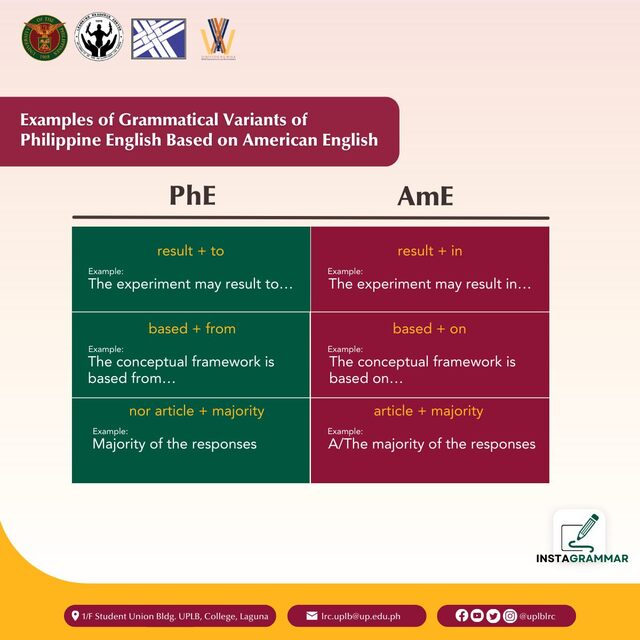
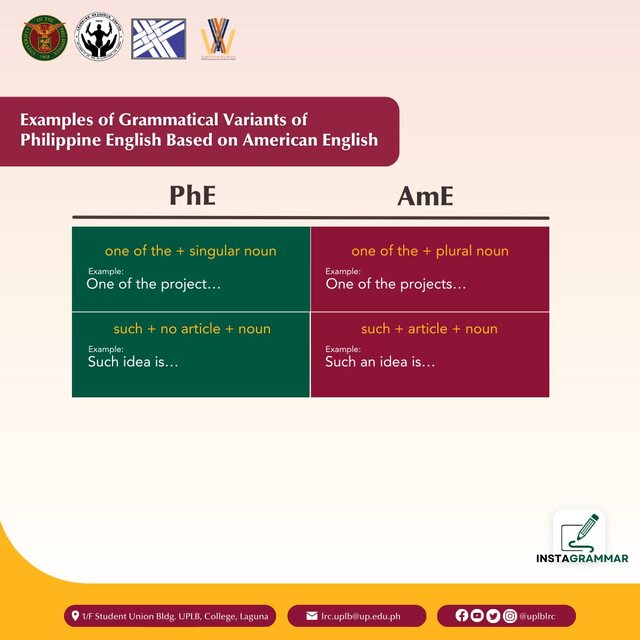
The examples might take a while to get used to, but Borlongan's earlier explanation forms the foundation for understanding the linguistic landscape that PhE occupies. Still, you might be wondering the same question the Filipino linguist Brother Andrew Gonzalez famously asked in 1983…
"When does an error become a feature of Philippine English?"
Addressing this in an upcoming paper, Borlongan came up with three objective measures for an initially erroneous word or phrase to be accepted in PhE: it should have frequency, structural influence, and history.
- Frequency: A usage must be frequent enough to become an accepted feature of a new English.
- Systematic reason/structural influence: There must be a logical reason why there is the emergence of that new usage or feature in a new English. Usually, this is because of the interference of a local language or cultural influence.
- History: The feature must have been in continuous use for around 30 years. It must not be some random usage that disappears in a few years or even months.
“I must emphasize here that grammaticality, by and large, is much a product of frequency, and, eventually, acceptability,” Borlongan said.
For this to happen, Borlongan said that PhE should be given more recognition in the same way American and British English rose to global prominence: through frequency in learning and reference materials.
“Dictionaries, grammar books, guidebooks, and textbooks about Philippine English must be made. It must also be taught in schools. Above all, Filipinos themselves must recognize that their own English variety is legitimate. The work is just beginning, but it is not impossible. The Philippines is on the right track," Borlongan said.
Also read: People Are Posting Mind-Blowing Observations for #BuwanNangWika