

This Polio Survivor Wanted to Make Crutches Cool, So He Invented His Own
His version is so much easier to use, too.
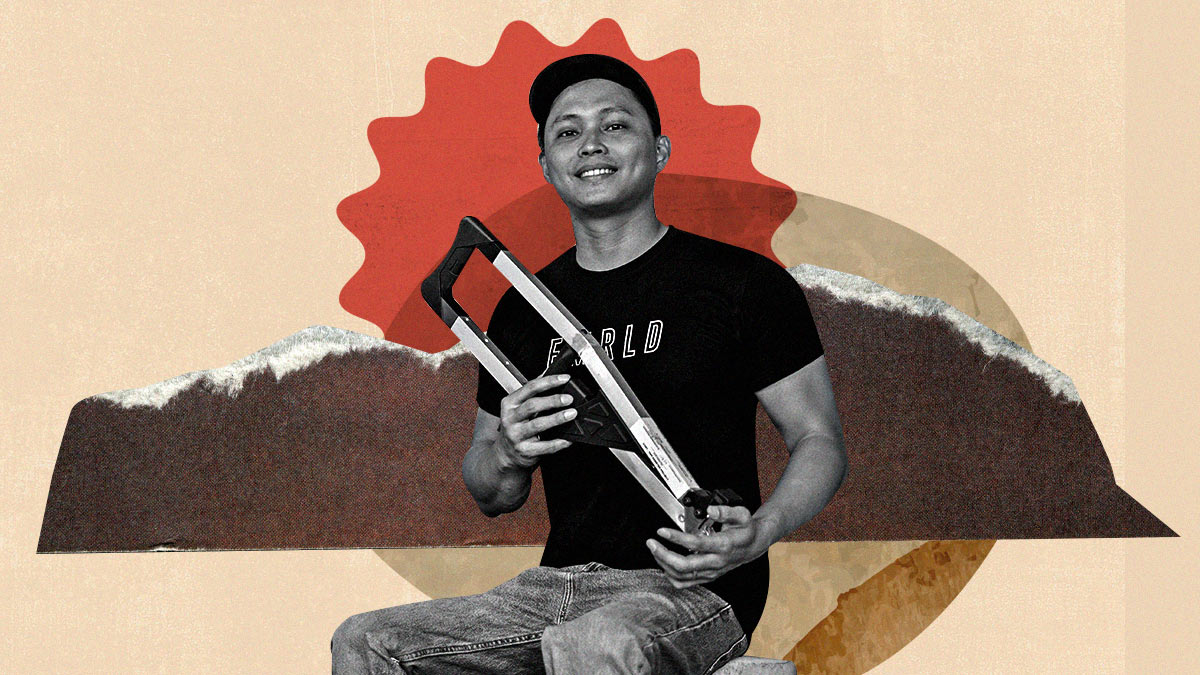
(SPOT.ph) James Camacho was only two years old when he was struck with polio. He has been living with the condition for the past 38 years now. As he takes this interview with SPOT.ph, his weight is carried by a pair of grey crutches under his arms—his own invention called the nano foldable crutch that has taken over seven years, and continuing, to perfect.
“All my life, I’ve been using mobility-assisted devices. Depressive siya sa early stages ko,” Camacho told SPOT.ph. His lived experience, marked by the highs and lows of navigating life with a disability, became the blueprint for his invention. “Nakita ko there’s an opportunity to apply mga experiences ko to create smart mobility-assisted devices.”
The result of this desire led to the development of the nano foldable crutch—and Camacho's end goal is to introduce it entirely for free for persons with disabilities (PWDs) across the country, no matter the age, weight, or location.
That, and he wants to make crutches look cool.
Also read: This Fresh Grad's Microscope Keychain Addresses STEM Laboratory Shortage in the Philippines
Helping hand?
The idea to do something about his predicament came to him on a flight to Sweden. He recalled the flight attendant taping his crutches together and stowing it in the back since there was no room in the cabin for his crutches. When Camacho needed to get up to use the bathroom, they had to remove the tape, hand it to him, and in the end, do it all over again when the plane landed. He couldn’t help but feel awkward about the whole interaction.
“Ang daming tao involved, ang daming process involved, whereas if it was right in front of me, I could do it on my own. Mabilisan lang sana, but there was no space for [my traditional crutch],” Camacho said. “As a PWD, ayaw mo mang-hassle. It’s supposed to help you become more efficient in traveling but the tendency is makakahassle ka pa.”
Closer to home, it’s near impossible to ride a jeepney or a UV express without the crutches getting in the way of everyone else. Camacho would know—he’s a fellow commuter.
“With this,” Camacho said, lifting his nano foldable crutch in the air. “Mabilis siyang i-fold, unfold quickly without hassling anybody. It gives you a certain level of freedom, of independence para hindi ka lagi inaasikaso or inaalalay.”
Also read: Elevated Walkways for Seniors, PWDs: What We Know About the EDSA Greenways Project
Coming up with the nano foldable crutch
Camacho has been actively working on the nano foldable crutches for seven years, but it only took off in 2023 with the help of the Department of Science and Technology - Technology Application and Promotion Institute (DOST-TAPI). That was where I met Camacho, in DOST’s awarding ceremony “Lunduyan" on October 2, which celebrated 28 local inventions long due for national recognition.
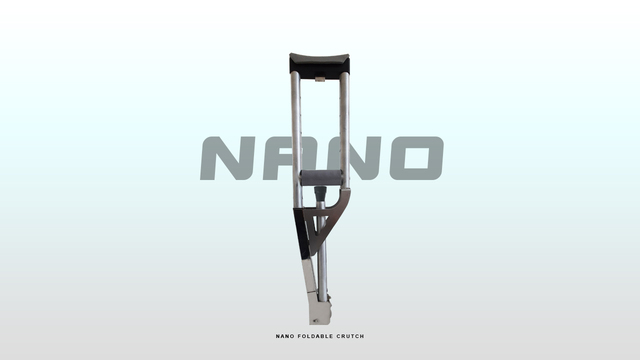
Prototype after prototype has led him to this: A nano foldable crutch that can be folded and unfolded with a push of a button—a significant step for PWDs even if it might seem trivial for able-bodied people. Beyond matters of size, Camacho said the term “nano” harkens to the concept that even the simplest and smallest solutions can make a big impact.
Camacho’s nano foldable crutch is comfortable and compact, designed with the precision that only someone who has walked a mile (and much more) with a mobility-assisted device could achieve. It can also support up to 300 kilograms of body weight.
There are at least 1.44 million PWDs in the country, according to the Philippine Statistics Authority’s 2010 Consensus of Population and Housing. The fact that the latest available official survey on PWDs is from more than 10 years ago speaks volumes about how they remain at the margins of our cultural, economic, and political realities.
“Paano makikinabang ngayon ‘yung mga regular na tao, isang person with disability na walang trabaho dahil wala silang mobility-assisted devices to become active members in society?” Camacho said. “The vision behind it is to provide smart mobility-assisted devices for all Filipinos for free.”
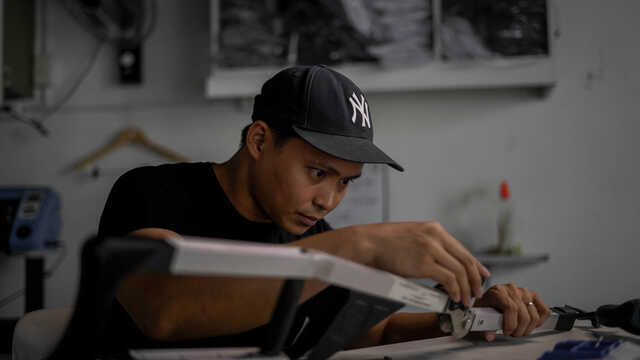
In the Philippines, a pair of traditional crutches will typically cost over P1,500. Elsewhere, Camacho said they are handed out for free by the government as part of broader accessibility programs. This is why Camacho is hoping to partner up with local government units (LGUs) for the free distribution of the nano foldable crutch to the PWD community in its clinical trial phase.
It’s a project that even private companies can take on for their corporate social responsibility, he said.
Of course, to truly service an underrepresented sector is to offer more than basic necessities. Camacho knows this, which is why he opted to conceptualize the nano foldable crutch as a lifestyle product rather than a purely medical one.
“I want to remove the clinical aspect of design, make it more of a lifestyle product.” His goal, apart from efficiency and stability, is to make crutches look cool—a device that PWDs would be proud to show off. Who says we have to stick to the status quo? “It’s better to innovate, to upgrade our technologies.”
How to buy the nano foldable crutch
The nano foldable crutch is well on its way to commercialization.
Camacho hopes to have it finished by January—or at least within the first quarter of 2024. It’s currently in pilot production with a few units in stock, with only Camacho feeling it out so far (he tells me it feels a lot more stable than the typical crutch). However, PWDs who are willing to make the purchase can have it pre-ordered through Camacho’s personal Facebook account as early as now.
I asked Camacho how much it would cost to purchase the nano foldable crutches. I noticed he hesitated a bit before telling me that it costs P12,000 for one pair. His pause is understandable—few can afford traditional crutches, what more an upgraded version of that, the first of its kind in the Philippines?
This reality is far from Camacho's vision to provide free mobility aid for everyone in need—he knows it—but this is just the beginning for him. What's seven more years of trying compared to his lifetime of challenges?
“Financially, di ko kaya magbuild ng factory. If makakuha ako ng funding, then I would be able to create this on my own, employ fellow PWDs, then lower the cost. If malower ko ‘yung cost, puwede ko siya ipa-retail,” Camacho said, chalking the P12,000 price tag up to the high cost of local manufacturing with a low production volume.

The Philippines has a long way to go in becoming PWD-friendly (just take a look at the Kamuning footbridge), but people like Camacho are putting in the work to promote accessibility, one crutch-assisted step at a time.
“Crutches is just the first. Hopefully, I could move into wheelchairs and other walking aids,” Camacho said. “It’s my prayer that one day, people see the vision behind the nano foldable crutches. 2023 na, magtulungan tayo, magbayanihan tayo. Different stakeholders can really pitch in para mabigyan natin ng dignidad ‘yung mga taong may kapansanan.”