
The Church's Statement About Blessing Same-Sex Couples Is Actually Cruel
Here's what the recently published Fiducia Supplicans actually means.
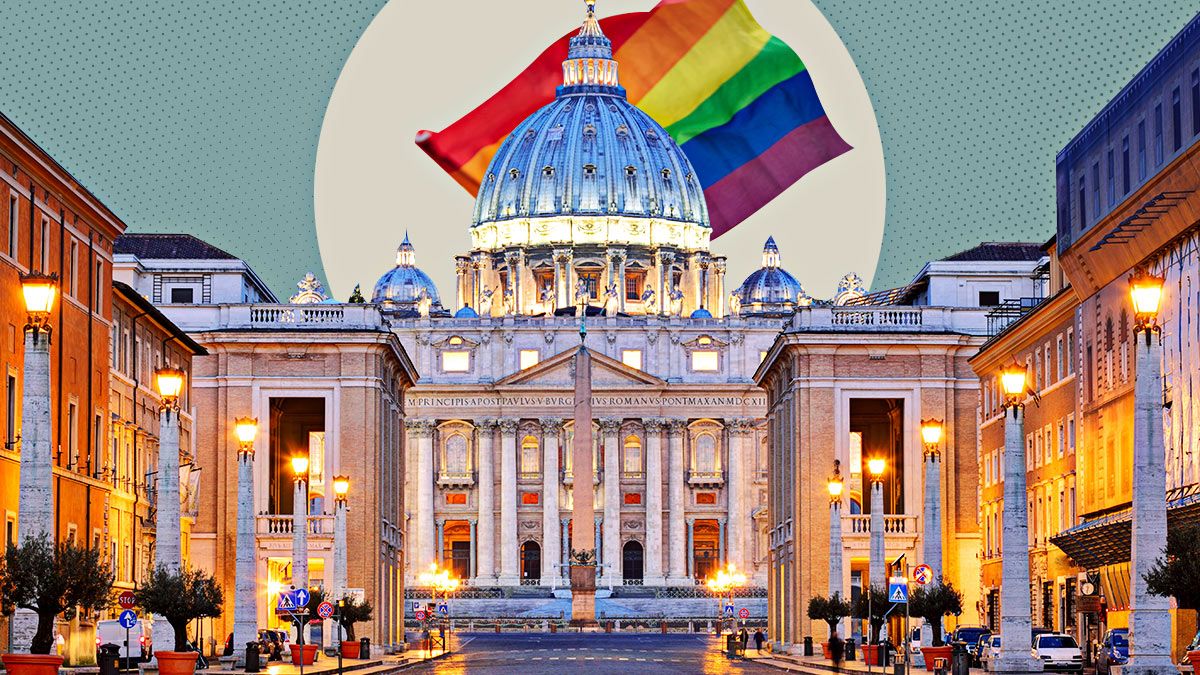
(SPOT.ph) In a controversial move, Pope Francis formally allowed Catholic priests to give their blessing when requested by a same-sex couple. This was announced by the Vatican on Monday, December 18, following the Dicastery for the Doctrine of the Faith's publication of Fiducia Supplicans. Intended as a Declaration, the official document is about 5,000 words long with 45 statements in total. As a lesbian raised in the Roman Catholic Church and in a nine-year same-sex relationship that's spiritually but not legally recognized through the Rite of Holy Union by an ecumenical Christian church, what does this mean for me?
What the Vatican's Declaration About the Blessing of Same-Sex Couples Mean
Fiducia Supplicans is essentially a declaration on the "pastoral meaning of blessings" and "possibility of blessing couples in irregular situations and same-sex couples" while still clarifying that it "remains firm on the traditional doctrine of the Church about marriage." It elaborates on Pope Francis' letter (a.k.a. Respuestas a los Dubia propuestos por dos Cardenales) last September in response to five cardinals who sent him a list of questions, a.k.a. Dubia.
One of the five Dubia from Cardinals Walter Brandmüller and Raymond Leo Burke was: "Dubium regarding the affirmation that the widespread practice of blessing same-sex unions is in accordance with Revelation and the Magisterium." The cardinals cited the Sacred Scripture: "God created man in his image, in the image of God he created them; male and female he created them and blessed them so that they may be fruitful" as well as Paul's Letter to the Romans about "shameful lusts" and "natural sexual relations"—you know which one. Finally, they asked if the Church can deviate from these teachings and accept unions with persons of the same sex as "possible good" despite being "sinful situations."
In the Pope's longer Fiducia Supplicans, he basically invites the clergy to "broaden and enrich the meaning of blessings."
What is a blessing?
Turns out there is this Book of Blessings, which explains that "formulas of blessing are primarily aimed at giving glory to God for his gifts, asking for his favors, and restraining the power of evil in the world." It's basically the kind of blessing Catholics seek out for various occasions (birthday, board exam, surgery, competition—you get the drill). It's also the kind of blessing that Catholics request from the priest when they have a new home (house blessing), a new car, food and drinks, and so on. This Book of Blessings even has particular prayers for the Blessing of Mothers on Mother's Day, Blessing of Fathers on Father's Day, Blessing Before and After Meals on Advent/Christmas/Lent, Occasion of a Birthday, among others.
Anything and anyone can be blessed, at least according to Pope Francis' description of a blessing that is "offered to all without requiring anything."
What the Vatican's Declaration Really Means
It is not a blessing for the relationship of a same-sex couple, more so, the union of a same-sex couple.
The Fiducia Supplicans explicitly defined, quoting Pope Francis' earlier Respuestas, what constitutes a marriage: "exclusive, stable, and indissoluble union between a man and a woman, naturally open to the generation of children." It added that it is only when this context is applied that relations are "natural, proper, and fully human."
In effect, the union between a same-sex couple is not "natural, proper, and fully human." This should not come as a surprise since the Catechism of the Catholic Church officially says that "tradition has always declared that 'homosexual acts are intrinsically disordered'," “contrary to the natural law," and "close the sexual act to the gift of life." The paragraph is closed with an ominous "under no circumstances can they be approved."
The Vatican's Declaration, in an effort to "avoid any form of confusion or scandal," pointed out that the giving of the blessing—when requested by a couple in an "irregular situation"—should never be done during ceremonies of a civil union. Giving of the blessing should also not be performed with "any clothing, gestures, or words that are proper to a wedding."
It is not an approval for same-sex weddings.
The Catholic Church, as mentioned above, is very firm in its traditional doctrine about marriage.
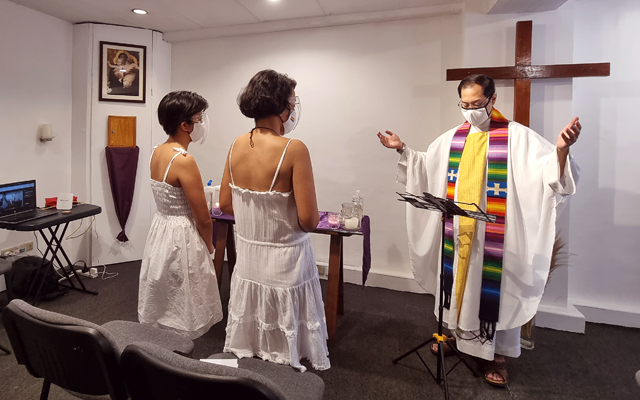
If you want your relationship to be blessed by a higher power, then you may want to consider other religious institutions. Open Table Metropolitan Community Church, for example, is an LGBTQ+-affirming Christian church. They facilitate the Rite of the Holy Union, which is one of the Rites of the Metropolitan Community Churches all over the world. Technically, it is the "spiritual joining of two persons regardless of sexual orientation and gender identity." It's similar to a wedding—just don't let the conservative Catholics hear about it. The couple walks down the aisle, listens to the liturgy, gets a blessing from the pastor, and later pronounced "spouses for life"—my favorite part.
It has no bearing on the legal framework.
Just in case we've forgotten about the separation of the Church and the State, the Vatican's proclamation has nothing to do with the lack of marriage equality in the Philippines. But as these lines are often blurred in our country, you just don't know.
Technically, marriage is a legal contract, while a wedding is a ceremonial celebration. Philippine law does not recognize same-sex unions since the Family Code of the Philippines indicates that "marriage is a special contract of permanent union between a man and a woman." It further indicates that marriage is only valid when there is a "legal capacity of contracting parties who must be a male and a female."
This means that, even when my partner and I have been together for nine years now and have been blessed through the Rite of a Holy Union for two years now, my civil status still says single. I also can't declare her as dependent on my health card, SSS, and other legal documents. Sure, there are legal workarounds like getting a Special Power of Attorney, but same-sex couples don't have it as easy as a man and woman who can just decide to go to the city hall and get married.
Why Pope Francis’ Declaration May Not Matter for LGBTQ+ and Same-Sex Couples in the Philippines
With all these technicalities and definitions of that Church document out of the way, it’s time to break it down. Words, after all, are never just words.
If anything, Pope Francis’ clarification on “the possibility of blessing couples in irregular situations and same-sex couples without officially validating their status or changing in any way the Church’s perennial teaching on marriage” just affirms that LGBTQ+ relationships are not welcome in the Catholic Church. Blessings can be given to everyone and everything, and the need to publish conditions and caveats of the Respuestas and then the Fiducia Supplicans goes to show that Catholics’ sexual orientation and gender identity are enough grounds for LGBTQ+s to not be on equal footing as the rest.
Second, while it’s not surprising, the Declaration is just another reminder of what the Catholic Church thinks about homosexuality and that homosexual acts are “intrinsically disordered. It's basically the phrase ‘love the sinner but hate the sin,’ which is not really a Bible verse but is often used by evangelists to perpetuate the belief that "homosexual acts" and "homosexual tendencies" are sins and LGBTQ+ people are sinners.
For young LGBTQ+s within the Roman Catholic Church, it just becomes another reason for promoting so-called Catholic guilt. I, for example, was sent to an all-girls Catholic private school where any sign of tomboyish "tendencies" can get you suspended. It was the best formula for compulsory heterosexuality and never fully realizing and accepting who you are until later in life. Add to that a tinge of internalized homophobia—which is common among LGBTQ+ people who have internalized the negativities that come with being outside the norm of heterosexuality, and the result is a case of a closeted gay, inadvertently or not.
Third, Lingayen-Dagupan Archbishop Socrates Villegas' words cannot be more outrageous. In his Episcopal Guidance for the Implementation of Fiducia Supplicans, published on December 19, the former president of the Catholic Bishops' Conference of the Philippines clarified the difference between the blessing of exorcism, which happens when a priest blesses a car, and the blessing of sanctification, which is when a priest blesses a newly married couple during their wedding. "For centuries, Catholic blessings often combined the two. An object was first exorcised before it was sanctified," he said.
The Fiducia Supplicans—at least according to Villegas’ interpretation, not necessarily found in the Vatican’s document—add the "blessing of mercy." And for a couple in an irregular situation, same-sex relationships included, asking for a blessing is "asking God to have pity on both of them and to give them the grace of conversion so that they can regularize their relationships."
Pope Francis' Declaration, in all fairness, is a baby step towards LGBTQ+ tolerance—not acceptance, mind you. At least, they're talking about it, an optimist may say. At least, the priests can still give us their blessing, albeit individually and not as a couple—I never knew they couldn't. At least, there's a space for people like me in the Catholic Church—as long as I ask for "pity" and the "grace of conversion," in the words of Villegas.
The Pope's Fiducia Supplicans and Respuestas', coupled with Villegas' Episcopal guidance, do not really change what the Catholic Church teaches about LGBTQ+s. The statement sounded a lot like a crisis management press release or a politician's empty promise to get the LGBTQ+ voting bloc. It sounded like the Catholic Church wanted to encourage its LGBTQ+ children, who have been continuously turned off by homophobic homilies, to come back with a promise of God's "Infinite Love." It sounded like the Catholic Church saying, "I love you, but..."
No, thank you. I'd rather be in my "irregular situation" in peace.
Christa I. De La Cruz, SPOT.ph's Associate Editor for Travel, Culture, and Video, has more than a decade of experience in feature writing for print, digital media, and coffee-table books. She is also a Palanca Award-winning writer; and has published works of poetry and fiction in local and international literary journals. Currently, she lives in Mandaluyong with her wife and three kids (a.k.a. dogs).