

Greenbelt 1: Why Demolition Is The Respectful Thing To Do
This 80s kid made Greenbelt his home in more ways than one.

(SPOT.ph) As Philosophy class taught us, “nostalgia” comes from two Greek words: “nostos” (“longing for home”) and “algia” (“pain”). As we get older, “home” becomes not so much a physical space but a sense—of the familiar, of shared memories, of being and belonging. Filipinos of a certain age who grew up in Manila at a certain time (read: pre-internet)—unlike those who lived in rural areas with plazas and open spaces—by and large enjoyed malls as the poor facsimile of “public spaces.”
Unsurprisingly, the news and prospect of Greenbelt 1’s impending demolition must have caused a bit of pain to a set that have come to regard it as home.
Also read: Goodbye, Greenbelt 1, Thanks for The Memories
Some personal context
Seventeen years ago, I decided to make my home somewhere near Greenbelt; a choice prompted in part by my then affiliation with a law firm in the neighborhood—and, to be perfectly honest, the close proximity to Greenbelt Mall.
As a child of the 80s, a great deal of my teenage years was spent hanging out in the mall. By the time I became a young professional, I was such a frequent visitor to Greenbelt that the prospect of saving on parking fees was enough to “justify” my eventual decision to live in Makati. I was there on an almost daily basis!
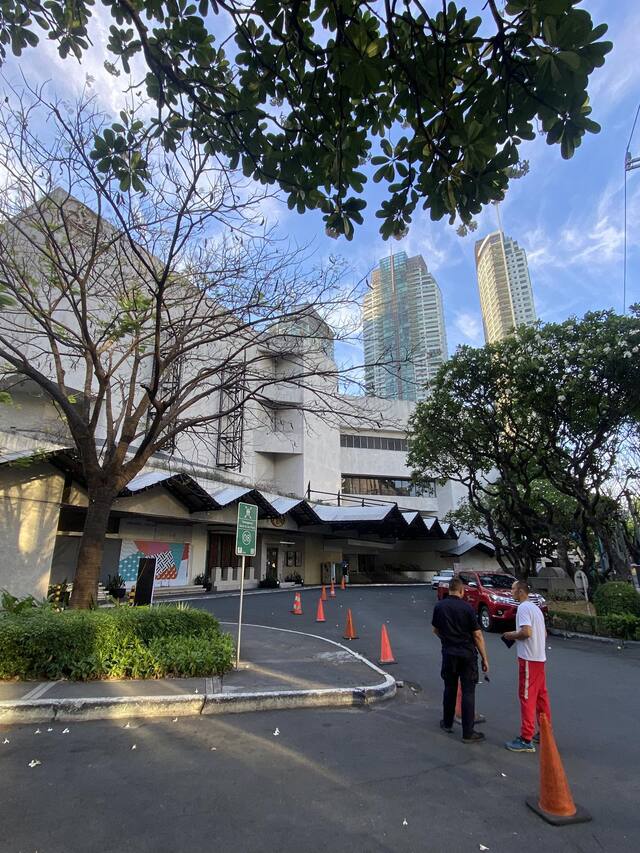
I have many core memories of being a “mall rat.” My earliest memory of Greenbelt 1 involves a visit to National Bookstore with my father who, after encashing his check, bought me my first books on Philosophy. Suffice it to say that, no doubt, many Filipinos like me, who are of a certain age, have similar memories (although, they should probably be glad they did not suffer from “early onset pretensions” just as I did—which is a different matter, altogether).
Since then, however, after over a decade of living in the neighborhood, Greenbelt started to represent something else. Its perimeter is the path that I walk as I go to the Chapel. The store clerks are no longer just “staff” but friends and faces I’ve known for years. To recall a few: the caring crew-turned-Manager at KFC; the various “Ates” at National Bookstore, Jamaican Pattie, Tickles (who have, at one point or another, received a burger from me); and, of course, the kind-hearted duo at Hen Lin who always looked after “Nanay Nenita,” the octogenarian homeless lady who was well-known and well-loved by everyone at Greenbelt. They are among the many reasons that make it difficult to say goodbye to Greenbelt 1.
This is not to say, however, that it’s not yet time to say goodbye.
Even as I wax nostalgic and have a professed personal fondness for Greenbelt 1, when I first heard of the prospects and possibilities of its demolition, I must admit that, on some deeper level, I knew and easily accepted that it was time.
Some relevant considerations
Over the years, with the development and construction of its newer siblings that form the loop of “Greenbelt Mall,” the eldest started to look and feel like the oldest—and not in a good way. More and more, it had a feeling of being disconnected from the rest of “Greenbelt,” not just in terms of architecture, interiors, ambiance, and design, but even with its sense of spirit and life.

In fact, what prompted these reflections is the impression that Greenbelt 1, as it stands today (or for the time being before its demolition) is a reality so far removed from the vision of National Artist for Architecture Leandro V. Locsin. The context and the circumstances have changed so much: the addition of the other buildings in the Mall Complex, the redevelopment of the park and open spaces, the introduction of a housing complex within the Greenbelt brand, the evolution of Legaspi Village and the emergence of its residential flavor, just to name a few. And yes, the additions and modifications to “Greenbelt 1” have turned it into a Frankensteinian monster of a mall that has diminished the grandness and scale of its Brutalist architecture. In fact and if anything, demolishing the structure would be the respectful thing to do.
Also read: The Brutalist Architectural Gems to Check Out in Metro Manila
Factual premises and presumptions
“Age” has a lot to do with the flood of emotions for the demise of Locsin's Greenbelt 1. When the National Cultural Heritage Act came into being in 2010, among those it deemed and “considered important cultural property” are “structures dating at least 50 years old.” The presumption afforded by the law has served as a layer of protection for important cultural properties. However, it has also led property owners to wise up—in order to prevent the presumption from setting in, some have been in a mad scramble to make sure their buildings do not reach their golden years.
In the case of Greenbelt 1, however, aside from its age, it is considered an “important cultural property” because it is the work of a National Artist. That being said, it is worthwhile to remember the merits of the work, even as it is considered as (or perhaps, moreso, because it is the) work of a National Artist. This is not the first time that the impending demolition of Locsin's work generated controversy. I regret that I am unable to find my copy of BluPrint where the statement of Leandro V. Locsin Partners (LVLP) appears, but from what I recall of its gist: the firm took on a humble position, mindful of how any statement on the merits of the Mandarin Oriental may be mistaken as self-laudatory and self-serving. And if memory serves, they made note of the fact and nature of the building as being primarily commercial in nature and thus subject to the same forces that prompted its development.
In a relatively recent interview with the same magazine, the National Artist’s son, Andy Locsin recalls the same view:
"Our responsibility for any of the surviving works is to provide summary information as we may have in our archives, memories, and external published works regarding design intent, technical issues, background, history, circumstance, and place of the work in the firm’s design lineage when inquiries come from the advocates, opposition, or the Commission. We will obviously have our own personal opinions on any case that comes up – any individual in the firm is free to express this as their own private view as a citizen – but in general we hold these close to the chest and will never represent this as the firm’s official view on the matter.
"Along similar ethical lines, LVLP will never lobby to take part in whatever structure replaces his work unless we are specifically asked to do so. In recent years however, we have been fortunate and grateful to be on the receiving end of such for three major projects, from a longstanding repeat client of over 60 years with a shared history. That said, there have been many other fine examples of his work that have been summarily torn down without notice, inquiry, or proper process."
It appears that that the above same considerations figured in the petition put forward and argued by Ayala Land, Inc. before the National Commission for the Culture and the Arts for the removal of the presumption that Greenbelt 1 is an important cultural property. In the “Notice to the Public,” the NCCA summarized the grounds raised, as follows:
- Greenbelt 1 does not qualify as a “property with exceptional cultural, artistic, and historical significance in the Philippines” under both the Republic Act (RA) No. 10066 and its Implementing Rules and Regulations;
- Because of the changes and renovations made by the owner prior to the effectivity of RA 10066, the current state of Greenbelt 1 is already not consistent with Locsin’s original vision of the building and signature architectural style found in his most celebrated creations; and
- Greenbelt 1 is primarily a commercial establishment and is better suited to house a brand-new comprehensive, well thought out mixed-used development that can be of service to a much larger population and, at the same time, provide much needed employment – one that is entirely aesthetically consistent and coherent with Makati Central Business District’s (CBD) urban architectural plan and design.
A postscript to an epilogue
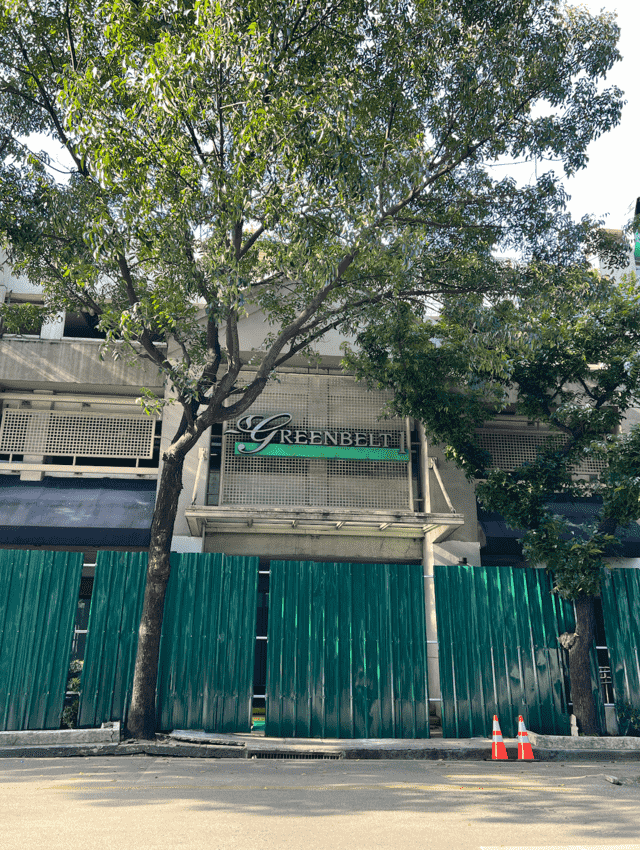
Since I started thinking about writing this piece, I have watched the scaffolding go up and have seen the façade of Greenbelt 1 boarded up, as though to spare us from the painful sight of its impending demolition. The shops that line the side fronting Legazpi Street are all closed; it is depressing as it is dreary. At certain times in the day, I see the flow of people walking towards Greenbelt 5 where the P2P station has been transferred. Knowing the developer, I have no doubt the recent statements about improving wayfinding in their malls is a wink at their embrace of space syntax, harnessing “the link between spatial configuration and human behavior.”
And if anything, knowing what malls are to Filipino urbanites—and the central role and location of Greenbelt to the business district so closely identified and associated with the Ayalas—the new Greenbelt 1 just might bring a new complexion of life to the neighborhood and with it, new memories for a new generation. The bitter truth is that, as much as we can romanticize our memories of these malls, because they are not public parks or plazas or gardens, they can never be truly ours.
Meanwhile, long after the last Facebook ode to Greenbelt has been posted, my generation—just like the many that came before us, who have come and gone and who have loved and lost—will have to be content with the stories we will tell ourselves, recalling the good old days of what used to be, occasionally feeling the pain that comes from the longing for that sense of home, from which we have been barred by time and loss.