

UST Library and Archives' 12 Most Important Treasures
Even Father Burgos' academic grades and other school records are here.

(SPOT.ph) In 2015, the official website of the University of Santo Tomas (UST) Museum of Arts and Sciences was hacked by suspected Chinese hackers denouncing Philippine “action” in its maritime territorial dispute with China. The UST Museum was targeted apparently because it is the oldest museum in the Philippines and the University itself, having been established in 1611, is the oldest European-style university in Asia.
Aside from its museum, UST safekeeps thousands of ancient books and important publications in its Antonio V. del Rosario rare books library and historic documents and priceless manuscripts in its Archives. This is despite the inherent difficulty of conserving them because of harsh tropical conditions. UST therefore keeps publications, documents, and other relics of key importance to Philippine and, indeed, world culture and civilization.

These are the most significant treasures of the UST Library and Archives:
1. Oldest books printed in the Philippines: ‘Doctrina Christiana” et. al. (1593)
The "Three Filipino jewels" of the UST collection are the three first books printed in the Philippines by the Dominicans in 1593: Doctrina Christiana en Lengua Española y Tagala, Doctrina Christiana en Letra y Lengua China and Pien Cheng-Chiao Chen-Ch’uan Shih-Lu.”
UST does not keep the original copies, but facsimiles of them.
The only copy of the original Tagalog-Spanish catechism, written by the Dominicans Fr. Francisco Blancas de San Jose and Fr. Domingo Nieva, is in the U.S. Library of Congress.

The Chinese catechism, Doctrina Christiana en Letra y Lengua China, was written primarily by the Dominican friar and later third archbishop of Manila and the founder of UST, Fray Miguel de Benavides, the first missionary to learn the Chinese language and the first friar sinologist. The only extant original copy is in the Vatican Archives.
Shih-Lu, the third book is subtitled Apologia de la Verdadera Religion (Testimony of the True Religion”). It was authored by another Dominican sinologist, Fr. Juan Cobo, also an astronomer and a diplomat.

The book contains a lively intellectual dialogue between a Spanish Dominican missionary and Chinese scholars, so a scholar has declared that the book "has the distinction of being the first to introduce European philosophy and science to China, at least in print.”
The only existing original copy was discovered in the late 20th century at the Bibliotheca Nacional de Madrid. The UST Press published a facsimile edition of the book in 1986, edited by the distinguished Spanish Dominican historian Fr. Fidel Villarroel, well-known in ecclesiastical and history circles for having written the very important positio or cause for beatification of the first Filipino saint, San Lorenzo Ruiz de Manila, and Companion Martyrs.
Also read: Is the University of San Carlos Really Older Than UST?
2. Oldest press in Asia, one of oldest in the world

The first three books printed in the Philippines were printed in 1593 by the wooden-block or xylographic press built by the Dominican friar Fr. Blancas de San Jose (who also wrote the Tagalog-Spanish Doctrina Christiana). In1602, Blancas de San Jose constructed in Binondo the first movable-type press through the help of Juan de Vera, a Chinese convert. Wenceslao Retana called the feat the “semi-invention of the printing press in the Philippines.” He later moved the press to the mission territory of the Dominicans in Abucay in Bataan and trained Tomas Pinpin and Diego Talaghay. The friar also trained later Fernando Bagongbanta and Luis Beltran. In 1625, the printery was again installed in Binondo and later, in UST in Intramuros. In 1943 the Philippine Historical Commission erected a historical marker in the UST Press in the España, Sampaloc campus calling it one of the world’s oldest.
3. UST’s ‘Baybayin’ documents (1623, 1625), National Cultural Treasures

The Doctrina Christiana itself has baybayin characters but the biggest corpus of documents containing the ancient pre-Hispanic alphabet are the UST Baybayin Documents, consisting of two 17th-century land deeds inscribed in Baybayin script; they were declared National Cultural Treasures by the National Archives of the Philippines (NAP) in 2014. This marked the first time paper documents were named a National Cultural Treasure by the NAP. These documents hold historical significance and add to UST's list of declared National Cultural Treasures, which include its Main building, Central Seminary building, Arch of the Centuries, and Open Grounds.
4. Oldest book: ‘La Guerra Judaica” (1492)

Gutenberg invented the European printing press in 1444 and those books that were produced with the new technology up to 1500 are considered incunabula (Latin word meaning “cradle” or “beginning”). UST keeps an incunabulum—La Guerra Judaica, which is the Spanish translation of Joseph Flavius’ The Jewish Wars. It was printed in Seville in 1492.
5. Most revolutionary book: Copernicus’ heliocentric theory (1543)

Perhaps the most famous book in the rare books collection of UST is the original 1543 edition of On the Revolution of Celestial Spheres, by the Polish clergyman-astronomer Nicolaus Copernicus. The book is historic for proposing the revolutionary heliocentric theory. The UST copy may be the one mentioned by Jose Rizal in El Filibusterismo. The book’s presence in the library is notable. Leila Maynard and Robert Strong, American internees in the Santo Tomas Internment Camp of the Japanese during the Second World War, made the famous catalogue of rare books in the UST collection and they singled out the work of Copernicus:
“A book of this kind is extremely interesting and rare for several reasons. In the first place, the great proportion of books printed in the first century after 1450 were reproductions of manuscripts, works by the Church Fathers, or commentaries on theological, philosophical, and legal writings of the ages past. Original and contemporaneous works were printed comparatively rarely. Here we have a first edition of one of the most revolutionary scientific treatises of all time... Such a book would be a proud possession of any library.”
The Polish embassy in Manila has pledged to restore the UST copy with the help of book-conservation experts of—what else but—the Nicolaus Copernicus University of Torun, Copernicus’ hometown.
6. Most priceless: Plantin Polyglot Bible (1569-1573)

But the most priceless in the UST collection is the famous Polyglot Bible, a series published under the auspices of King Philip II between 1569 and 1573 and printed by the famous Antwerp printer Christopher Plantin. The Bible is in Hebrew, Syrian, Aramaic, Greek and Latin, and its typographical quality is of the highest degree. When Maynard and Strong found the volumes in the collection of UST, they were astounded: “We believe these to be by far the most valuable books in the possession of the various libraries of the University of Santo Tomas,” they wrote. “We suggest that when communications are again restored, some important library such as that of the Vatican, the British Museum, or the Huntington Library of America be notified that Santo Tomas possesses a set of this Bible so that it may be listed among the copies now known to be extant.”
7. Synod of Manila documents (17th century)
The Synod of Manila, convened in 1582 by the first bishop of Manila, the Dominican Fray Domingo de Salazar, addressed reports of abuses suffered by Filipinos under Spanish rule. The assembly documented various forms of oppression and outlined restitution measures in a handbook for confessors. The original text was probably destroyed in the fire that broke out at the time of the death of Governor Gonzalo Ronquillo de Peñalosa in 1583. A clean copy was made in the mid-17th century, incorporating annotations from the early 17th century, and the longest section of the reconstructed text is kept at the UST Archives and a facsimile of it has been published by the Philippiniana Sacra of the UST Ecclesiastical Faculties.
The Manila Synod should impress upon us that the establishment of the Philippine nation was founded on the earnest search for the Dominican ideal—veritas –and its concomitant vertu – caritas. The council that Bishop Salazar convened criticized the abuses of the Spaniards against the natives and objectively tackled the moral and theological bases of colonization and evangelization.
Thus right from the start, in the late 16th century and in the early 17th century, we saw the Philippines setting the bases of her identity, and this identity was molded and formed in the dynamics of Christian evangelization carried out by the great missionary orders—the Augustinians, Franciscans, Jesuits, Dominicans, and Recollects.
8. Magna Carta of UST (1645)
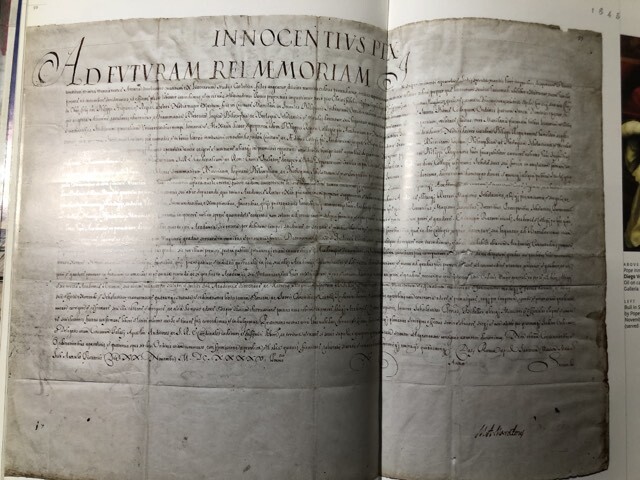
On November 20, 1645, Pope Innocent X issued the historic bull "In Supremi Militantis Ecclesiae," officially elevating the Colegio de Santo Tomas to the status of a University and placing it under papal authority. The University remained under the guidance, rule, and administration of the Order of Preachers, also known as the Dominicans, with the Order’s Master General serving as the University’s Grand Chancellor. The bull by Innocent X is considered UST’s “Magna Carta.”
9. Cardinal Zeferino González’s book (1864) that helped revive the teachings of St. Thomas Aquinas worldwide
The Spanish Dominican friar Zeferino González came to the Philippines when he was just 18 years old; he acquired all of his academic degrees in UST and in 1864, the UST Press published his Estudios Sobre de Filosofia de Santo Tomas, the book that helped launch the Neo-Thomism movement worldwide. Going back to Europe in 1867, he became adviser to Leo XIII, who made him cardinal-primate of Spain and who issued apparently on his advice the historic encyclical “Aeterni Patris” in 1879, which called for a revival of the teachings of St. Thomas Aquinas to help Catholics engage in a dialogue with secular modernity while following Church doctrines and tradition.
10. Fray Casto de Elera’s monumental catalogue of Philippine fauna (1895, 1896)
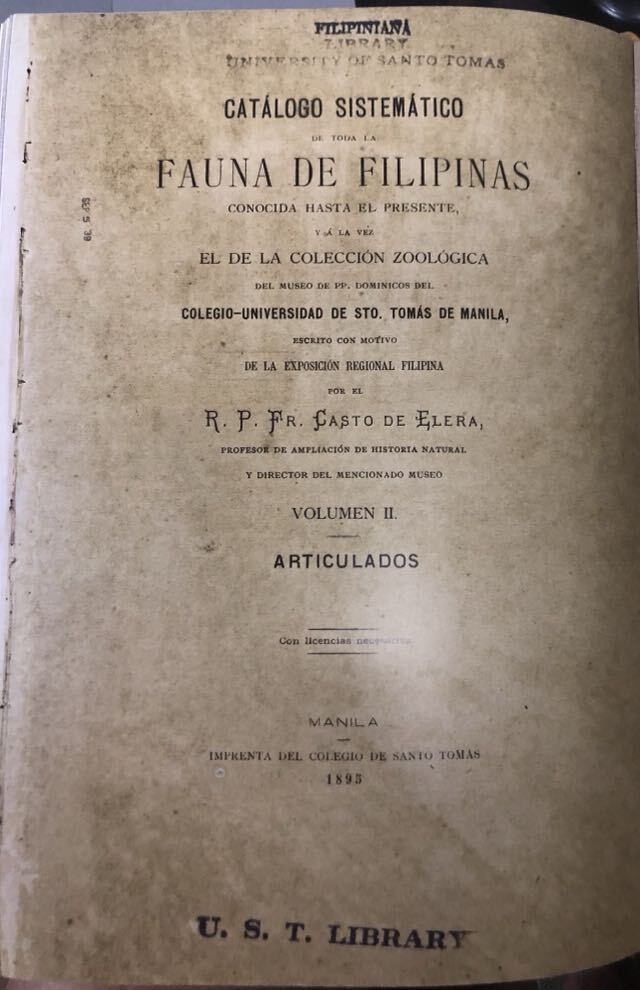
Accused of obscurantism and superstition by Masons, liberals and ultranationalists, UST, however, keeps the oldest and a most extensive natural-history collection in the country, which is documented in the massive three-volume work of the Dominican zoologist Fray De Elera, Catalogo Sistematico de Toda la Fauna de Filipinas.
Published in 1895 and 1896 by the UST Press, the first volume covers vertebrates, the second articulates, and the last mollusks. Elera extensively researched various sources including friar-chronicles, missionary reports, soldiers' accounts, and foreign travelers' writings. In the prologue, he expresses his enthusiasm for the Philippines' biodiversity and his desire to introduce it to the world.
Although De Elera had intended to include illustrations in a subsequent project, it never materialized. Nevertheless, his catalogue remains a crucial reference for biologists and naturalists studying Philippine fauna, praised by Retana as "a monumental work representing the life of a man."
11. School records of Rizal, Father Burgos, and other founders of the Philippine nation

Perhaps the most interesting section in the UST Archives is the “Becerros” (broadly speaking “student records”), because it contains the “Libros de diligencias de grados y de matriculas” – or academic grades – of Jose Rizal, Apolinario Mabini, Marcelo H. del Pilar, Emilio Jacinto, and the other founders of the Philippine nation, nearly all of whom matriculated in the Pontifical University.
It is often alleged that Rizal got low grades in UST when compared to those he got from Ateneo de Municipal because he was an indio and discriminated against by the Dominicans. But a cursory review of his records in UST should show that he got high grades and he was a good student, above average, though not excellent; and none of his classmates were excellent either. His UST grades show that Rizal was not as gifted in Medicine as he was in Letters and the Arts.
In the wake of the hit historical movie Gomburza, UST Archives director Fr. Gaspar Sigaya, OP showed SPOT.ph the academic grades of Fr. Jose Burgos, whose record of having attained eight degrees, including his doctorate, from the Pontifical University remains unparalleled to this day.
12. Oldest Spanish-Chinese dictionary in the world (early 1600’s)
The world's oldest and largest Spanish-Chinese dictionary was only recently discovered by Spanish and Taiwanese scholars at the UST Archives. Dating back nearly 400 years, the Diccionario Hispano Sinicum offers translations not only between Spanish and Mandarin but also includes Hokkien equivalents. This discovery is significant as Hokkien is spoken in Taiwan and Fujian province, the ancestral home of many overseas Chinese in the Philippines and much of Southeast Asia.
Compiled by Spanish Dominican missionaries in Manila during the early 1600s, the Diccionario predates the Kangxi Dictionary by at least 70 years. It is believed to have connections to the Spanish occupation of Taiwan between 1626 and 1642.
The dictionary contains entries that reflect historical contexts, such as references to Formosa (modern-day Taiwan) and indications of the existence of the Ming dynasty during its compilation. Impressively, it comprises over 1,100 pages and 27,000 vocabulary entries, including terms in Spanish, Chinese characters, Mandarin, Hokkien, and even Tagalog.
The Taiwanese government has published a facsimile edition in several volumes of the Diccionario.
Overall, the discovery sheds light on the rich linguistic and cultural exchanges in the early history of the Philippines.
Also read: 10 Libraries in Metro Manila That Are Open to The Public