

The UP Chapel is 69: Here's The Miracle That Built It
There was a threat of a storm but a bunch of praying students saved the day.
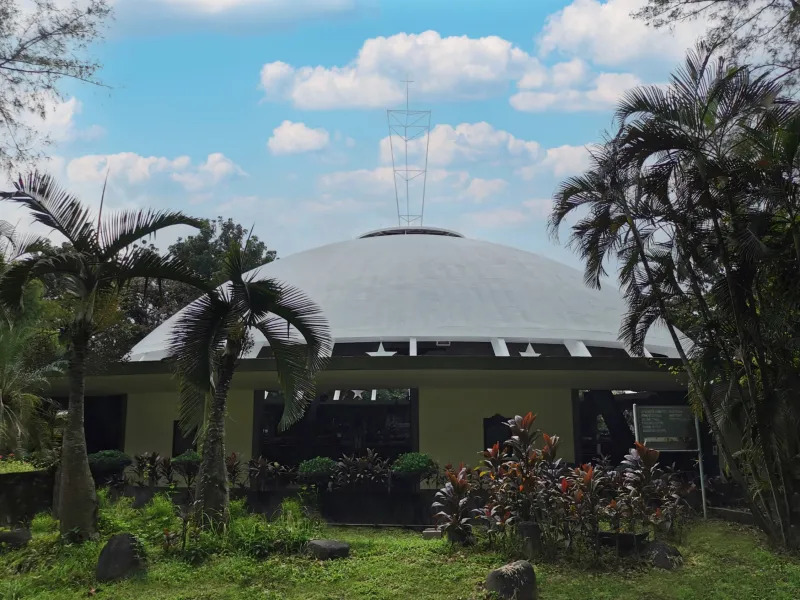
(SPOT.ph) If you’ve ever strolled along Apacible Street inside the University of the Philippines Diliman campus, you’ve likely noticed a distinct flying saucer-shaped structure. A university icon as well as an architectural landmark, it is the Parish of the Holy Sacrifice, or more fondly known as the UP Chapel, and it marked its 69th year recently (August 25, to be exact).
In 2020, foremost property developer DMCI Homes undertook the challenge of handling the repairs of this historical landmark, with the aim of bringing new life into the timeworn structure. The aging and weathered components were fixed while its interior and exterior were granted a fresh coat of paint. The year 2020 may not have been the most ideal time but it sure produced something good: by the end of that first pandemic year, the restoration of the UP Chapel was complete.

Also read: The Brutalist Architectural Gems to Check Out in Metro Manila
Story Behind the UP Chapel’s Creation, as Recounted by Engineer Consunji
In honor of the chapel’s anniversary, property developer DMCI Homes posted an excerpt from David M. Consunji's memoir, A Passion To Build, in which the engineer and DMCI Holdings Inc. founder looks back on the events that led to the making of this religious edifice.
In the post, Consunji recounts the challenges and divine intervention that figured in the construction of the UP Chapel's dome in August 1955. There was the looming threat of a storm but the concrete needed to be poured continuously to complete the shape of the dome, a task that required at least 18 hours. "I clearly remember that day, the 25th of August, 1955," writes Consunji. "I woke up at 4 o’clock in the morning. It had started to rain and I could see the beginning of a storm. When I arrived in UP, the rain and the wind had started to come in as well...I went straight to the chapel. Fr. Delaney was preparing for the 5 a.m. mass. I asked him if we should proceed in spite of the weather. He said, 'Yes, go ahead. You do the pouring. I will do the praying.'"
Work began in May that year but construction of the dome started in July. "We made the form, laid the steel bars, and built the scaffolding and the runway. Then we had a dry run of the pouring system until we were confident we could do it perfectly," recalls Consunji in the memoir. "The crucial part about this was that the concrete on the dome had to be poured continuously: that was non-negotiable. I estimated the job would take not less than 18 hours. So the weather had better cooperate with us."

Just before the big day, Consunji had expressed his concerns to Fr. Delaney: the water would ruin the concrete. But all the priest told him was: “Just come here early in the morning and we'll see what the weather will be like.”
When the 25th of August arrived, it did feel like a storm was going to make good on its promise. Told to just go on ahead and build, Consunji said he could do nothing but obey. "With a heavy heart. I went to see my workers, who were all ready to go home. To their surprise, I said: 'We will do the pouring today, so let's start."
Consunji writes in his book: "At 5 o’clock, everything was set. The concrete mixers were humming and the workers were ready to pour concrete around the base of the roof. I looked up once more and saw the dark skies. There were rain showers all around the UP campus-but not on the site itself. It didn't look good to me, but I gave the go-ahead just the same.
"We started pouring. After an hour, the weather turned for the worse. The entire morning, we saw UP students running from building to building drenched, their umbrellas blown all over by the strong wind. It seemed to us that the entire campus was experiencing a storm. But, miracle of miracles, not a single drop of rain fell on the spot where we were working! The entire jobsite was dry."
Consunji went to the old chapel and finally saw the reason behind the miracle he had just witnessed: student members of the UP Student Catholic Action were "storming the heavens with prayers!"
"Three hours into the work, the entire periphery of the dome, about a meter high, was concreted. It was going to be a lot easier from then on. My workers stopped worrying about the rain and just kept working on and on, moving the buggies around on the runway, loading, pouring until at last, the entire dome was covered.
"It was already 11 o’clock in the evening when the last buggy of concrete was emptied, 18 hours since we started. In the next hour, we did the finishing touches — smoothening out the rough edges, making sure the contour of the dome was perfect. At 12 midnight, a rain shower began to fall on the dome, as if on cue, curing the concrete in the process. By then, all our anxieties had vanished. The dome had been built.”
History of the UP Chapel
The UP chapel actually traces its roots back to 1954 when Fr. Delaney, S.J. envisioned an enduring sanctuary to replace the sawali-bamboo structure that had served as the community’s place of worship since the university moved from Manila to Diliman in 1949.
With a vision of creating a church that embodied the spirit of the Holy Sacrifice of the Mass—where the priest and parishioners shared a profound sense of unity—Fr. Delaney enlisted the talents of a group of young UP artists, engineers, and one architect, Leandro Locsin, future National Artist. Locsin was inspired by Delaney’s vision and designed a church that "would always have its doors open to anyone seeking communion with God," making it a timeless symbol of faith and inclusivity.
Meanwhile, engineers Alfredo Juinio, who served as the structural engineer for the project, and Consunji crafted what would be the nation’s first circular chapel with the altar at its center. The structure was the first in the country to feature a thin-shell concrete dome, ingeniously supported by pillars along the church’s periphery, ensuring an open, unobstructed space within. It was made possible by Engr. Consunji’s pioneering advancements in concrete technology.
In the chapel, there is a floor mural designed by the artist Arturo Luz called the "River of Life," which seems to "flow" through the terrazzo pathways, extending toward the altar. Napoleon Abueva sculpted the monumental double-sided wooden crucifix and crafted the altar base with his signature artistry. Meanwhile, Vicente Manansala and Ang Kiukok brought the 15 Stations of the Cross to life with their evocative murals.
As time passed, these five extraordinary talents—Locsin, Luz, Abueva, Manansala, and Kiukok—would each be honored as National Artists of the Philippines, making the UP Chapel a singular achievement: the only structure in the country adorned with the works of five National Artists.
With its distinctive and enduring architectural design, the UP Chapel has earned the prestigious titles of National Historical Landmark from the National Historical Commission of the Philippines and Cultural Treasure from the National Museum of the Philippines.
Also read: The Iconic San Miguel Corp HQ Is 40—Here's How It Was Made