

Panag-Apoy: The Grand Bonfire That Draws Crowds to Sagada
The unique ritual has drawn crowds to the local gravesites.

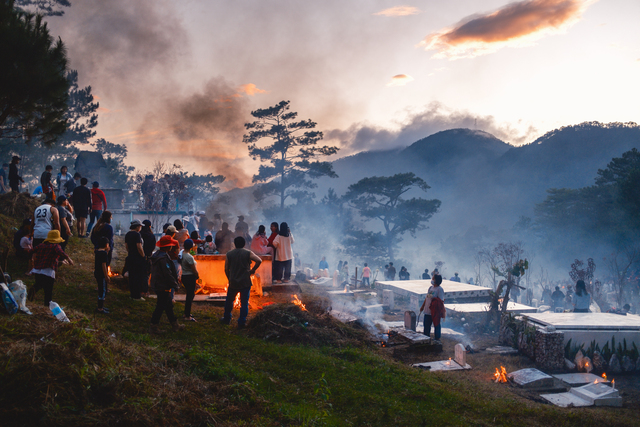
(SPOT.ph) At twilight, on the first of November, Sagada folk converge at the Saint Mary the Virgin Cemetery and illuminate catacombs with sanctified pinewood shards, creating a pool of flares, warming the crowd gathered to commemorate their departed.
Locally called the “panag apoy,” the annual ritual marries Christianity with highland culture and is meant to remember those who passed and reunite family members against a backdrop of Sagada’s mountains and Amihan chill.
What is panag-apoy?

The panag -apoy [Kankanaey for "to light a fire"] begins before dusk, at the St. Mary's Episcopal Church with a mass, ending with the blessing of the saleng (pinewood) held by the locals to offer to nearby gravesites.
As the sun sets, families of the dead take the short walk to the wooded cemetery, some carrying picnic food but most clutching only the saleng to be lit amidst silent prayers and the customary tête-à-tête between the living and the dead. As the saleng bonfires are consumed, the scent of pine mixes with the soft and musty smell of the saleng.
Also read: 10 Best Places to Stay in Sagada


The panag apoy is a short and sweet affair. Soon, the hoard who sojourned to the sepulchers make their way back as the bonfires weaken, lighting their path. Families prepare simple dinner fare to be shared at home, capping the ritual of remembrance.


The lighting of the saleng instead of candles is thought to be born more out of necessity rather than aesthetics (it’s a beautiful, cinematic ritual as Jilson Tiu’s pictures prove here). Sagada elders did not have access to wax candles then to illuminate the tombs so they used what was widely available: pinewood scraps.
The mini bonfires proved to be practical and a more logical choice even when candles became widely available, because a saleng blaze can withstand the Sagada breeze as opposed to the flimsy, flickering light from a frail candle.


Tourist attraction
Over the years, the spectacle of the panag -apoy has drawn curious tourists to the quiet town, with tour agencies including the ultra-local tradition in their packages. This year’s commemoration alone, there were at least eight vans of tourists who flocked to witness the grand bonfire.


Tourists are welcome but are cautioned to observe the solemnity of the saleng lighting. There are, however, always those who forget they are in hallowed ground and make noise or take selfies with the graves. Thank heavens for tour operators who know well enough the sensitivities of the tradition they whisk the offending parties away from the tombs.
Sagada has always piqued the curiosity of a multitude seeking to partake of its culture. But photographer Jilson Tiu braved the threat of a storm recently to take part in it for a different reason. He needed closure from witnessing the rescue of a two-year-old girl from a landslide that took place in Talisay, Batangas during Tropical Storm Trami. Her entire family of four perished in the mishap, leaving the child an orphan. “Ang suwerte ng mga yumaong mga tao na may mga bumibisita pa sa kanila,” he says, likely still thinking of that little girl in Talisay.

All photographs by Jilson Tiu