

Hive Modular Is Changing the Way We Build Luxe Homes in the PH
It will only take three to six months to build a house from scratch.

(SPOT.ph) Owning a home is a dream for many Filipinos, but building one from the ground up? That’s a whole other story.
Between the skyrocketing cost of materials, unreliable contractors, and the never-ending wait for permits, the lengthy process can drain the time, energy, and pocket of even the most patient future homeowner.
This is where Hive Modular comes in. Instead of following the same slow, inefficient process, they are offering a way to skip the stress and move into a home—a high-end one— in a fraction of the time. They’re certainly not the first to introduce modular homes to the Philippine market, but they just might be the most ambitious.
What is Hive Modular?
Founded in 2023, Hive Modular specializes in luxury modular homes for those who want a faster, more efficient way to build. Unlike traditional houses that take months—or even years—to complete, Hive Modular’s homes are built in a controlled factory setting before being transported and assembled on location.

Case in point: its recent pop-up installation at One Bonifacio High Street in Taguig was assembled and installed in just one week. In the real world, it would typically take three to six months for Hive Modular to complete a house, wherever the location.
“We set out with a really ambitious mission, which was to revolutionize the way we build in the Philippines,” Hive Modular CEO John Avrett told SPOT.ph. “The goal is to make the process of building a house much more precise, efficient, and sustainable.”
At present, Hive Modular offers three models to choose from. There’s Casita One45, a 45-square-meter unit featuring one bedroom, one bathroom, a kitchen, and a deck, starting at P7.5 million. A slightly larger version of that, Casita One60, is a 60-square-meter unit with similar amenities, which is priced at P10 million.
Hive Modular’s biggest offering is Casita Two75, a 75-square-meter unit offering two bedrooms and two bathrooms for P13 million.
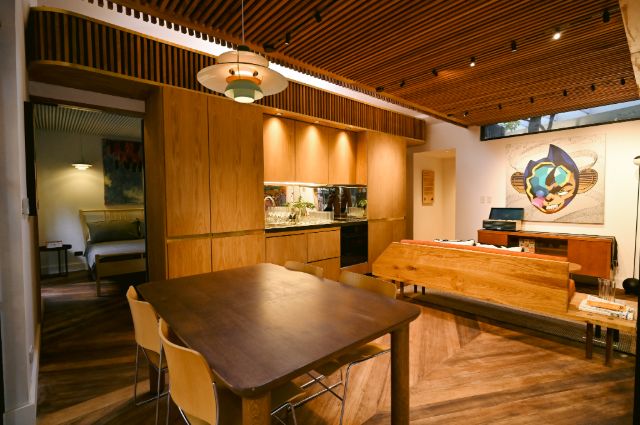
No matter the Casita model, certain features remain consistent across all offerings. Expansive floor-to-ceiling windows wrap around the home, flooding the space with natural light while enhancing airflow for better ventilation. The kitchen features sleek countertops, built-in appliances, and generous storage to keep everything within reach.
For those who love the outdoors, spacious rooftop decks offer the perfect spot to unwind, entertain, or simply take in the view.
“We set out to build a house that was so beautiful, well-crafted, functional that you wouldn’t even know it was modular,” Arvett said. “I mean, building a house in half the time? That’s a game-changer. For many of these developers, time is money, so we’re offering them a solution that saves them money.”

Whether it’s a coastal retreat, a mountain hideaway, or a city home, Hive Modular homes can be customized to fit various landscapes—something that feels long overdue in a country as geographically diverse as the Philippines. The company isn’t stopping there either. As early as now, Hive Modular is already planning an expansion to increase production and even explore exporting to the U.S.
Also read: These Services Can Make Your Tiny-House Dreams Come True in a Matter of Days
The building of Hive Modular
Avrett, who we meet at the Hive Modular launch in BGC, was no architect or businessman when he started venturing into real estate—he was a U.S. Air Force officer who grew up in a family of builders. Being surrounded by high-tech machinery, he couldn’t help but wonder: Why is building a home so much more complicated than building automobiles, airplanes, and satellites? Armed with his military background, he took on the task of figuring out how to change the game.
“Seeing the challenges of traditional construction firsthand, I knew that someday I would set out what I learned as an aerospace engineer to the process of home-building,” Avrett said, pointing to the Casita One45 behind him. “To build so fast and efficiently, we used industrialized techniques that are common in the automotive and aerospace industries. Every piece of this house was designed with the idea of modularity.”

Squeezing in all the modern amenities a small family would need in a 45-square-foot home is no easy feat. When asked how they balanced the need for sleek, modern designs with the expected practicality and functionality of a house, Jeremy Hughes, Director of Product Development at Hive Modular, answered with such ease like it was the most obvious thing in the world.
“The two don’t need to be diametrically opposed. Good design can be both,” Hughes said. “This is a perfect example for that. It’s very economical in its plan as there’s not a lot of wasted space.”

Almost all of the materials for the modular homes are sourced locally, including wood, timber, and bamboo which are used in the ceilings and floorboards. But just how customizable is a Hive Modular home? Not much, as it turns out—but there’s a certain beauty in that, too.
“We are trying to change the paradigm of construction. We have certain products, certain models. The customization will be on minor aesthetics, bells and whistles, but the essential template is the same,” Anton Herbosa, Sales Manager at Hive Modular, told SPOT.ph.
Hive Modular homes aren’t just designed to look good—they’re built with longevity in mind. Hughes said the steel they use offers thermal resistance, fire protection, and soundproofing—all in one. Plus, since every component is built in a factory-controlled environment, there’s less room for structural weaknesses caused by human error or environmental factors.

“Because the materials have to be transported, the structure [must be designed to withstand being] picked up, moved, manipulated. That makes it stronger than the construction [of a] regular house. The structural steel in this is incredibly thick, incredibly rigid,” Hughes said, adding that it is already used all across the world. “It would perform much better in an earthquake than concrete.”
And when Hive Modular says eco-friendly, they’re not just talking about slapping on energy-efficient lighting or throwing in some wooden accents. Sustainability is embedded in the entire construction process. Concrete-based construction is one of the world’s biggest contributors to carbon emissions, which is why Hive Modular chose to use structural steels that can be disassembled, recycled, or repurposed at the end of its lifespan.
How to order at Hive Modular
Herbosa walked us through what it takes to build a home with Hive Modular.

You start with a P25,000 reservation fee, which secures a site visit from the team, no matter how remote the location. Is the plot large enough? What is the layout of the land? Does the topography provide stable foundation? How accessible are essential utilities like water and electricity? Once everything checks out, a 40% downpayment is required to kick off the production.
You’re not just paying for speed but also convenience. Herbosa said the Hive Modular team takes care of all the legwork, coordinating with contractors, local government units, and third-party providers to secure the necessary permits, so you don’t have to.
“While we don’t currently offer these services, we’ll connect you with a trusted provider who can. We’ll also coordinate their work alongside our installation of your Casita,” it said on Hive Modular’s website. These include landscaping, outdoor kitchen, off-grid solar, well digging, and pools, to name a few.
Hive Modular has established a factory in Silang, Cavite, with a capacity to produce 50 modular houses annually. For now, though, Herbosa said the team can only assemble and install one home at a time.
“The house is meant to last for over 100 years,” Herbosa said. We had to ask—is that a guarantee? He smiled, “Yup.”
Also read: Weekend Spot: This Modular-Style Airbnb Near Tagaytay Is Great for Big Groups