
Why Alex Eala's Defeat Still Felt Like a Win for the Philippines
For a few hours, the fissures of politics, region, and religion were invisible,

(SPOT.ph) If one pays attention to the news at all, it must have seemed that all hope in the Philippines rested on the shoulders of a 19-year-old girl.
Today, the fissures of politics, region, religion—and the opportunist algorithms of social media—were invisible, at least for those watching the Miami Open Semifinals. On one side, the No. 4 in the world in Women’s Tennis, Jessica Pegula, and on the other, the Philippines’ first tennis player in the top 100—Alex Eala. Yes, it all felt strangely Pacquiao-ish—how the country paused for a bit and paid attention. But it is also its own story— brand new and hopeful, because when Pacquiao vs. Morales was happening in 2005, our new tennis star wasn’t even born yet.
Eala lost the first set, clawed back the second, but eventually fell short in the third, finally losing 6-7, 7-5, 3-6. But for her long-time followers—and all the Filipinos who turned their eyes towards this 5’9 teenager during her Miami Open run—a borrowed line from the poet Jack Gilbert might ring truer: She was not failing as she fell, but just coming to the end of her triumph.
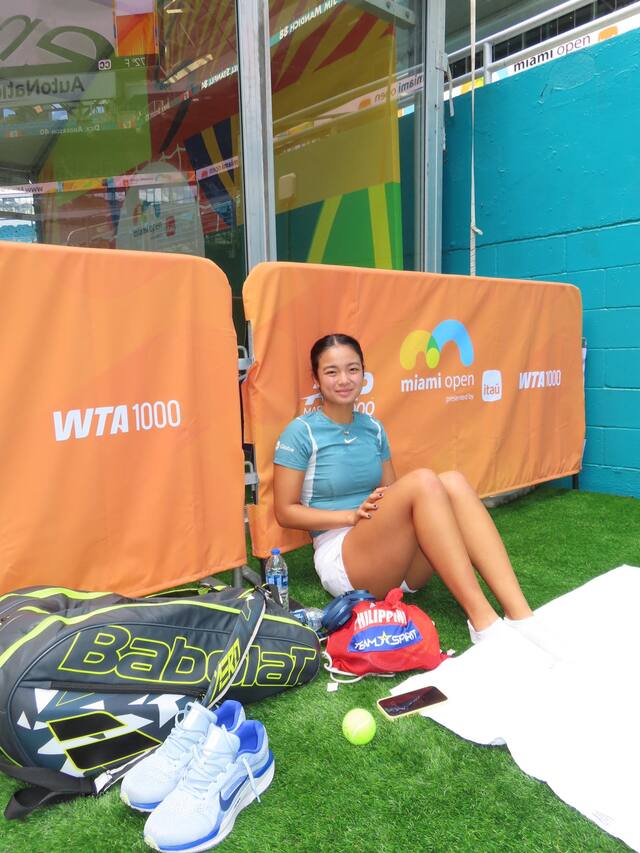
Also read: Who is Alex Eala, the Filipina Tennis Star Making Headlines Now?
"Kaya niya kaya si Iga?"
In the days leading up to Alex Eala’s Miami showdown with Iga Swiatek, the tennis courts were buzzing. Next to “fault,” “out,” and “deuce,” it felt like the most commonly uttered words there were: “Kaya niya kaya si Iga?” And surely, in the coming days, when the titos stroll into the courts with their racquet bags, they will look at each other and say: “Sayang no? Muntik na.” In the Philippines’ relatively small tennis communities, no one needs to clarify who they’re talking about—because everyone was watching Alex.
I have a confession to make: Before this week, I already loved Alex Eala—but I wasn’t always a believer. People questioned her footspeed, her second serve, or her experience. These observations were offered with caution, of course (perhaps because most of us in the tennis courts would nonetheless get aced by Eala’s “questionable” second serve).
Nevertheless, being an Eala fan last year was a practice in heartbreak. There were many almosts. Last April, as a wildcard in the Madrid Open, Alex defeated no. 41 Lesia Tsurenko, which put her a win away from a showdown with then-No. 1 (and eventual champion) Iga Swiatek. But that dream match-up vanished after her three-set loss to No. 30 Sorana Cirstea. She was also one win away from making the main draw in each of Roland Garros, Wimbledon, and the US Open, but lost in the last qualifying match (lower ranked players have to win three qualifying matches to make it to the main tournament).
It was hard to be too bleak about it—because 19 is so young—but onlookers like myself felt an undercurrent of doubt about her potential. It was tempting to think: Is this it? Is this her ceiling as a player? And perhaps that is the most consequential result of this week’s events: witnessing that ceiling being completely and utterly shattered.
In women’s tennis, there is perhaps no better proof of having made it than defeating Iga Swiatek—introduced to new fans as the World No. 2. But let’s not forget that Iga was the World No. 1 for the most part of the last three years. She has won the French Open four times, and the US Open once. She has won 22 titles in five years and even beat Jessica Pegula 6-1 6-0 in the 2023 WTA Finals. And she had not lost to a player outside the top 100 in the past four years. Some tennis fans might argue that Iga is inconsistent—but she never loses to players of a significantly lower quality.
So, when No. 140 Alex Eala beat her, convincingly—that does not mean Swiatek slipped up. It just means Eala is just that good. She stepped into Iga’s second serve, the average speed of which is around 150 km/h, and sent them flying back—forcing the Polish No. 1 into error. During their back-and-forth rallies, Eala routinely went for broke, placing her balls in the edges of the court with blistering pace. “She went all in… She was pretty loosened up and just went for it,” Swiatek later said.
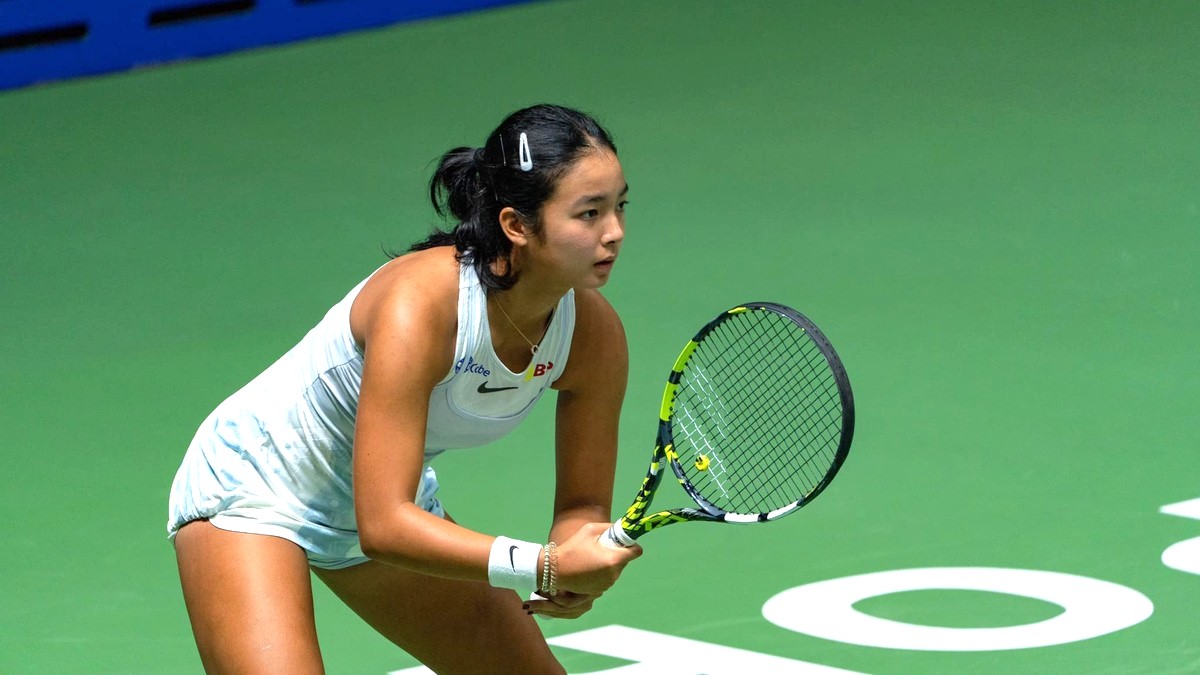
Also read: Alex Eala Wins in Red Nike Tennis Outfit at Miami Open
A remarkable story
As sports fans, we are predisposed towards deconstructing Alex’s game—maybe the same way we would comment on Shaq’s free throw shooting. And perhaps that is the fun of sports. At 19, it is likely that Alex’s serve will improve—if not in pace, then in variance and placement. Her movement has visibly gotten better by leaps and bounds—and her ground strokes are clearly world class already.
But tennis is about the mind, too. In fact, tennis legend Jimmy Connors once said it is 90% mental. And during her games, Alex displayed the mentality of a shaolin monk. Her mental game, in a word, is elite, even among the world’s best. In her match with Swiatek, she was locked on until the end—and even after winning. When she was trailing Jessica Pegula earlier, she displayed the same stoic intensity, while letting in some joyfulness—telling the physio “I feel like a mummy” as her foot was being taped up during a medical timeout. A reminder that she is both Filipino and 19.
The same way that temperament can be the downfall of a tennis player (see: Nick Kyrgios), it can make a career. And while people might debate about Alex’s serve, footspeed, forehand, backhand, volleys, and drop shots—what assures us of her eventual success is her astounding aggression, anticipation, bravery, composure, concentration, decision-making, and all the other intangibles. She is calm under pressure. She gets the job done.
It’s hard to teach this kind of mentality. Maybe it is good parenting—evident in her father Michael Eala’s past statement: “We believe being there for the wins is good, but being there for the losses is much more important.” Maybe it is environment—that we see in Alex Eala what we see in the very best among us Filipinos—the ability to keep going even when it’s hard; and the idea that you are representing your country wherever you go, so act with dignity. And of course, maybe part of the maturity is completely hers—developed during her years training in Mallorca.
Regardless, it is a remarkable story: Before Alex Eala joined as a wildcard in the Miami Open, she was in Slovakia, losing to the World No. 266 in a lower-level (ITF) tournament. Now, she lost in the semifinal of a WTA 1000—a tournament with prestige, points, and prize money second only to Grand Slams. She is set to earn $332,160. As she parroted in a meme, indeed: Bigla kang sumakses, e.
I look back on how I once doubted Alex—and now I wonder if the doubt was ever about her in the first place. Maybe it was a doubt that creeps into every Filipino’s mind—the resignation that these stories of promise or potential are hardly ever fulfilled. And yes, maybe that is the triumph of Alex’s performance this week—how everyone doubted her against every new opponent—because how dare we think we can beat the best in the world; because good news feels so foreign to Filipinos. And by winning those matches, she didn’t just advance, she pulled us out of that bleak and hopeless thinking.
“To have a week like this,” Alex said “The stars need to align.”
The stars did align, Alex—and you beat them all. Three grand-slam champions in a row in straight sets. It was something none of us had ever seen before—not just your transcendental performance, but your poise, your grit, and even your accent—a reminder that you took a piece of us with you. It shouldn’t fall on the shoulders of a 19-year-old to unite a broken country, but it did—and for those few hours on the court, you brought us together. And sure, someone else might win Miami. That’s how sports works. But for one week, this teenager didn’t just make us believe in her—she made us believe in ourselves. And it feels as if she made every historian in the Philippines open their books, reach for their pens, and write.