

Why the MRT-3 Can't Operate 24/7
"She took the midnight train going anywhere" isn't happening here.

(SPOT.ph) Ever wondered why Manila trains don't operate beyond 11 p.m.? After train operating hours, commuters traversing EDSA have limited choices: take the EDSA Carousel buses or hail a cab or Grab, a more expensive route compared to a maximum P28 you'll pay for an MRT train ride from North Avenue in Quezon City to Taft Avenue in Pasay.
The matter of limited train operating hours at night in a city is what a commuter raised on X (formerly Twitter), asking why, in a region where there are so many call centers and night shift jobs, the latest train leaves "way too early."
“You know what really doesn’t make sense here in Metro Manila? How the last rides of trains are between 8:30 to 10:30 PM,” Sison said.
The Department of Transportation's short answer to SPOT.ph? Trains need the off-hours for maintenance. To explain it further, the MRT-3 management took the media to an overnight tour of its depot to see what happens at night once it stops its operations.
"Ine-ensure natin from the tracks to the signalling and the power na lahat po 'yan chini-check natin para reliable ang ating train operations at 'yung safety, nae-ensure natin na wala tayo aberya," said Oscar Bongon, MRT-3's OIC Director for Operations.
"Number 1 po ang safety siyempre dapat komportable, reliable para walang aberya 'yung biyahe ng mga mananakay natin."
Also read: LOOK: What Happens Inside MRT-3's Underground Maintenance Operations
What happens during MRT-3 maintenance
Once the last passenger train departs from the stations, it goes straight to its depot just underneath Trinoma and Vertis North in North Avenue, Quezon City. There, trains undergo inspection before it's ready for a whole day of operations.
In charge of maintaining and rehabilitating the MRT-3 is Sumitomo Corporation, Mitsubishi Heavy Industries, and its group company TES Philippines which in June 2023 signed to extend its contract with the Department of Transportation until July 2025.
Maintenance happens daily, weekly, bi-annually, and even every eight years, depending on the requirements. For the overnight check-up and works, this includes the light maintenance where train cars are inspected for minor repairs, aircon maintenance to ensure the AC unit in every train works, train cleaning where it goes through an automated car wash machine for its exteriors and staff cleaning the seats and handrails for the interiors.
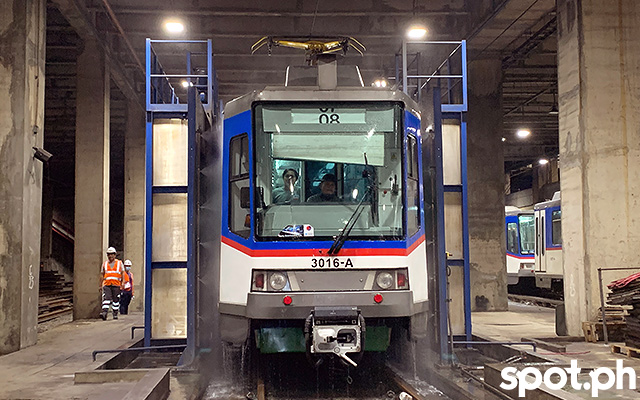
Trains are also scrutinized and troubleshot by engineers at the technical research section where they check if the lighting is fine, the doors open and close without issues, and the public address (PA) system works so the train drivers can manually announce the next stop plus other reminders, said Jun Quinton Jr. , general manager of Safety, Quality, and Planning of TES Philippines.
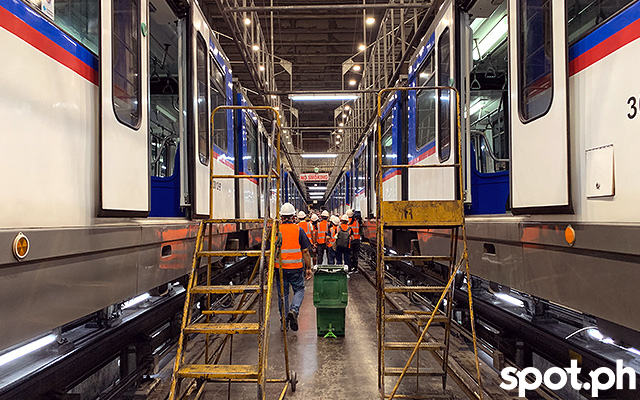
These are just some of the activities that cannot be delayed as one issue could derail a train car's scheduled operation, said Quinton and Bongon.
"Meron po 'yang mga interfacing sa maintenance activities. 'Pag ma-delay nang konti 'yung isa, apektado po ang iba. Kaya kailangan po natin na as per time scheduled, masunod natin," said Bongon.
"When it comes to other countries, depende sa structure kasi sa kanila maraming linya e, pupuwedeng 'yung isang linya papatayin mo muna for maintenance at dadaan siya sa kabila e tayo iisa lang po ang linya natin so we really have to maintain it."
Why not do it during daytime? Maintenance works continue throughout the day inside the depot, but the rails need to be inspected when there are no trains in operation because power has to be turned off, said Bongon.
Also read:
It's High Time Our Train Stations Get Safety Barriers
Be Mindful of Your Laptop, Says Student After Gadget Got Damaged in an MRT-3 Scanner
MRT-3 on passenger capacity: 'Kayang-kaya'
Unused Dalian trains were parked and gathering dust inside the depot. It can be recalled that these trains were procured during the Aquino administration and delivered from China in 2016 in its aim to increase the MRT-3's capacity to 800,000 passengers daily from 500,000, but it remained largely unused due to incompatibility with the rail system.
The non-operation of the Dalian trains is "depriving the riding public of the benefits of a more comfortable transportation system,'' the Commission on Audit (COA) said in its 2022 audit report of the DOTr. State auditors recommended that the DOTr follow-up with Chinese firm CRRC Dalian to fasttrack the changes needed to deploy these trains.
Bongon said the current CKD trains in operation can still handle the passenger requirements, which is currently at 80% of the MRT's daily capacity.
"Sa pangangailangan naman ng ating mga pasahero, natutugunan naman natin po 'yan kasi meron tayong mga datos, nae-estimate natin 'yan... 'Yung load factor na 'to, kayang-kaya naman ma-load ang ating mga mananakay."
How about the four-car trains that Transportation Secretary Jaime Bautista mentioned would be in deployment soon? While there's still no need for it according to Bongon, Sumitomo is working to expand the MRT-3's signaling system to cover four-car trains and may be deployed before 2025 ends, he said.
Also read: MRT's Four-Car Trains Are Coming Soon to Accommodate More Passengers