

PSA: You Might See Higher Fees on Your Card for Netflix, Spotify, and More
All thanks to a 1% assessment fee from Visa and Mastercard.

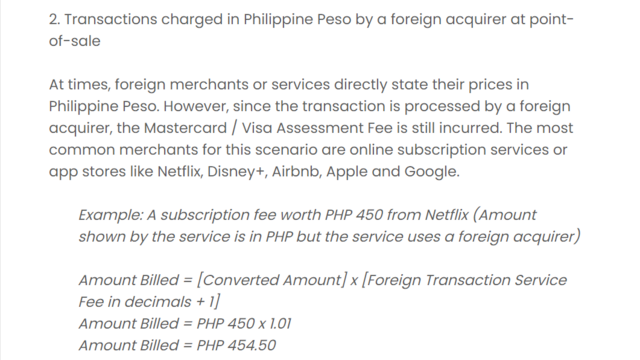
(SPOT.ph) Credit card payments are ideal for paid subscription services—it streamlines the process without interruption and eliminates the need for manual payments each billing cycle. However, Mastercard and Visa are now charging an additional 1% assessment fee on transactions processed by a foreign acquirer for that convenience.
This move is currently being rolled out by local banks. Based on BPI’s latest advisory, a “Mastercard/Visa assessment fee of 1% shall apply to the converted amount of foreign-denominated transactions, using the foreign exchange rate of Mastercard.” This applies to all foreign-processed transactions like Netflix, Spotify, Prime, Apple, and Google, to name a few.
That 1% assessment fee translates to an additional P3.99 for Netflix standard (P399) subscribers, P1.49 for Spotify Premium individual (P149) subscribers, and P10.46 for Adobe Photoshop (P1,046) subscribers every month.
It turns out other major banks like BDO, Metrobank, Security Bank have been charging this fee since last year as other users have pointed out on X (formerly Twitter). Based on the tweets, foreign transactions under P1,000 in Citibank and GoTyme are supposedly not implementing this charge as of writing.
Some users are also circumventing this additional fee by switching to GCash as their new payment method for these subscriptions, so that’s always an option.
Also read: Spotify Is About to Get More Expensive for Premium Users in the Philippines
Not just credit cards: Digital services could be taxed by the government soon
On that note, the Philippines is also on the verge of implementing a 12% VAT on digital services by non-resident providers and platforms, with Senate Bill No. 2528 gaining approval on February 6. Under the measure, a non-resident digital service is defined as not having a “physical presence” in the Philippines.
Senator Sherwin Gatchalian clarified that the government is not introducing a new tax but rather enforcing the collection of existing taxes from foreign digital service providers who have not been paying taxes in the local jurisdiction.
“This is not a new tax imposition. We are just collecting the tax that we ought to be collecting from non-resident digital service providers,” Gatchalian was quoted as saying in the Senate plenary session.
However, doing so could also mean subscribers will indirectly bear the cost. The tax applied to digital services by non-resident companies may lead to increased prices for subscribers, as these companies might pass on the tax burden to consumers in the form of higher fees for online services. We’ll have to wait and see what happens then.
Also read: Heads Up: Netflix Is Coming After Sharing of Passwords
this strange new world.